Have you ever had someone say something obnoxious to you and you, instead of coming back with a clever riposte, just sit there like a turnip? Then, later, all the smart remarks you could have made come to you but it’s too late. The person has moved on with their life and probably doesn’t even remember their comment. You, on the other hand, stew about the exchange months or even years later.
This is me after an EDS Echo training course. I genuinely appreciate EDS Echo (this is a branch of the EDS Society that offers courses for healthcare providers). They are wonderful and the work they do to educate is truly laudable. But I will never forget when the lead instructor, a noted MD, realized that I am a practitioner of Chinese medicine and said to me, “Does acupuncture work? I’ve thought about this and wondered.” At the time, I was really struggling with MCAS and not my usual self, so I mumbled a bland reply and faded back into the woodwork of the Zoom meeting.
Sometimes, I think about sending this doctor a copy of my book, Chinese Medicine and the Management of Hypermobile Ehlers-Danlos Syndrome, but honestly? I don’t think this person would care. I think that this MD is pretty typical as far as EDS Society thinking goes. In sum: based on my experiences with them thus far, I have been left with the sense that the EDS Society is fine with dry needling by physical therapists but not necessarily welcoming of actual practitioners of Chinese medicine. Well. If the acupuncturist were someone who privileged biomedicine above all other and was humble and grateful to be included, maybe they’d let that practitioner have a crumb or two, but that’s not me. I don’t need their crumbs and neither does Chinese medicine.
I still need to reply to the question, though. But first, some framework.
Great expectations are not just for novels
I’ve written this elsewhere and I’ll write here again: remember that you don’t go to your PCP and expect them to be expert in everything. You can’t ask them to do the job of a rheumatologist and a gastroenterologist and psychologist and a pain management specialist and an immunologist and and and… Nope. You get basic general medicine, ideally without a hefty side of gaslighting (if you’re lucky), and a referral.
With acupuncture, people really do expect a full range of medical care provision at each and every appointment (including psychoemotional support). This can work in some situations because for us, everything is connected. We don’t isolate or silo any aspect of the body and its workings. Honestly, though, it can be a bit much in others.
The TL/DR of this subject is: go to your appointment with a focus. Do you need pain relief? Are you looking to support your gut health? What about overwhelm and anxiety and exhaustion as a result of living with a chronic condition? Maybe you have deeply-embedded chronic inflammation. All of these things (and more) can be ameliorated, if not resolved, by working with an acupuncturist.
The following essay, “How Chinese Medicine Treats hEDS (Where to Begin)” discusses the four primary areas that truly benefit from a Chinese medicine approach:
*****
*****
Keep in mind though: these are complicated issues and if you think that three or four treatments will resolve them then you will be a person who says, “Acupuncture doesn’t work.” And that’s not fair, because when the conditions are complicated, it takes some effort to improve things. Just like when you go to the biomedical doctor’s office, if you ponder it. No matter which tradition you try, East or West, the fact is that Rome was not built in a day. And you cannot expect your acupuncturist to be ten practitioners in one. Some can pull off several specialties (I do, but in part that’s because I was a professor in my first career and am very good with complexity, in part it’s because I live with several of the conditions I treat, and in part it’s because I’ve now been treating EDS for over ten years so I know the landscape). But that’s not a given and it’s not a realistic expectation.
If you know what you want (pain management, gut health restoration, anxiety relief, just to cite a few good options), you find someone who treats this and knows EDS, you have realistic expectations, AND you are able to commit to an ongoing program and you can make some lifestyle shifts to go along with your treatment? Acupuncture (and other modalities of Chinese medicine, namely: herbs, nutrition, tui na, and/or qigong) can and does work.
Keep in mind that you will also have a better experience if you find a practitioner who either knows and treats EDS or who–at the very least–is a good listener who is willing to work with you, rather than impose a top-down treatment that doesn’t necessarily take your unique presentation into consideration. (Just like when you try to find the right biomedical doctor(s), if you ponder it…)
*****
*****
Culture counts
Different countries have different relationships with Chinese medicine. Two very interesting examples are France and Italy.
France, for instance, has a strong tradition in rheumatology. In fact, the first clinical outline of rheumatoid arthritis in 1800 comes from a French physician, Augustin-Jacob Landré-Beauvais. One of the better manuals of Chinese medicine and rheumatology is a French text that, fortunately, has been translated into English. But that’s not all. Jesuit missionaries brought acupuncture to France in the 18th century and Chinese medicine has a solid place in the firmament of medicine there (although I’m not too jazzed by the way only MDs are able to offer acupuncture there, so win-some/lose-some in France).
Italy can boast of being the home of Luigi Stecco, whose work on fascia in the 80’s has blossomed into the popularity of techniques like myofascial release that we know today. Mr. Stecco is a physiotherapist and, if you ever read any of his books, he is very clear in his assertions. As far as he’s concerned, everything truly useful he’s ever learned has come from Chinese medicine. His books show pictures of cadaver dissections and demonstrate the links between fascial planes and the meridian system from Chinese medicine. His daughter, Carla Stecco, is an orthopedic surgeon and professor in Padova, Italy; his son, Antonio Stecco, is a professor in the NYU Grossman School of Medicine. Both son and daughter carry on the work of their father, though with less credit given to Chinese medicine by either one. I, personally, am incredibly grateful to Luigi Stecco for his enthusiastic endorsement of Chinese medicinal brilliance.
I bring up these two countries because it really is important to keep in mind cultural narratives and the expectations that they bring.
If you’re reading this in the United States, you may have been socialized to believe that acupuncture is a form of “alternative” medicine but not everyone views it that way. In China, for instance, hospitals have Western medicine treatment centers and Chinese medicine sections. It is truly integrative medicine there. Bottom line: if you put in the time to find the right acupuncturist for your condition and you go with a realistic mindset, your chances of success truly are much higher. Conversely, if you think that this is “alternative medicine” and you’re not entirely sure of it (unless it’s dry needling or “medical acupuncture” delivered by anyone but an acupuncturist), you might not do as well.
What you expect will often bear fruit; not always, but expectations do guide outcomes. And this brings me to the subject of the notion that acupuncture’s success relies on the placebo effect.
*****
*****
Placebo and Moar Placeboooooo!
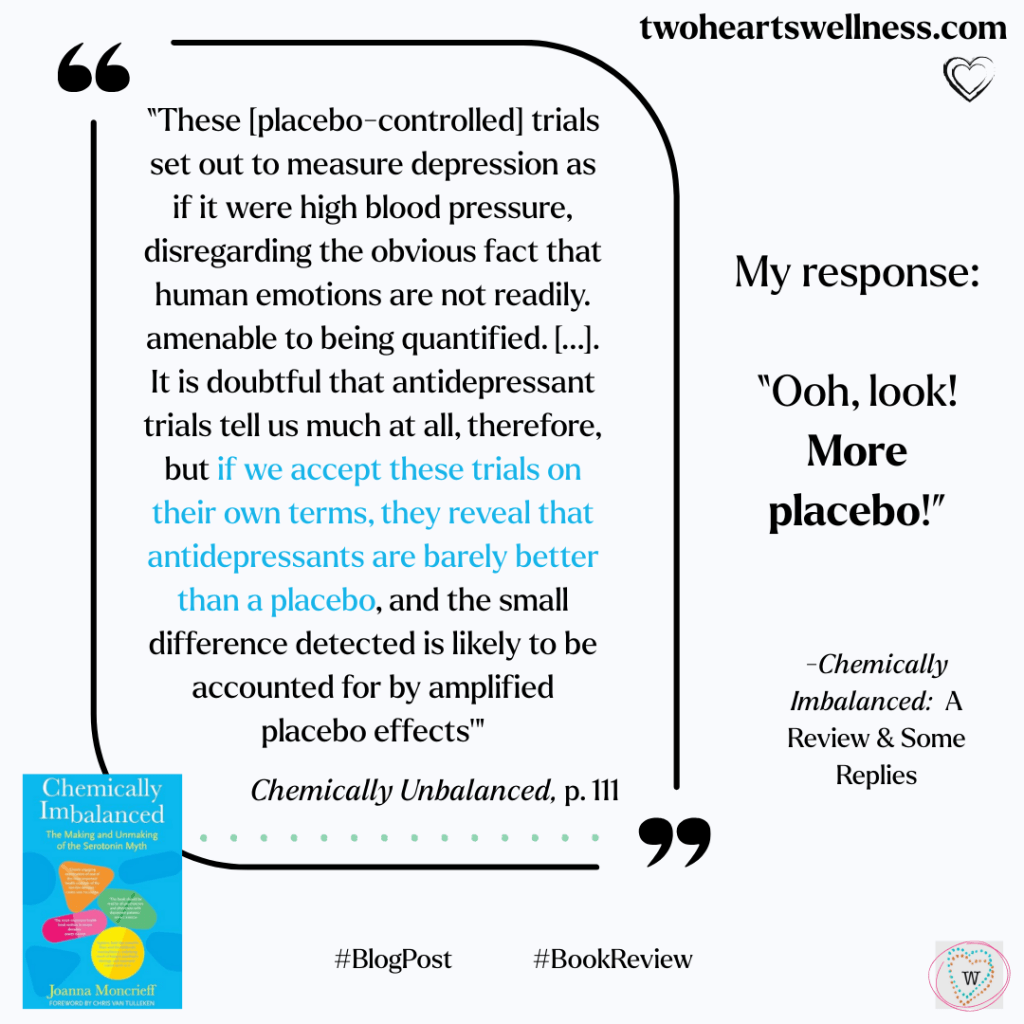
My primary website has a worthy blog post on this subject. Have you heard of the book Chemically Imbalanced: The Making and Unmaking of the Serotonin Myth (Flint, 2025)? Written by practicing psychiatrist, researcher, and professor at University College London, Joanna Moncrieff, it systematically debunks the claim that depression is the result of a serotonin imbalance in the brain. It also outlines how Big Pharma created a narrative that supported the use of SSRI meds to restore balance in the brain and thus sold us all on the need for antidepressants.
Her conclusion? The way SSRIs “work” (if and when they do) is, and I quote, “barely better than a placebo.” Refer to the linked blog post for more:
*****
*****
The TL/DR: Is acupuncture only successful due to the placebo effect?
In some cases, the answer is maybe. It really all depends. Some points clearly have a cause and effect that even biomedicine recognizes. For instance, women who experience postpartum incontinence can go to an acupuncturist and the practitioner will surely needle Spleen 6, a point on the medial aspect of the lower limb just above the ankle and, depending, they might rely on electricity to boost the signal (e-stim). If a woman goes to a urogynecologist for PP incontinence, that doctor will probably stimulate that point in the same way an acupuncturist does, via a needle in the same location and–more likely than not–also in combination with e-stim. The acupuncturist will say that they are strengthening the qi via a key point for women’s health. The urogyn will say that they are stimulating the pudendal nerve. Same-same, just different language.
There are a number of points that directly affect specific nerves, in fact. Similar to the way that SP 6 is known to improve pudendal nerve function, Stomach 36, for instance, has been shown to affect the vagus nerve. There are several points like these two. Some point combinations result in endorphin (neurotransmitter and feel-good hormone) release. Others improve blood circulation or release fascial adhesions. It all depends. Either way…if you come to your appointment expecting that you will have a lovely acu-nap and feel calmer by treatment’s end, you probably will experience that outcome via at least some level of placebo effect.
So? That doesn’t mean it doesn’t work. And anyone who points a finger at Chinese medicine and scornfully proclaims it a placebo needs to read Chemically Imbalanced and consider their viewpoint on placebos. Is it only ok when it’s Western biomedicine?
Huh.
The Moncrieff book inspires questions, though, doesn’t it? For instance: does Pharma prescribed by your trusted family physician work for you? For some of us, it does. For me, and many patients I’ve treated, those sweet, sweet Pharma prescriptions bring nothing but chaos and adverse events. That’s actually what brought me to Chinese medicine. Oh, do I have a history of horrifying adverse events to even the most common and generally safe Pharma drugs!
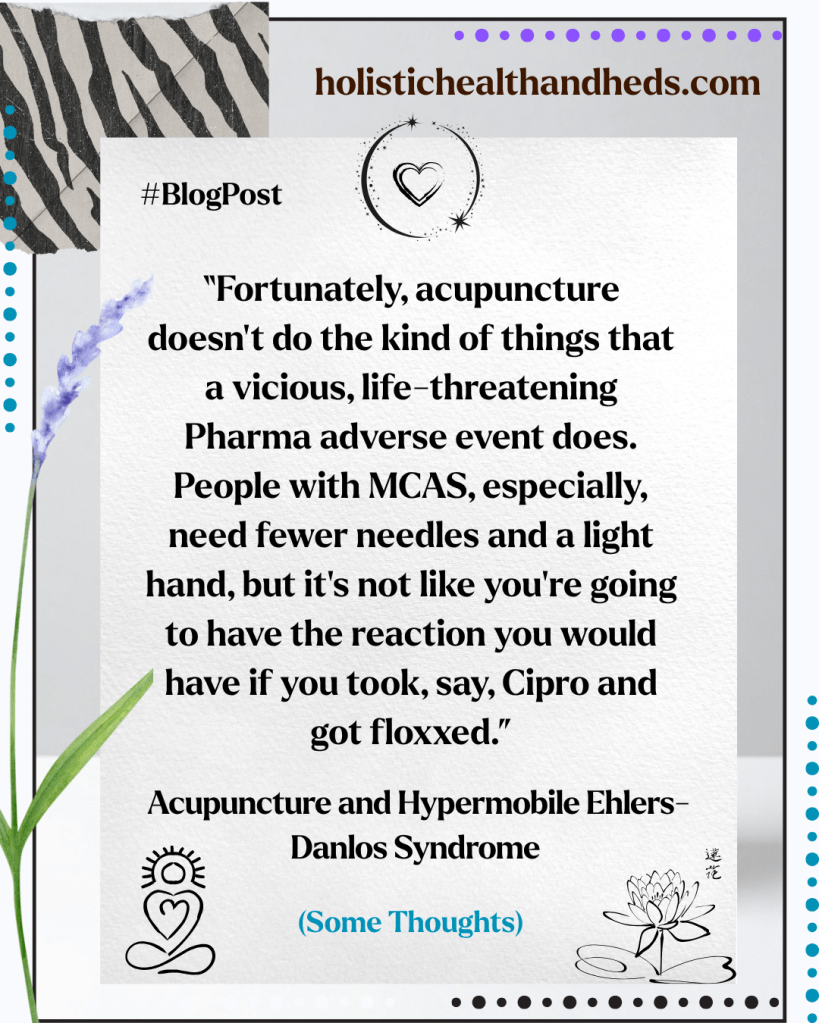
Fortunately, acupuncture doesn’t do the kind of things that a vicious, life-threatening Pharma adverse event does. People with MCAS, especially, need fewer needles and a light hand, but it’s not like you’re going to have the reaction you would have if you took, say, Cipro and got floxxed.
*****
*****
In conclusion (at least for now)
Acupuncture does work.
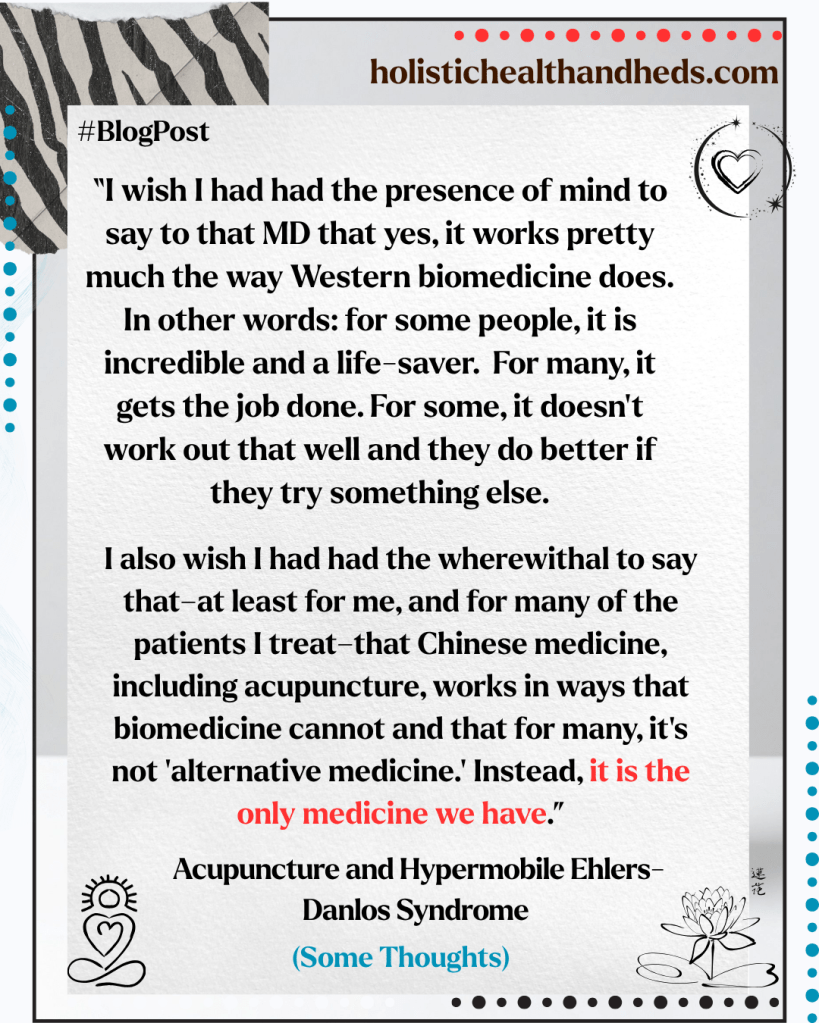
I wish I had had the presence of mind to say to that MD that yes, it works pretty much the way Western biomedicine does. In other words: for some people, it is incredible and a life-saver. For many, it gets the job done. For some, it doesn’t work out that well and they do better if they try something else.
I also wish I had had the wherewithal to say that–at least for me, and for many of the patients I treat–that Chinese medicine, including acupuncture, works in ways that biomedicine cannot and that for many, it’s not “alternative medicine.” Instead, it is the only medicine we have.
I, personally, love Chinese medicine. Not everyone does, and that’s fine. But it does work, and if Pharma drugs do nothing for you…it could be time to consider Chinese medicine.
What do you think?
*****
*****

Dr. Paula Bruno, Ph.D., L.Ac., is a licensed acupuncturist and herbalist, an AOBTA-CP traditional Chinese bodywork therapist, an author, and a health coach. She maintains an active and growing practice at Two Hearts Wellness, her Austin, TX office. Dr. Bruno is also available for distance appointments for wellness consultation or coaching.
In her first career, she was a Spanish professor.
Dr. Bruno’s specialties as a Chinese medicine practitioner include: • Musculoskeletal health (acute or chronic pain relief; Ehlers Danlos syndrome & hypermobility support) • Digestive support, gut health, and weight loss • Aesthetic treatment, including scar revision • Men’s health • General preventative care and wellness support for all persons.
She is the author of Chinese Medicine and the Management of Hypermobile Ehlers Danlos Syndrome: A Practitioner’s Guide.
When you are ready to discover what traditional medicine plus a vibrant and engaged approach to holistic health can do for you, either contact Dr. Bruno or book an appointment online.
*****
*****
Two Hearts Wellness/Holistic Health & hEDS does not accept paid advertising on this website and only relies on strictly necessary cookies.
Note: Material on this web site site is not intended to diagnose, prevent, treat, or cure any disease, illness, or ailment. A Chinese medicine practitioner in Texas identifies syndrome patterns but does not diagnose illness. Material on this web site does not purport to identify syndrome patterns.
*****
 Holistic Health and hEDS