
The spleen is a little guy, only about the size of a fist or an avocado. As far as biomedicine is concerned, it’s not a vital organ necessary for survival and can be removed if there are problems. Chinese medicine does not see things this way. We are big fans of the Spleen (as always, I capitalize Chinese medicine organs to distinguish them from Western biomedical versions of same) and would not be inclined to view losing it as something insignificant.
What do you know about this organ? Do you know how important it is to the big picture of an HSD/hEDS presentation?
*****
*****
Pulp and circumstance
The spleen is like your liver in the sense that it, too, is a cleaning machine. The spleen filters your blood by identifying and removing the damaged, worn out, or misshapen red blood cells. It also recycles iron. But that’s not all. If you need extra blood, your spleen will release its reserves in case of emergency. Your spleen is also a little storage shed that holds platelets and white blood cells. On top of the filtering and recycling, your spleen is also important for your immune system because it produces white blood cells (lymphocytes and monocytes) that make antibodies to battle infection.
There are two types of tissue in your spleen: red pulp (responsible for the red blood cell action) and white pulp (that would be the aspect that relates to your adaptive immune response). Did you know that your spleen is your body’s second largest lymphatic organ?
If your spleen could talk, oh…the things that it might say!
*****

*****
Seriously, take a minute to see the above-linked video. It’s a play on the viral hit “What does the fox say?” and if you google that and watch it too…well, what else do you need to know about the spleen? I mean… And I love how they had an Asian guy be the Spleen. I wonder if this was intentional? I like to think so. Hm. (Also…if you look at the screen shot above, do you notice any hypermobility? I sure do).1
*****
*****
A Chinese Spleen
For us in Chinese medicine, the Spleen is a big deal. Its pair organ is the Stomach and, for us, the Spleen takes part in digestion and metabolism. We would term this as “transport and transformation” and what this refers to, in essence, is the role the Spleen plays in breaking down food and fluids. The Spleen controls the Blood, and if you are someone who bruises easily, we would say that your Spleen is not controlling the vessels the way it should. On the emotional end of things, the Spleen is associated with worry and ruminating. The Spleen also governs muscles. If you have what we call Spleen qi sinking you can experience organ prolapse, for instance, and one of our dearest Chinese herbs is part of a centuries-old formula used for precisely this issue:
“[H]uang qi is anti-inflammatory, it is a staple herb for prolapse, and it supports immune function. This is noteworthy for any of us with MCAS, as huang qi is a natural antihistamine that can affect inflammatory mediators (histamine and cytokines) and help to restore gut health too.”
—Astragalus for Ehlers Danlos Syndrome and MCAS (Or… What is Huang Qi?)
And on a related note? Your Liver, for its part, governs your tendons and sinews. It is another blood filtration system just like your spleen (among the many tasks that your liver performs). Take a look at the companion piece to this blog post that you can find on my main website (Two Hearts Wellness). For us in Chinese medicine, the Liver and the Spleen have quite the interactions and often come up in our assessment of HSD/hEDS patients. When the Liver isn’t working well, it can affect Spleen function and when the Spleen is weak, the Liver can make things very challenging indeed.
*****
*****
There is so much to say about the Spleen in Chinese medicine! Each season has an organ associated with it and the Liver’s is springtime. The Spleen’s is what we call late summer, the fifth season that exists according to Chinese medicine. While your Liver likes bitter flavors, the Spleen likes sweet. The Liver’s emotion is anger and, as mentioned, the Spleen is associated with worry and rumination. When the Spleen is happy, your digestion runs smoothly, you don’t bruise easily, and your muscles are healthy.
When your Spleen is not happy, you bruise easily, you bleed easily, you get bloated or gassy after you eat, you may have loose stool or even diarrhea, and/or you end up with prolapsed organs. And that’s just if it’s Spleen only. If there’s evident disharmony between Spleen and Liver, you may be angry, chronically worried, or depressed. And, as my favorite teacher used to say, “Liver beats up Spleen, Spleen doesn’t work so good” (meaning: your digestion is weak and problematic on many levels).
So what can you do if your Spleen isn’t operating at its best? Well, if you’re interested in Chinese medicine…
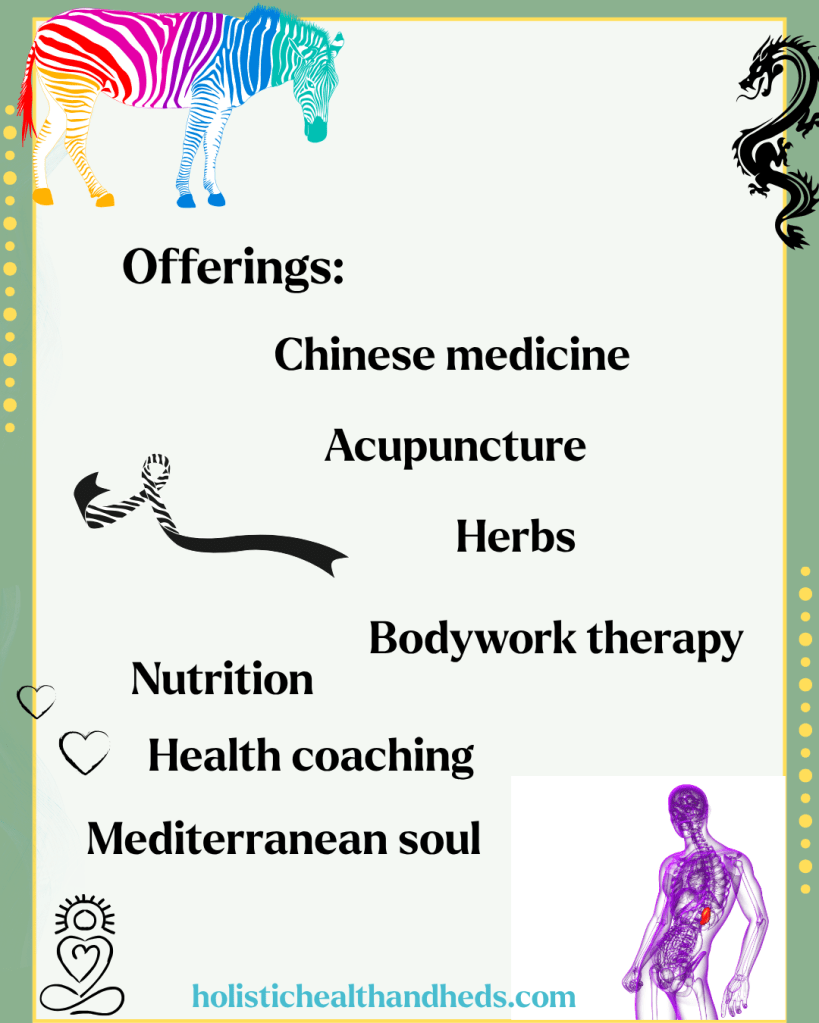
It is important to work with someone who is familiar with EDS, and if at all possible, MCAS.2 Your practitioner of Chinese medicine can offer you acupuncture treatments designed to nurture Spleen health (and we’ll probably attend to the wellbeing of your Liver too). Some of us are more gut health oriented than others (I’m a gut health specialist) and, when we are, we can educate you in the ways of Chinese medicine’s views on nutrition. If you’re ready to work on your gut health, we definitely are a resource. And we also have exceptional herbal options that work. This is especially helpful for those of us (I include myself here) who have an adverse event history when it comes to Pharma drugs.
Take care of your Spleen and your Spleen will take care of you (same goes for your Liver). When you live with EDS and the common comorbidities. a healthy Spleen can make a big difference in your overall health trajectory.
Isn’t it time you did something good for your Spleen?
*****
*****

Dr. Paula Bruno, Ph.D., L.Ac., is a licensed acupuncturist and herbalist, an AOBTA-CP traditional Chinese bodywork therapist, an author, and a health coach. She maintains an active and growing practice at Two Hearts Wellness, her Austin, TX office. Dr. Bruno is also available for distance appointments for wellness consultation or coaching.
In her first career, she was a Spanish professor.
Dr. Bruno’s specialties as a Chinese medicine practitioner include: • Musculoskeletal health (acute or chronic pain relief; Ehlers Danlos syndrome & hypermobility support) • Digestive support, gut health, and weight loss • Aesthetic treatment, including scar revision • Men’s health • General preventative care and wellness support for all persons.
She is the author of Chinese Medicine and the Management of Hypermobile Ehlers Danlos Syndrome: A Practitioner’s Guide.
When you are ready to discover what traditional medicine plus a vibrant and engaged approach to holistic health can do for you, either contact Dr. Bruno or book an appointment online.
*****
*****
Two Hearts Wellness/Holistic Health & hEDS does not accept paid advertising on this website and only relies on strictly necessary cookies.
Note: Material on this web site site is not intended to diagnose, prevent, treat, or cure any disease, illness, or ailment. A Chinese medicine practitioner in Texas identifies syndrome patterns but does not diagnose illness. Material on this web site does not purport to identify syndrome patterns.
*****
- It may be that I find these things incredibly humorous because I’m a practitioner of Chinese medicine… but Western biomedicine spleen song videos are SO FUNNY. Another one that is just hysterical (and also useful) is KLT Academy’s “The Spleen Song!” I’m embarrassed to admit how many times I’ve watched that video but…well, take a look and see. Educational and humorous? I love it! ↩︎
- And yes, of course there is a blog post for that. Refer to “Acupuncture & EDS: How to Find a Practitioner of Chinese Medicine When You’re a Zebra” for useful information on ways to find a knowledgeable practitioner. ↩︎

