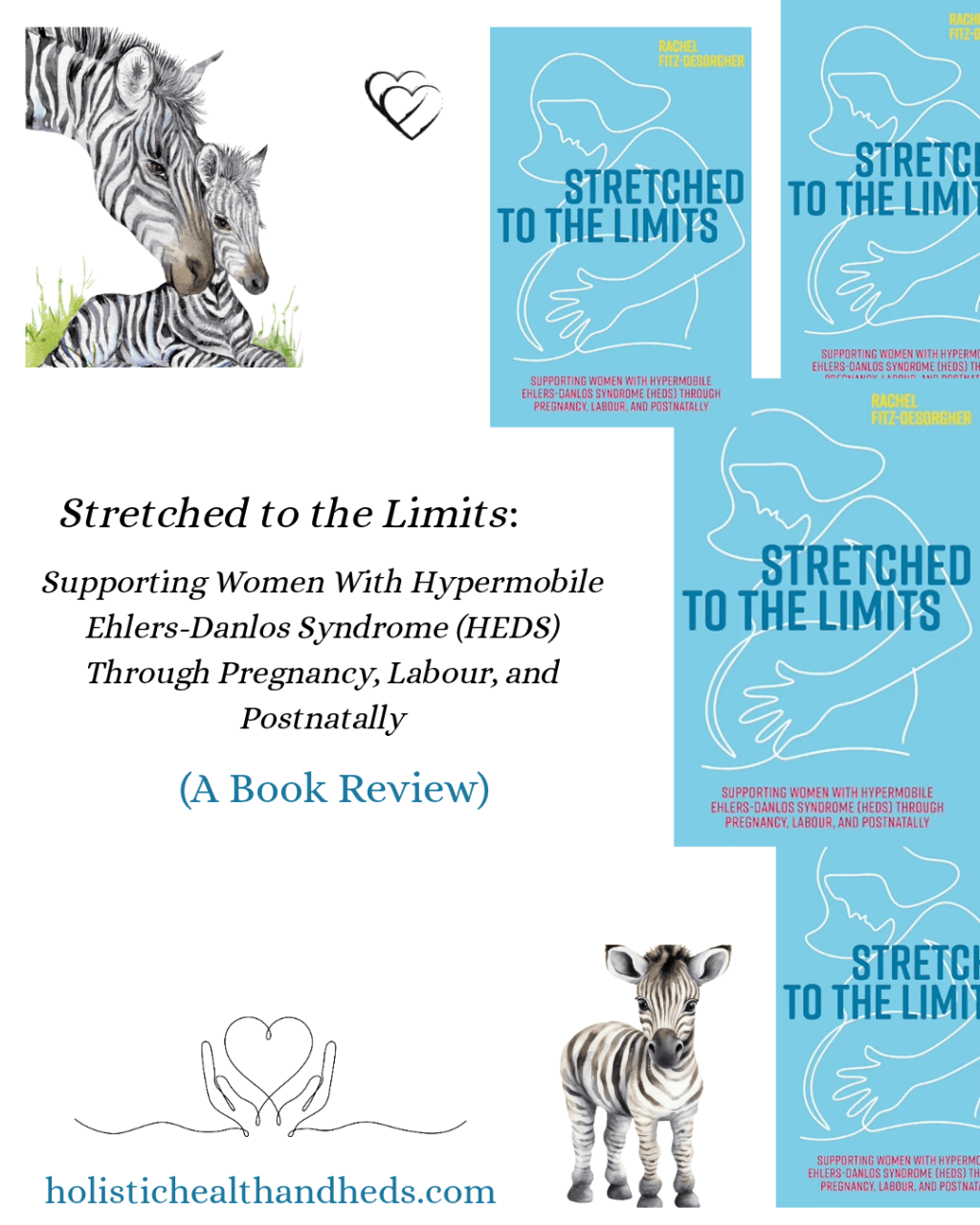
Stretched to the Limits: Supporting Women With Hypermobile Ehlers-Danlos Syndrome (HEDS) Through Pregnancy, Labour, and Postnatally by Rachel Fitz-Desorgher (Jessica Kingsley, 2024) is directed towards a specific audience and that would be midwives. Even so, it’s worth reading whether you are a pregnant (or hoping to become pregnant) hypermobile person or, on the other side of the table, you are in any kind of support role to a gestating bendy.
I’m a practitioner of Chinese medicine and a health coach who specializes in, among other things, HSD/hEDS. I don’t usually do much with women’s fertility or prenatal healthcare. The one exception is when it comes to things like helping folks with HSD/hEDS support a healthy pregnancy in a collagen-compromised body or settling MCAS chaos enough to become (and remain) pregnant. Even the best fertility and prenatal specialist can be baffled by hypermobility and comorbid conditions, and these patients really do need specialist care. My life experience and my professional acumen acquired in over a decade of specialization makes me comfortable in this role in a way I would not be with a normie pregnant patient. (Usually, the only time I work with fertility is if it’s the man’s issue and that focus is part of my dedicated area specialty in men’s health).
*****
*****
Consequently, though it may seem quite a departure from my usual topics, I decided to write a book review of Stretched. This book has its pluses and minuses, but the TL/DR is that I highly recommend it for anyone involved in pregnancy and HSD/hEDS, whether they are the patient or the caregiver or even a family member or a friend.
It stands to reason that pregnancy is both a blessing and cause for special concern when HSD/hEDS, not to mention the common comorbid conditions, is a factor. Some women feel the best they have ever felt during their pregnancies but then experience a host of exacerbated health problems after the fact. Others struggle throughout. Pregnancy is hard on any body, but relaxin, the hormone that loosens ligaments and prepares the body for childbirth, can wreak extra havoc on an already-hypermobile body that doesn’t need this kind of help. Aside from the added joint instability, relaxin can also be the cause of debilitating pelvic girdle pain and separation of the pubic symphysis. And what about the added threat of pelvic floor dysfunction and prolapse?
Rachel Fitz-Desorgher offers a calming message via Stretched. She herself is hypermobile and is the mother of four sons. Professionally, her background is sterling: she worked for over thirty years as a specialist midwife, an infant feeding consultant, and a parenting consultant. She authored Your Baby Skin to Skin: Learn to Trust your Baby’s Instincts in the First Year (Hodder & Stoughton, 2017) and founded Henley Birthcare, an independent midwife and doula service based in the UK, before writing this valuable resource for the bendy amongst us.
*****
*****
And yes, the book definitely has a UK vibe to it.
By the time I was halfway though the first chapter I felt like I was getting a bracing chat from a British auntie. Fitz-Desorgher definitely has an unfazed “let’s just get to it, no whinging” attitude that made me laugh every now and again. She’s very reassuring, and I think that’s great!
The book was written for midwives and doulas, as mentioned, but it is certainly accessible to anyone who wants to read and learn. If I may quote myself from another blog post here at Holistic Health & hEDS:
“I read an online review of my book that dismissed it, saying (in essence) that the book is fine if you don’t know anything at all about hEDS, but it’s basic otherwise. I could tell that this was written by a fellow acupuncturist because they then gave some treatment advice. I was a little pissed off, to be honest, but I got over it quickly. My book was written with the philosophy I held during my professor years: I don’t teach people what to think; I teach ways to think. And if someone thinks that’s basic, well… (A) I doubt the reader followed up on my copious endnotes and (B) this is the same mentality that would have thought that reading classics of Spanish literature once made them an expert. I had students like that when I was a Spanish professor and there’s not a lot you can do to change their minds. It’s the Dunning-Kruger effect at its best.
—Hypermobile Ehlers-Danlos Syndrome Awareness (There’s Always Something New to Learn)
I share this because the second thing that happened was that very soon after (I mean within days) I read an excellent book on pregnancy and hEDS, Stretched to the Limits: Supporting Women with Hypermobile Ehlers-Danlos Syndrome (hEDS) Through Pregnancy, Labour, and Postnatally (Jessica Kingsley 2024). I zipped through the first section, which is dedicated to outlining hEDS and its issues for the benefit of midwives and doulas. I caught myself thinking: Oh, this is basic information and I already know it… and then I had to laugh, because here I’d just rolled my eyes at a fellow acupuncturist saying the same thing about my book.
I took this as a reminder to slow down as I read. If I read this with the eyes of an acupuncturist who has substantive experience with HSD/hEDS, then sure, it is relatively basic information. If I read it as an acupuncturist who is not a doula or midwife, though? Then I am fortunate to be given a window into what a pregnancy professional sees as the most important general information that birth workers must know. This is important information and offers a good lesson on several levels.”
So yes, for some people this might be basic information but… given the context, and the fact that the author makes important information so accessible? I have no criticism of the level of information and how it’s provided. This is a useful book and one that can be read by practitioner and patient to create a shared understanding of HSD/hEDS and pregnancy. Patients need resources like this one and so do practitioners.
Fitz-Desorgher is thorough in her panoramic discussion of the topic. The book’s initial section is titled “a guided tour of the EDS body,” and she delivers, clearly and concisely. This introduction is followed by sections for all three trimesters, with focus on specific concerns (heartburn, headache, ligament laxity, etc). Next, she provides a clear discussion on what to take into account while preparing for birth and planning for contingencies. She walks us through the birth process and then discusses baby health and postnatal support.
All good, but I do wish that there had been more discussion of MCAS and POTS. I understand, though, because either of these conditions merits their own book. You either start writing about them and are compelled to keep writing, which shifts the center of gravity of your book, or you briefly mention them and try to keep your narrative contained. So yes, I do understand. But still. MCAS and POTS most certainly do affect fertility, pregnancy, birth, and postpartum and these are so common in the HSD/hEDS community.
Ah, well.
When I started working with complex conditions it really didn’t seem like there was a lot for pregnant folks with HSD/hEDS. This has begun to change in recent years, though I do think that the UK is ahead of us here in the United States. A resource that I really like a lot is HEDS Together, which is in fact in the UK, and has developed specific projects pertaining to maternal health, including but not limited to:
- EDS Maternity Co-created Tools #EDSMaternity
- Hypermobility and musculoskeletal conditions during and after pregnancy
- EDS Maternity Literature Review #EDSMaternity
Another option that I like is A DOULA’S GUIDE TO EDS & PREGNANCY 2025, which provides a TL/DR version of what Stretched discusses. I especially like the links at the bottom of the essay. The author is quite thorough and there is a true wealth of information to follow up on for anyone who is interested in so doing.
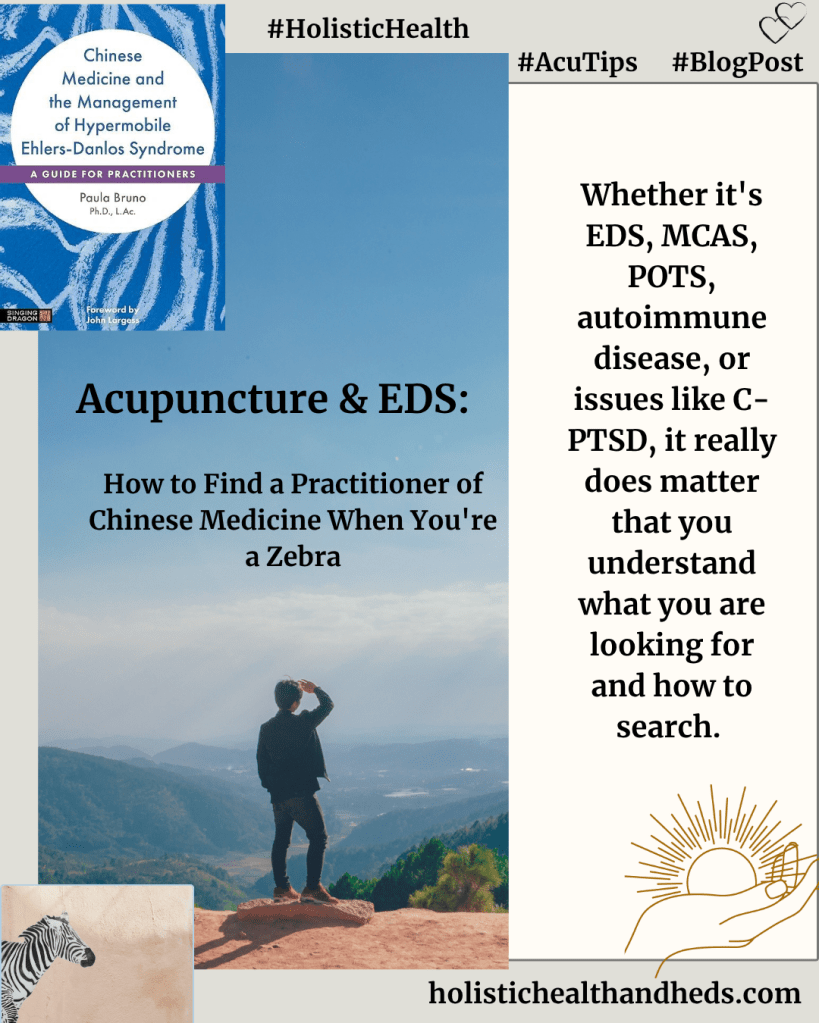
None of these have anything substantive to say about Chinese medicine, though, and I would be remiss if I didn’t mention that you can find a lot of meaningful support at your acupuncturist’s office. Of course, it is important to find an acupuncturist who treats HSD/hEDS and/or MCAS.
*****
*****
*****
For dedicated fertility support, it would be optimal to look for someone associated with the Acupuncture and TCM Board of Reproductive Medicine, also know as ABORM. But remember: if they’re not familiar with HSD/hEDS and the common comorbids, then you might also want to at least consult with someone who is.
“What about a consultation?
—Health coaching, Edu-coaching, Consultation: The Which and Why and When for People with Ehlers-Danlos Syndrome
Sometimes, you need clarification. Dr. Google and their colleague, Dr. Chat GPT, are giving you contradictory information. Your MD is not giving you any meaningful information. You love your Facebook group and appreciate the community on Reddit. But you’re overwhelmed by the variety of information you’re getting and you just do not have the energy to double-check and assess the validity of the seemingly-good material you are getting online. And your MD’s gaslighting sheds no valuable illumination of your situation.
A one-off consultation might work for you, especially if you are fairly self-reliant. Sometimes, your best bet might be to have a short series of sessions, each with a clearly defined topic of discussion and goal. If this is what you would like, the coach’s credentials should be the first thing you check. Does this person have substantive credentials that match your goals? Be prepared before every session and expect to do the daily work on your own. But if you function better that way, then this could be great for you.”
Myself, I’ve had patients for whom I’ve been a resource starting from fertility treatment to the arrival of the longed-for happy, healthy baby. With others, it’s been shorter term and more of a consulting role. As I always say, though: knowledge is power, and the more you know, the better off you are when it comes to being able to advocate for yourself and make decisions based on not just your health and safety needs but also your values and sense of self-determination.
Pregnancy and childbirth have their challenges for every body, but an HSD/hEDS body really does need some extra help. Rachel Fitz-Desorgher’s Stretched is, in my estimation, a must-read for anyone who is either a mom-to-be or part of the support system for this life-changing process.
Highly recommend!
*****
*****

Dr. Paula Bruno, Ph.D., L.Ac., is a licensed acupuncturist and herbalist, an AOBTA-CP traditional Chinese bodywork therapist, an author, and a health coach. She maintains an active and growing practice at Two Hearts Wellness, her Austin, TX office. Dr. Bruno is also available for distance appointments for wellness consultation or coaching.
In her first career, she was a Spanish professor.
Dr. Bruno’s specialties as a Chinese medicine practitioner include: • Musculoskeletal health (acute or chronic pain relief; Ehlers Danlos syndrome & hypermobility support) • Digestive support, gut health, and weight loss • Aesthetic treatment, including scar revision • Men’s health • General preventive care and wellness support for all persons.
She is the author of Chinese Medicine and the Management of Hypermobile Ehlers Danlos Syndrome: A Practitioner’s Guide.
When you are ready to discover what traditional medicine plus a vibrant and engaged approach to holistic health can do for you, either contact Dr. Bruno or book an appointment online.
*****
*****
Two Hearts Wellness/Holistic Health & hEDS does not accept paid advertising on this website and only relies on strictly necessary cookies. All our copy is generated by human effort (there is no AI slop here!)
Note: Material on this web site site is not intended to diagnose, prevent, treat, or cure any disease, illness, or ailment. A Chinese medicine practitioner in Texas identifies syndrome patterns but does not diagnose illness. Material on this web site does not purport to identify syndrome patterns.
*****

