
It probably sounds trite and obvious but it is a lesson that many do not seem to take to heart. To wit: there is always something new to learn when it comes to hypermobility, HSD, and hypermobile Ehlers-Danlos syndrome. It does not matter if you live with the condition or you are a famous medical doctor or researcher who is known for your acumen regarding this condition. There is always something new to learn.
As a patient, you should be able to work with healthcare providers who listen to you and who make you part of your wellness team. How many of us have gone to the doctor and had our symptoms dismissed because the tests came back normal and the practitioner thought they knew more about you than you do? Or maybe the doctor knows zero about HSD/hEDS or MCAS or POTS and does a quick Google search and then pretends to know it all. Maybe that care provider knows a little bit, or even has the condition themselves, so they think they know everything.
This attitude is not helpful in the context of complex chronic illness. It’s not safe or affirming for patients and it’s in no way admirable in practitioners. You, dear reader, deserve practitioners who retain some humility and the capacity to recognize what they know and that they need to keep learning. I also think that keeping a learner’s mind is optimal for you, too (but you, unlike healthcare providers, are not ethically obligated to take this posture).
Fact: there is always something to learn.
Myself? I have my personal experience and over ten years of professional experience. I wrote a book: Chinese Medicine and the Management of Hypermobile Ehlers-Danlos Syndrome (Singing Dragon, 2023). I’m still learning. I will be learning for the rest of my life, I am sure.
So why a blog post?
I was thinking about this subject anyway, because I (A) have a lot of experience with patients who have medical PTSD and (B) I’m a former professor and I think a lot anyway. But then two things happened. Well, actually three things happened. All fairly small, but put them together and this blog post started going in a direction that I did not necessarily anticipate. Nothing too tangential, but just not what I had originally planned, that’s all.
*****

*****
The first two things are related.
One: I read an online review of my book that dismissed it, saying (in essence) that the book is fine if you don’t know anything at all about hEDS, but it’s basic otherwise. I could tell that this was written by a fellow acupuncturist because they then gave some treatment advice. I was a little pissed off, to be honest, but I got over it quickly. My book was written with the philosophy I held during my professor years: I don’t teach people what to think; I teach ways to think. And if someone thinks that’s basic, well… (A) I doubt the reader followed up on my copious endnotes and (B) this is the same mentality that would have thought reading classics of Spanish literature once made them an expert. I had students like that when I was a Spanish professor and there’s not a lot you can do to change their minds. It’s the Dunning-Kruger effect at its best.
I share this because the second thing that happened was that very soon after (I mean within days) I read an excellent book on pregnancy and hEDS, Stretched to the Limits: Supporting Women with Hypermobile Ehlers-Danlos Syndrome (hEDS) Through Pregnancy, Labour, and Postnatally (Jessica Kingsley 2024). I zipped through the first section, which is dedicated to outlining hEDS and its issues for the benefit of midwives and doulas. I caught myself thinking: Oh, this is basic information and I already know it… and then I had to laugh, because here I’d just rolled my eyes at a fellow acupuncturist saying the same thing about my book.
I took this as a reminder to slow down as I read. If I read this with the eyes of an acupuncturist who has substantive experience with HSD/hEDS, then sure, it is relatively basic information. If I read it as an acupuncturist who is not a doula or midwife, though? Then I am fortunate to be given a window into what a pregnancy professional sees as the most important general information that birth workers must know. This is important information and offers a good lesson on several levels.
I want to think that we all know why it is so important to be humble and always learning but I’m not sure that this is so the case. Again… how many of you, dear readers, have gone to a doctor that dismisses you with the attitude that they’re the doctor and you don’t know about your own condition? Many of you, right? And it’s not just a matter of being belittled, gaslit, or dismissed and feeling badly about it, though that is important. What the real problem can be is that, as many of us know, we end up getting treatments that hurt us, getting no treatment at all (and that can hurt us), and being sent here and there and everywhere, while our conditions worsen and our quality of life diminishes.
*****
“It may seem hard to believe if you are not chronically ill or you do not know anyone with a rare condition, but the reality is this: there are individual medical care providers, some of whom are excellent and caring, and there are systems, some of which sustain a healthcare network that functions well. On the flip side, there are individuals who are cruel and ignorant and there are systems that set up patients for failure. Of course, my focus in this essay is on the latter rather than on the former.
—Medical PTSD and Chronic Illness: Root Causes and Strategies for Survival
You can be an expert in your own condition and not survive it if you find yourself trapped in a medical riptide that drags you under and pulls you down.”
*****
Humility and the capacity to say, “I don’t know” and/or “There is so much to learn here and I’m up for the challenge” make a big difference, don’t you agree?
The purpose of this blog post is not to pat myself on the back. It is not. Instead, it really is a reminder to all of us about what matters:
Your perceptions count. The healthcare provider has knowledge and expertise that you do not but that does not mean that they know everything. You live in your body and your experience is valid.
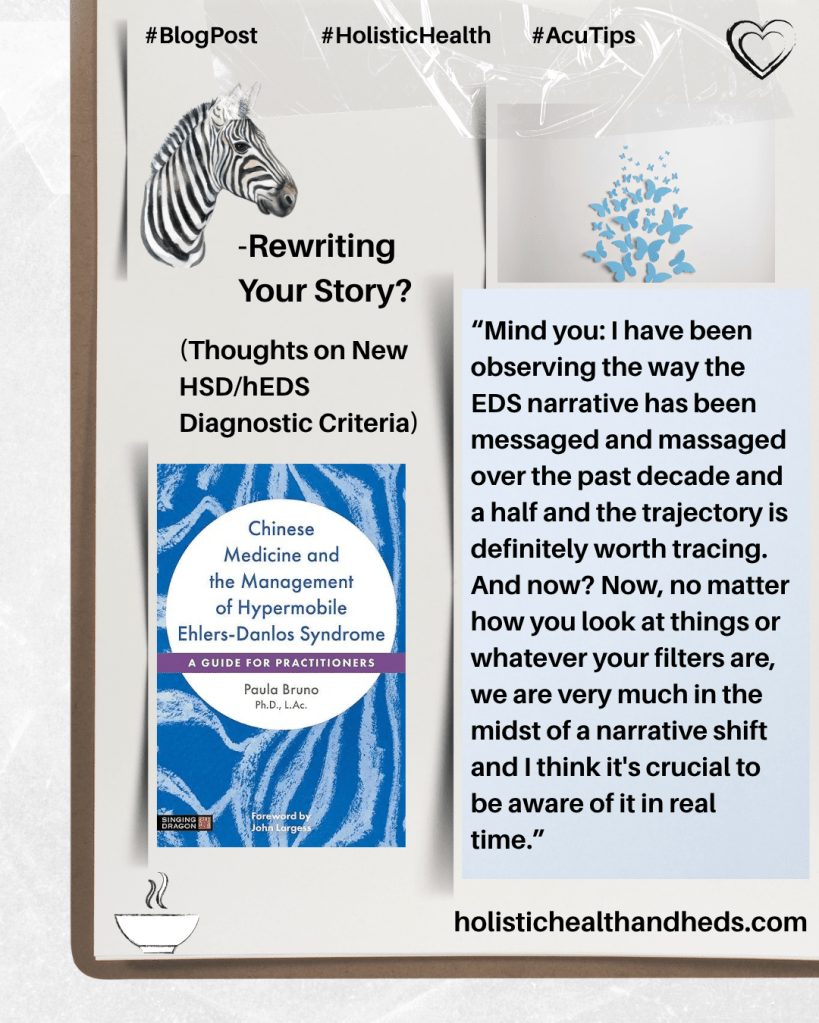
You do not need a diagnosis in order to be validated or to deserve being treated with respect. The question of diagnosis is an open one even now. And diagnostic criteria are about to change yet again. This is a story whose ending has not arrived, but one thing will not change: how EDS is categorized and how it is a lived experience is never going to be 100% uniform across the board for all of us.
*****
*****
When your practitioner says “I don’t know but I can find out” that’s a good thing. It’s better than acting like they do know as they surreptitiously google it, only to come back to you masking their insecurities with crappy treatment and a superior attitude.
You and practitioner should work as a team. From the most simple, basic health concern to the complicated ones, care providers and patients should be a team. That doctor who is deciding what your condition is and what they’re going to do about it? They have a job and an identity because of you, the patient. You can’t be a doctor without patients. They owe you some decency, at least, for that. And really? You should be a team, with the goal being your best level of wellbeing.
It’s not that tough.
I sometimes think I should be a little more “I know and that’s that” but I modeled critical thinking and meaningful learning when I taught and I do the same as a practitioner. That’s not the same as acting like my years of study and PhD are equal to an undergraduate’s first thoughts on Spanish literature. I knew a lot more than the students did, that’s why they were in my classroom, but that didn’t mean that I knew everything. And I do know more about Chinese medicine and ways to ameliorate the challenges of complex chronic illness than patients–that’s why they make an appointment to see me. That’s why they trust me with their care.
But I do not know everything and I can always find something to learn for the patient’s benefit. And if I can learn something from the patient? Even better. (When your practitioner listens, no matter if they are an important MD or a humble acupuncturist, they can learn if they want to do so. Truly.)
The third thing that happened was that I was cleaning out old files on my computer. I do this periodically, as one should, and I was surprised and touched to find a screenshot of an old Twitter exchange. Yes, this was back when it was Twitter and it was pre-COVID, I think from about 2019 (I transferred what was on my old computer to this newer one, so it could be even older, but I digress). Anyway, it was an exchange between myself and a noted EDS practitioner, Dr. Emma Reinhold:
Me: “Traditional Chinese medicine is my 2nd career; in the 1st, I was a Spanish professor. I have no problem saying, ‘I don’t know but let me do some research & get back to you ‘ & patients love the honesty. When I get back to them, it’s ‘This is what I found, where I found it […] & here are some suggestions for your own home reading.’
It’s like I’m your favorite Spanish professor who became your acupuncturist. You can expect that I’ll prepare for class–uh, the appointment–& yes, you will get homework.”
Patients appreciate it, I find.
Dr. Emma Reinhold: ‘Totally they do! Treating patients as equal adults. Exploring complex scenarios together. Sharing our existing knowledge and looking at potential ways forward. Medicine at its very best.’”
*****

*****
I don’t remember making a screenshot of the exchange but I do remember, upon reading it, how much I appreciated this encouragement. I remember how much I admired Dr. Reinhold and how I appreciated the collegiality she extended to me. Biomedical physicians are not necessarily respectful of practitioners of Chinese medicine and, while I really don’t need their validation (seriously, I do not), I did react to this exchange enough to take a screenshot and save it. And here I am, with my Canva graphic, above, sharing it all these years later.
There are many roads to healing but one thing holds true: we are all learners here. When you decide that there is more than where you are right this minute you give yourself an opportunity to learn and grow and maybe even shift things in the direction you want to go. When your healthcare provider does the same, they are giving you a chance to experience something different, something that might change your situation for the better. They are demanding the best of themselves, too, by putting in the time, the effort, and the dedication necessary for treating human beings with complex conditions.
At the very least, they are treating you like a person, not an illness. They are treating you as though you are part of a team, not an object to be worked on or fixed (or discarded). I know that is how I treat my patients and health coaching clients, anyway: like human beings with the capacity for change, human beings with their own stories and needs, and human beings who are learners. Aren’t we all learners?
We are when we choose to be.
What do you think about this topic? And what are you learning today?
*****
*****

Dr. Paula Bruno, Ph.D., L.Ac., is a licensed acupuncturist and herbalist, an AOBTA-CP traditional Chinese bodywork therapist, an author, and a health coach. She maintains an active and growing practice at Two Hearts Wellness, her Austin, TX office. Dr. Bruno is also available for distance appointments for wellness consultation or coaching.
In her first career, she was a Spanish professor.
Dr. Bruno’s specialties as a Chinese medicine practitioner include: • Musculoskeletal health (acute or chronic pain relief; Ehlers Danlos syndrome & hypermobility support) • Digestive support, gut health, and weight loss • Aesthetic treatment, including scar revision • Men’s health • General preventative care and wellness support for all persons.
She is the author of Chinese Medicine and the Management of Hypermobile Ehlers Danlos Syndrome: A Practitioner’s Guide.
When you are ready to discover what traditional medicine plus a vibrant and engaged approach to holistic health can do for you, either contact Dr. Bruno or book an appointment online.
*****

*****
Two Hearts Wellness/Holistic Health & hEDS does not accept paid advertising on this website and only relies on strictly necessary cookies. All our copy is generated by human effort (there is no AI slop here!)
Note: Material on this web site site is not intended to diagnose, prevent, treat, or cure any disease, illness, or ailment. A Chinese medicine practitioner in Texas identifies syndrome patterns but does not diagnose illness. Material on this web site does not purport to identify syndrome patterns.
*****

