Hypermobile Ehlers-Danlos folks are, each and every one, unique. It’s never a surprise to have a patient with HSD/hEDS plus MCAS and/or POTS or other manifestations of dysautonomia. As a practitioner of Chinese medicine who has been treating such patients for over a decade now, I am constantly on the lookout for non-invasive treatments that are not only gentle, but also effective. If it is something I can teach the patient to do at home, too, then more the better.
Such is the value of magnet therapy.
You may not have ever experienced a dedicated magnet therapy treatment, dear reader, but you probably have tried something that includes magnets. Aside from Chinese medicine, you may have a vibration plate at home. Mine, at least, has an outline for each foot in the form of magnets. I also have a slant board with magnets embedded in the silicon cover.
As far as Chinese medicine is concerned, we have small magnet stickers that are used for auricular treatment, similar to ear seeds. Korean hand treatment will also use the small magnet stickers on specific acupuncture points. Personally, I do not like them at all, but you may have also seen cups with red or blue columns inside the cups. The magnet at the tip is either positive (red) or negative (blue) polarity and when the cups are set, the magnets touch the person’s skin. I remove these because, in my estimation, they pinch and are not useful but some acupuncturists use them to fine effect.
*****
*****
What I do in my office is a bit different, and why I followed up on my interest in magnetized gua sha tools and therapeutic magnets is all due to my specialty in hypermobile health. A good number of my patients are truly fragile. Most people with HSD/hEDS live with chronic pain. If and when I can find something that doesn’t require potentially vigorous pressing or pulling that moves qi and effects the changes that I seek, I jump on it. And people with MCAS and/or dysautonomia need options that are subtle for other reasons. When your system is hyper-reactive to all the things, you need a light hand and a treatment that coaxes change rather than drives it.
I wrote a companion piece to this one at Two Hearts Wellness that outlined some of my more prevalent uses for magnets (injury recovery, scar revision, and musician health) and I shared some history there:
“Magnet therapy has an interesting history. Magnets were known and used from India and China to the Eastern Mediterranean and Africa for centuries. Magnets themselves have their own intriguing history, one rooted in Asia. Greek legend holds that a shepherd, one Magnus, noticed lodestones, or naturally occurring magnetized rocks (magnetite) that clung to the iron nails of his shoes as he walked in the Magnesia region that was then Greece and is now a part of Turkey. Sometime around 200 BCE, Galen wrote about magnets and their use as purgatives. By the 11th century, Chinese explorers used lodestones as compasses. (There’s a lot more to this phase of history but discussing it really would be quite a digression…)”
—Magnet Therapy: How It Works, What It Can Do For You (It’s Amazing)
This blog post is pitched to normies and the information is useful (and yes, I do mention that I got into magnet therapy due to my work with hypermobile Ehlers-Danlos syndrome patients) but I didn’t really go into detail there as to why this should be so. In essence, I developed my treatment strategies because my HSD/hEDS patients–not to mention my MCAS and dysautonomia folks–need options. They need options and they need gentle approaches that (a) work and (b) don’t further damage fragile tissue or, as in the instance of MCAS, cause flares.
I’ve been experimenting since I started working with complex patients, actually, and it often has led to good things. For instance, I had a patient with MCAS who could only be treated via their feet unless we wanted to elicit a flare. I am really good with foot treatments and make great use of this skill to this day, but I probably wouldn’t have even considered treating via feet if it weren’t for that patient. Same goes for auricular (ear) treatments. And now, magnet therapy.
*****
*****
I’ll repeat from my other blog post what, precisely, I’m doing with the magnets:
“I also have a method that I have been developing that uses magnetic forks and special neodymium magnets. (These rare earth magnets consist of an alloy of neodymium, iron, and boron that creates strong and powerful magnets). My approach is a combination of what I do with tui na (and I am a very dedicated practitioner and have been for a decade plus by now) and what I might do with acupuncture needles. The mechanism for this, if you look at it from a scientific perspective, relates to the way magnets are thought to affect cellular ions (mainly sodium and calcium), strengthen local blood circulation, and shift nerve excitability. However, since I view these things via the lens of Chinese medicine, what happens is that I move qi and Blood.
—Magnet Therapy: How It Works, What It Can Do For You (It’s Amazing)
In many instances, I will hold the magnet just a tiny bit away from the skin, hovering until I can feel the person’s qi with my other hand. Patients will report that they can feel the magnetism even when the magnet is not touching them or barely doing so. The magnet elicits the qi and my hand guides it along its way, if I am using one hand-held magnet. I could equally use a fork in one hand and a curved magnet in the other; the two magnets speak to each other through the fascia and other tissues.”
This is gentle, and that’s the key point. Interestingly, I’ve found that not everyone truly feels the magnetic charge… except for my patients with HSD/hEDS, MCAS, and/or dysautonomia. They all feel the energy, each and every one. So we are gentle and conservative until we figure out just how much it takes to shift things. And yes, the qi definitely shifts.
I’ve written about this before and I will write about it again and again, but… when a person with EDS or MCAS or dysautonomia tries Chinese medicine they need to be attentive to how the practitioner responds to their issues. If the first treatment is vigorous and the outcome a little dicey, there is but one correct response on the part of the practitioner. That would be: “Okay, let’s try something else then, something gentler” followed by “Can you please help me to understand how you responded to this treatment so that I can calibrate my approach to a better level for you?” If the practitioner pooh-poohs your experience and tells you that it’s a “healing crisis” (as if that were a good thing) or a herx reaction (and thus a good thing) or–worst of all–acts like they’re the doctor and they know everything and you just need to take what they’re giving you? Nope.
*****
*****
Gentle treatments that create a dialog between practitioner and patient are the ones that build patient strength and efficacy. They are the ones that create a healing space. And for me, the subtle power of magnets really do have something to offer my sensitive patients. Thus far, I have had success via magnet therapy with chronic illness patients suffering from: intractable costochondritis; lipedema; knee and back pain; coat hanger pain; headache; brain fog; and/or MCAS flares. It really is amazing!
Even better? I can teach patients a few techniques to take with them so that they can nurture their health at home. It can take a little practice, but magnet therapy is a wonderful self-care tool.
Are you ready to try magnet therapy?
*****
*****

Dr. Paula Bruno, Ph.D., L.Ac., is a licensed acupuncturist and herbalist, an AOBTA-CP traditional Chinese bodywork therapist, an author, and a health coach. She maintains an active and growing practice at Two Hearts Wellness, her Austin, TX office. Dr. Bruno is also available for distance appointments for wellness consultation or coaching.
In her first career, she was a Spanish professor.
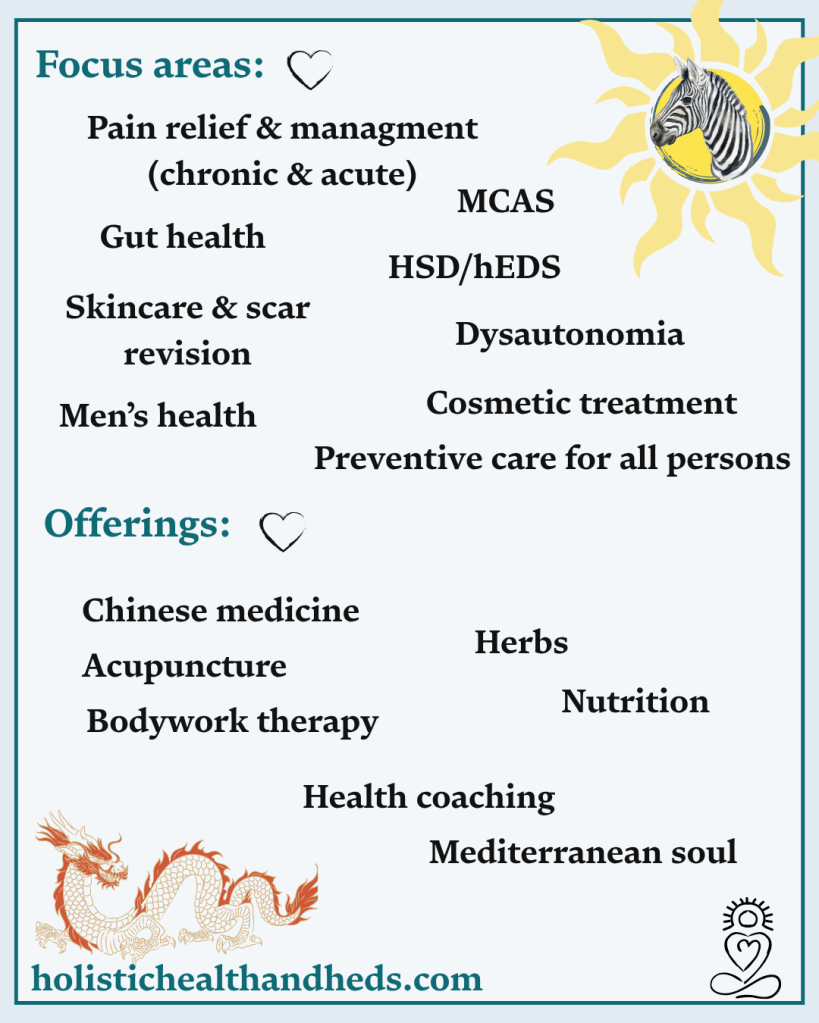
Dr. Bruno’s specialties as a Chinese medicine practitioner include: • Musculoskeletal health (acute or chronic pain relief; Ehlers Danlos syndrome & hypermobility support) • Digestive support, gut health, and weight loss • Aesthetic treatment, including scar revision • Men’s health • General preventative care and wellness support for all persons.
She is the author of Chinese Medicine and the Management of Hypermobile Ehlers Danlos Syndrome: A Practitioner’s Guide.
When you are ready to discover what traditional medicine plus a vibrant and engaged approach to holistic health can do for you, either contact Dr. Bruno or book an appointment online.
*****
*****
Two Hearts Wellness/Holistic Health & hEDS does not accept paid advertising on this website and only relies on strictly necessary cookies. All our copy is generated by human effort (there is no AI slop here!)
Note: Material on this web site site is not intended to diagnose, prevent, treat, or cure any disease, illness, or ailment. A Chinese medicine practitioner in Texas identifies syndrome patterns but does not diagnose illness. Material on this web site does not purport to identify syndrome patterns.
*****
 Holistic Health and hEDS