*****
Nothing is ever simple when it comes to complex chronic conditions like hypermobile Ehlers-Danlos syndrome, especially when the common comorbids–MCAS, and/or POTS–are also muddying the water. From managing your range of symptoms to trying to get a diagnosis (if you want one) to trying to put together a program to manage your condition(s), you have a lot going on and it never seems to end. Being chronically ill makes it nearly impossible to enjoy a simple, no-fuss life.
And what about the gap between healing and finding a cure? I think that here, if we ponder it, is a space for simplicity. It might not seem that way, but it can be that way when we focus on meaning.
What do these terms mean to you?
A cure is the easier concept. The problem is resolved. You have something that can be resolved by biomedicine or lifestyle change or Chinese medicine, just to cite three options. There is a beginning and there is an end to the endeavor. Maybe you have an ear infection so you get an antibiotic and then it’s gone. Maybe you are plagued with insomnia but you dedicate a good bit of intention to sleep hygiene, working through any emotional issues, and turning off the computer or your phone by 6:00 p.m. so that finally, you become an easy sleeper and your insomnia is gone. Or you struggle with slow digestion and you get the right Chinese herbs and a short series of abdominal tui na sessions and the problem is solved.
Specific issues that can be fixed and forgotten are cured, in essence.
I think that we are, a lot of the time, sold the idea that a cure is the only truly worthy outcome. Whenever there’s a new genetic finding I notice on social media how some will say, “Maybe they’ll find a cure!” Honestly, I don’t think that EDS will ever be curable. Instead, I believe that healing can be an equally worthy goal that takes into consideration both scientific advances and the power of the individual to chart their path and find ways to coax out their strengths.
*****

*****
Popular idioms will refer to healing journeys and healing paths. Whether that sounds groovy to you or not, these terms make sense. Every step we take–every intentional step we take–towards becoming healthier is a hero’s journey, and the hero is you.
A lot of it comes back to mindset but, before I write something that might make you think I’m spreading toxic positivity (I’m not, I promise!) I want to share a personal story about a recent injury I sustained.
Note: I take good care of myself, and some of the time, things are great and others, less great. My own hypermobility is fairly contained now. I know how it manifests, I know what to do when it becomes problematic, and I know how to avoid a lot of issues. This is all due to knowing my own body and to being a practitioner of Chinese medicine who treats HSD/hEDS. This is a topic I know very, very well. The MCAS, on the other hand, can get out of control at times but with this, too, I generally tend to manage it well.
So about two and a half months ago, I fell. You know those round seats with wheels that usually are at the head of massage tables at your acupuncturist’s (or at your massage therapist’s) office? At my office (though thankfully not when I was with a patient), I shoved one of those chairs with my foot to move it out of my way and I lost control of my balance. I was having a hyper-flexible day and I just did the splits, basically. As I went down, I rolled to try to protect my “bad” knee (this is the one that slips) and fell hard on my hip instead. Naturally, I jumped right up and pretended nothing was wrong, kind of the way a cat does when they fall off a table. This was a bad choice. My balance was left so off-kilter that a few days later, I lost my balance and fell up the cement stairs going up to my home. This was a hard fall, too, hard enough to rip the knee of my pants and leave me bleeding and bruised.
Yes, like any normal hypermobile person, I can easily fall up the stairs.
The long story short (you know where this is going) is that I finally had no option other than to face that I had genuinely injured myself. From my muscles that became tight and hard like iron rods to my sinews that were now alternating between being suddenly very loose to becoming tight and feeling like they were fraying and about to break, I was injured. Painsomnia? Oh, yes, lots of that. Limping? Yes, with every step. Being unable to eat and losing thirty pounds in eight weeks because I have no appetite (who can eat when you’re in agony all the time?), yes. And so forth. I had periods where I genuinely thought a wheelchair was going to be in my near future and lots of time to ponder whether being cured of this affliction should be my goal or would I do better to focus on healing, step by step.
Of course, I chose healing because too many factors involved are, in fact, incurable. There are a lot of lessons for me to learn from my injuries and I’m not entirely convinced I’ll be the same person when they’re resolved that I was before I acquired them. At the time of writing this blog post, I am still deep in a very slow healing cycle and no, I don’t know where this will all end. But I choose to move forward and I do, even if on any given day I may improve only a tiny, tiny bit. It’s a choice to not give in to despair.
But what does this mean? For me, for you, for anyone with a serious injury and/or a truly difficult hEDS presentation…what does this mean?
*****
*****
Healing is a process and it requires choice and intent
Cured of all ills would be nice, but that’s not how these things go. Instead, maybe deciding to focus on what one does today in hopes of a better tomorrow is a worthy option. Is it possible to sit down and think of a few small things to do to improve your wellbeing? How about committing to rest (real rest, without guilt or shame) and some very gentle breath and movement each and every day? We can’t all stretch or pop on over to the gym to build muscle, but everything from water aerobics (gentle water aerobics), tai chi or qigong, or even chair yoga are all good options.
It’s really hard to keep one’s hope up when the pain seems endless and any sense of getting better appears to be out of reach. I think it must be like becoming sober after addiction, though: my understanding is that every day, the person chooses to remain sober. Being sober and healthy doesn’t just fall out of the sky because the person wants it; instead, they choose. Same goes for healing. Every day there is an opportunity to choose. And if this seems impossible, then pick one tiny thing that may help you and stop there. Small actions build over time and Rome was not built in a day.
*****
*****
Healing calls for a plan and some strategizing, but it also needs a bit of wiggle room
I’m definitely a planner. I make plans for patients who come to see me for Chinese medicine and I make plans for clients who work with me in a health coaching context. I make plans for myself, too.
I no longer offer personal training or yoga teaching (both certificates I still maintain) but I do include breath and movement into my treatment strategies when appropriate. Aside from being a practitioner of Chinese medicine I am also a health coach and consultant. All of my certificates and my license give me a wide range of options for both myself and my patients and clients. In my first career, I was a Spanish professor. Anyone reading this blog post who teaches will know that strategy and planning make for a great semester and the same can be said for creating a blueprint for a health journey.
Healing does require strategizing and planning, true. But you also need to leave a cushion of space for days when you’re flaring and just can’t complete your plan. And what if you have a great day and want to do something different that is not on the schedule?
How about this? Healing means to become whole and you can’t do that without self-awareness and self-compassion. Maybe today is the day to rest a little more and do a little less. It could be that today you could push yourself a bit. Learning how to listen to yourself and actually hear your mind and body’s message is a healing action.
And yes, you do indeed deserve self-care.
*****
*****
Healing asks of us that we listen to ourselves, lovingly and with compassion
Yes. Self-compassion is key and the practice of listening and hearing is perhaps lifelong in the learning. I work on this with patients and clients (and I work on this myself, too, actually). Someone who comes to me for Chinese medicine will be given some options and the chance to say yes or no. If a person isn’t in the right frame of mind for acupuncture, we have manual therapy instead. If they want LED light therapy one day and at the next appointment, no, then the answer is no. Again, the years of teaching reveal themselves in my health coaching too. Clients get options.
And all the while, the end-goal is to learn that yes, you do have choices in the matter. There is an element of control over your wellbeing. Everyone has their strengths. Everyone has their point of entry that brings them forward in their healing journey. This can mean achieving a form of radical acceptance of what is combined with healing the grief a person may feel when they acknowledge that pain is always going to be there and life must shift to accommodate it. Other times, it’s plugging along and focusing on possibilities, realistic or otherwise. We can’t choose to not be chronically ill or in pain but we can decide how we are going to face things.
It’s really tough to live with complex chronic illness and I think a lot of people in this world don’t understand just how challenging it is. Your version of becoming whole is your own; what healing means to someone with chronic pain is different than what someone with pain and MCAS and dysautonomia and… and… and… is going to experience. We all have our journeys and it’s not a competition. No one of us is any more virtuous than the one next to them and we all are learners who deserve patience and kindness. Healing takes many different forms, and yours is unique to you.
All you need to do today is choose.
*****
*****

Dr. Paula Bruno, Ph.D., L.Ac., is a licensed acupuncturist and herbalist, an AOBTA-CP traditional Chinese bodywork therapist, an author, and a health coach. She maintains an active and growing practice at Two Hearts Wellness, her Austin, TX office. Dr. Bruno is also available for distance appointments for wellness consultation or coaching.
In her first career, she was a Spanish professor.
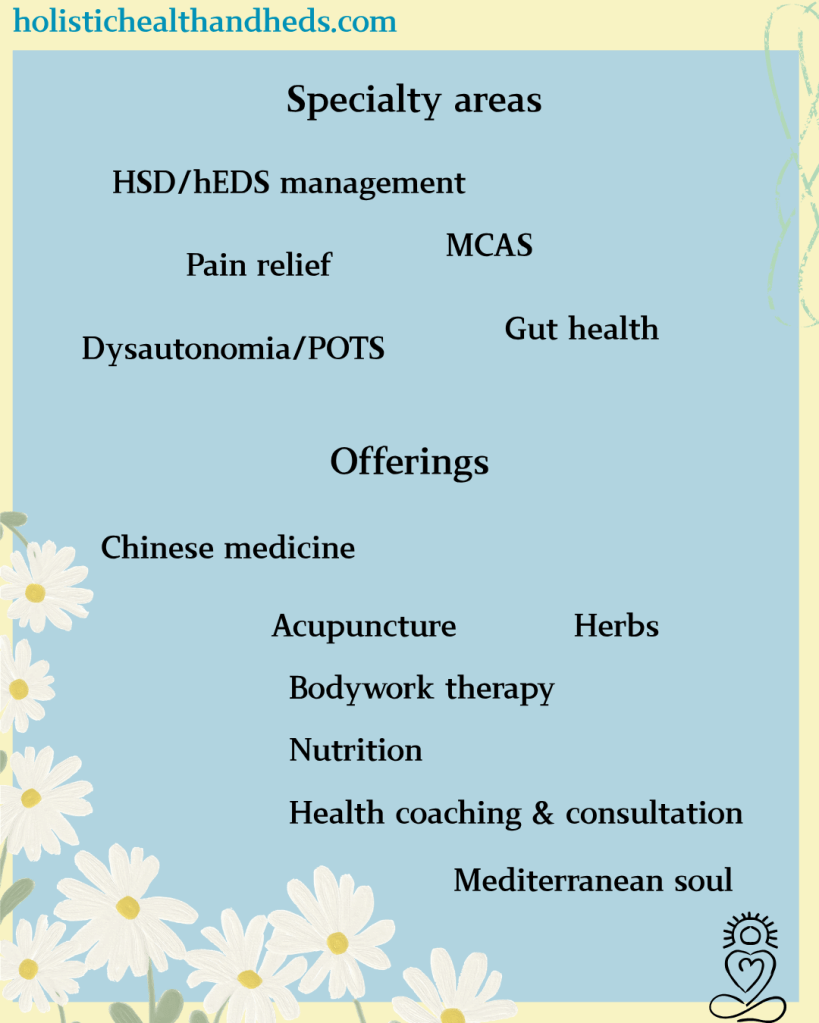
Dr. Bruno’s specialties as a Chinese medicine practitioner include: • Musculoskeletal health (acute or chronic pain relief; Ehlers Danlos syndrome & hypermobility support) • Digestive support, gut health, and weight loss • Aesthetic treatment, including scar revision • Men’s health • General preventative care and wellness support for all persons.
She is the author of Chinese Medicine and the Management of Hypermobile Ehlers Danlos Syndrome: A Practitioner’s Guide.
When you are ready to discover what traditional medicine plus a vibrant and engaged approach to holistic health can do for you, either contact Dr. Bruno or book an appointment online.
*****
*****
Two Hearts Wellness/Holistic Health & hEDS does not accept paid advertising on this website and only relies on strictly necessary cookies.
Note: Material on this web site site is not intended to diagnose, prevent, treat, or cure any disease, illness, or ailment. A Chinese medicine practitioner in Texas identifies syndrome patterns but does not diagnose illness. Material on this web site does not purport to identify syndrome patterns.
*****

