We all know this, but there is a wide range of exercise ability within the hypermobile Ehlers-Danlos syndrome community. Some people are able to exercise and participate in various sporting activities. Others, and I would venture that this describes many of us, have a harder time creating and sustaining a movement practice. To this segment of the population, I say: gentle is the way, and this blog post is for you.
One of the ways I describe hEDS in soundbite form for normies, for example, is to say “Hypermobile Ehlers-Danlos syndrome on a broad scale: If you’re lucky, you get a job at Cirque du Soleil and make a good living out of being hypermobile… if you’re like most, though, then maybe you roll over in bed and your ribs pop out or you have a knee that constantly slips out of place, just to cite two examples.” And it’s true, if you ponder it. There are people who are able to use what they’re born with to excel in careers of this nature. Meantime, there are a lot of people who are in no way capable of that sort of activity.
That doesn’t mean you are exempt from moving your body or from benefitting from gentle, consistent practice. Just because you can’t perform cool and interesting acrobatic actions doesn’t mean that there is nothing left for you.
How about trying some forgiving, doable, and regular actions? This is possible for any of us, even if a person has to start with simple visualization and breathwork.
*****
*****
No movement leads to worsening pain and stiffness
True fact: if you don’t move, you only become weaker and/or stiffer. But what if it hurts to move, or what if you are scared to move because you really cannot trust your joints to stay together? I wish I could say something different but … real talk: lack of movement leads to increased stiffness and/or weakness.
I understand not wanting to move when you’re in pain, though. In a recent blog post, I mentioned that I had injured myself and described just how serious things were:
“From my muscles that became tight and hard like iron rods to my sinews that were now alternating between being suddenly very loose to becoming tight and feeling like they were fraying and about to break, I was injured. Painsomnia? Oh, yes, lots of that. Limping? Yes, with every step. Being unable to eat and losing thirty pounds in eight weeks because I have no appetite (who can eat when you’re in agony all the time?), yes. And so forth. I had periods where I genuinely thought a wheelchair was going to be in my near future…”
—Healed vs. Cured: A Not-So-Simple Life
One of the more humbling lessons I got out of this experience (mind you, I’m still recovering from it) is that (a) lying around in bed with my heating pad felt great in the moment and no, I really didn’t want to move and (b) when I didn’t move, I paid dearly for it in terms of stiffness and weakness.
*****
*****
No movement is a metaphor for stuck-ness
There’s an odd vibe to doing nothing when you’re in pain. It feels like giving up, for one thing. And it feels like acting out the role of being stuck. It feeds into the freeze choice between fight, flee, freeze, or fawn. It keeps you in one place.
Can you wiggle your toes? Are you able to tap your fingertips gently together? Well, that’s movement. What about walking peacefully in a circle in your living room? Simply getting up and doing something, or–if you can’t get up–doing something simple yet mindful is good enough. Especially for people who are substantively disabled by their EDS presentation, there is no reason to be hard on yourself. But if there is a way to gently move, even if it’s as small a practice as wiggling your toes, then give yourself some credit for breaking a pattern of being stuck.
Even five minutes a day of tai chi is a meaningful accomplishment if this is a new thing for you.
There’s no reason to overdo things and you definitely don’t want to get hurt. Only you know what’s going on with your health. It can be a really good idea to speak to your doctor before starting, or you might see about having a PT appointment or two if you need guidance and the help of a professional. Once your doctor has cleared you, though? Start slow and be gentle. Give yourself credit for trying. Keep going.
You can do it.
*****
*****
No muscle leads to increased instability
Building muscle takes some effort but it is worth every bit of energy that you put into it. Muscles can keep you stable. The tendons and the ligaments might not be able to do their job but muscle can stabilize you in their stead. Speaking for myself, I pretty much grew up in the gym and up until the COVID shutdown interrupted so many things, I remained muscular. In the past four-five years though, I let myself go.
Big mistake. Now, in addition to working on lingering pain and stiffness, I also need to gain back some muscle. What about you? And did you know that it is possible to be gentle with yourself while adding muscle? If you’re a complete newbie to exercise, it probably is in your better interest to start with a PT or, at the very least, an EDS-aware personal trainer. But once you are cleared to do some strength training and you have the right support system, then why wait?
I used to work in the weight room during my first graduate program. I loved introducing people to the joys of the gym and the power of working out with weights. At the same time, I always, always, always counselled people to start at a level that didn’t injure them. Gentle consistency until you know your body and your limits in the weight room is the way to go. Same here with starting a program when you live with hEDS: gentle and consistent, and one of your goals may be to learn how to enjoy what you’re doing. It doesn’t even need to be weights at the gym. Bodyweight in your own home is quite sufficient indeed.
*****
*****
Moving slowly to go fast
Be kind to yourself. Start gently. Chair yoga or swimming or tai chi can all be great options. Did you know that Nicola, the owner of Earth Balance Tai Chi, has hEDS? She’s a great resource for gentle movement that can become challenging or forgiving as needed. You do have options:
“[Question]: What would you like readers of this blog post to know about you, and about your views on tai chi for people with EDS?
—Traveling With Hope: An Interview With Nicola of Earth Balance Tai Chi
[Answer]: That I am just an average Joe, who lives with EDS and happens to have spent 19 years as a Tai Chi, Qigong and Taoist meditation student. Like me, anyone out there can become proactive in their health management, can learn new skills, can re-wire their bodies through exercise, can build a self-care tool kit, and improve their quality of physical life and mental wellbeing. Most importantly anyone can learn skills to down regulate and self-regulate stress. To soften when faced with adversity, to live gracefully through ebb and flow, and learn the gentle power of the absence of resistance.
Aside from not wanting to be stiffer and/or suffer more pain, there are a lot of reasons to start a movement practice. But keep that key word in mind: gentle. Be gentle with yourself. Be gentle in your movement. Be gentle to your soft and vulnerable places, including the ones in your heart.
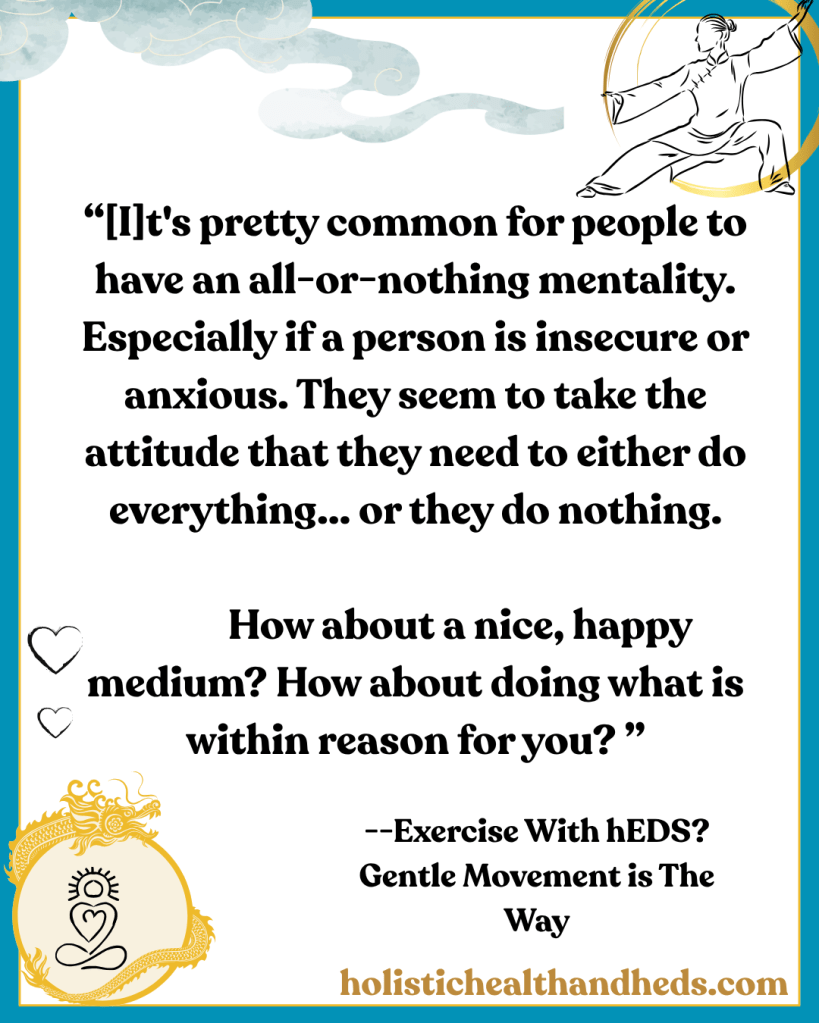
Since I mentioned my years working in a weight room, I will also say this: it’s pretty common for people to have an all-or-nothing mentality. Especially if a person is insecure or anxious. They seem to take the attitude that they need to either do everything… or they do nothing.
How about a nice, happy medium? How about doing what is within reason for you? Find your why, first of all. Movement juices your fascia and when we live with hEDS, healthy fascia is definitely important. As discussed, it can help you to build muscle. And what about proprioception? If you are one who constantly bangs your arm into doorways (that’s me, alright, I confess) or otherwise are lacking in a good sense of where your body is in space, then movement can help with that. Safe, healthy movement is a way to regain confidence, too.
Where would you like to begin?
*****
*****

Dr. Paula Bruno, Ph.D., L.Ac., is a licensed acupuncturist and herbalist, an AOBTA-CP traditional Chinese bodywork therapist, an author, and a health coach. She maintains an active and growing practice at Two Hearts Wellness, her Austin, TX office. Dr. Bruno is also available for distance appointments for wellness consultation or coaching.
In her first career, she was a Spanish professor.
Dr. Bruno’s specialties as a Chinese medicine practitioner include: • Musculoskeletal health (acute or chronic pain relief; Ehlers Danlos syndrome & hypermobility support) • Digestive support, gut health, and weight loss • Aesthetic treatment, including scar revision • Men’s health • General preventative care and wellness support for all persons.
She is the author of Chinese Medicine and the Management of Hypermobile Ehlers Danlos Syndrome: A Practitioner’s Guide.
When you are ready to discover what traditional medicine plus a vibrant and engaged approach to holistic health can do for you, either contact Dr. Bruno or book an appointment online.
*****
*****
Two Hearts Wellness/Holistic Health & hEDS does not accept paid advertising on this website and only relies on strictly necessary cookies. All our copy is generated by human effort (there is no AI slop here!)
Note: Material on this web site site is not intended to diagnose, prevent, treat, or cure any disease, illness, or ailment. A Chinese medicine practitioner in Texas identifies syndrome patterns but does not diagnose illness. Material on this web site does not purport to identify syndrome patterns.
*****

