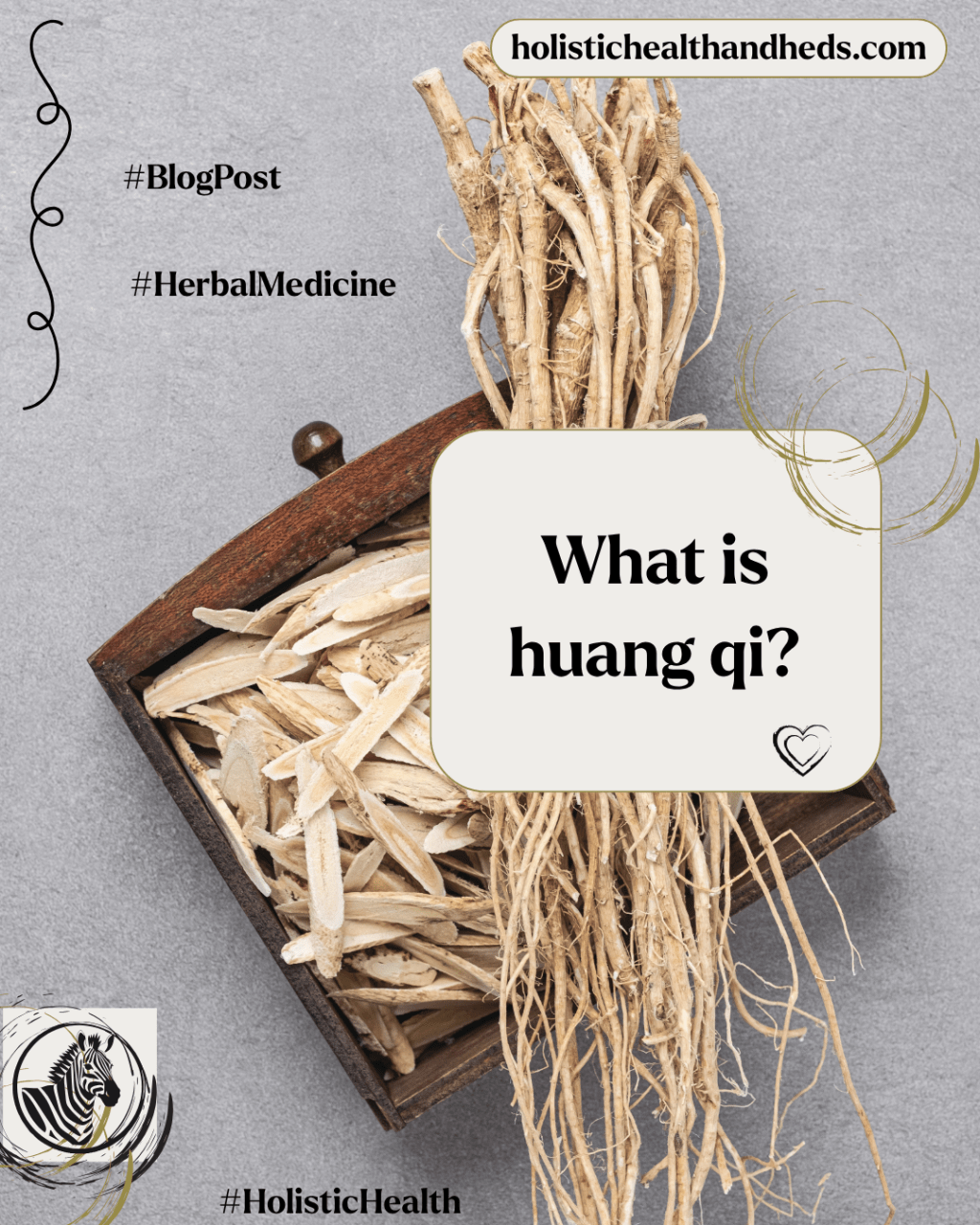
Astragalus… you may have heard of it. If you have EDS and/or MCAS and are familiar with the supplement options popular within the community, you probably have tried it too. Astragalus grows in China, Mongolia, and North Korea and is a beloved herb in Asian tradition. Its Chinese name is huángqi (alternate spelling: huáng qí, with or without the tone marks). Since I am a practitioner of Chinese medicine I use huang qi or, if I’m feeling fancy, huáng qí.
In this blog post, I hope to introduce the marvels of this particular herbal treasure and I also want to share a little bit about the role of herbs in Chinese medicine on a broader scale. As you will see, there is a whole cultural facet to herbal medicine that, if you consider it, may make you look at your supplements with greater respect (or inspire you to explore Chinese herbal medicine and maybe even try it).
Botanical and chemical details about this plant
Astragalus is a member of the fabaceae, or legume, pea, or bean family. This is the large and varied plant line of flowering plants that includes everything from trees to shrubs to herbaceous plants. Astragalus is one of the five largest genera from this family and there are some 3,000 different species within this lineage. When referring to huang qi, we are referencing the versions that are common in Asia, namely: Astragalus membranaceus, propinquus, and mongholicus. In this manifestation, the plant’s use as a medicinal and a cooking herb have deep roots in Asian culture.
I am not a chemist, but it’s still interesting to know how things are made, and what–as a consequence–they do.
The short version, then: Astragalus consists of polysaccharides, which are a class of biomolecules consisting of long chains of carbohydrate molecules made up of numerous monosaccharides. Starch, glycogen, and cellulose are examples of polysaccharides. They are a source of energy in animal cells and, in plant cells, they help to provide structure. A significant component of astragalus are triterpenoid saponins, which are plant compounds with immune-modulating, anti-inflammatory, antiviral, and anticancer effects. Another of the herb’s main constituents are flavonoids, which are similar in their antioxidant effects to the aforementioned triterpenoid saponins.
*****
*****
What can huang qi do for people with hEDS or MCAS?
Huang qi is an adaptogenic herb. Well-known adaptogens include holy basil and ginseng, and these are the herbs that can help to balance your system, either by boosting or soothing internal processes, depending upon what your body needs. Their function is to restore homeostasis or, when we are speaking about Chinese medicine, to restore and maintain the right balance of yin and yang. Huang qi is used to treat fatigue, chronic illness, and a weak immune system. It’s also used to resolve prolapse, among several other common conditions that people with EDS experience, and it can be an excellent resource for people with MCAS due to its function as a mast cell stabilizer.
Any internet search shows a fairly basic description of huang qi when it’s being introduced as astragalus for folks who are hypermobile and/or hypersensitive. Most times, there is at least some mention of TCM (traditional Chinese medicine), but–unless you go looking for it–popular culture blog posts don’t often go into the significance or history of Chinese herbal medicine. This is a shame, because the meaning and role of herbal medicine within the trajectory of Chinese healing practices is tremendous.
I will return to the subject of what this herb can do for EDS and MCAS in a second. First, though, I want to share its origin as a Chinese herb.
*****
*****
Chinese herbal medicine is a cultural treasure
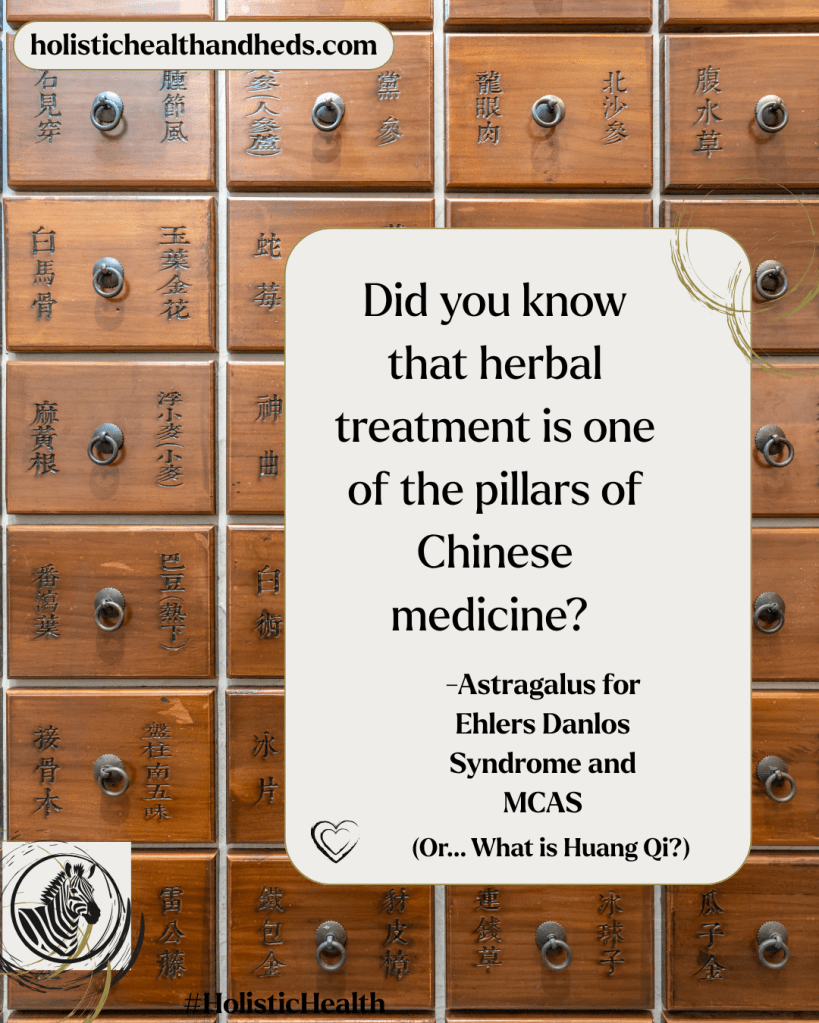
Did you know that herbal treatment is one of the pillars of Chinese medicine? People often equate acupuncture with the whole of the tradition, but that is an incomplete picture of what you might experience at your acupuncturist’s office. The pillars of this medicine include acupuncture, tai chi, nutrition, herbal medicine and manual therapy, or tui na (pronounced “twee nah”). Herbal medicine, for its part, is venerated in China in a way that we don’t always necessarily understand or recognize in the US.
If you’d like to discover more about what Chinese medicine has to offer, then don’t skip this footnote.1
The legend surrounding how this medicine came to be in China has deep roots, starting with the mythology surrounding Shennong, or the Divine Farmer, who is said to have brought herbal knowledge and farming to China four thousand years ago. He is named as the author of the Shén Nóng Běncǎo Jīng: The Divine Farmer’s Class of Materia Medica but, since his legend does precede written history, the authorship of this treasure is unknown.
Each entry in this compendium teaches us about what was important, health-wise, back in the days of its origin, and the following, regarding huang qi, is instructive:
Huángqí: “Yellow attainment” — Treats welling- and flat-abscesses and chronic putrefying sores; pushes out pus and stops pains; [treats] great wind lài leprosy; the five [kinds of] Hemorrhoids, and Rat Fistulas; supplements emptiness; and [treats] the hundred diseases of small children. Grows in mountain valleys.”
Shén Nóng Běncǎo Jīng: The Divine Farmer’s Class of Materia Medica, p 2322
I do not know what a rat fistula is, although I imagine the use here is a metaphor or somehow poetic. Either way, this description carries in it the seeds of what we might use huang qi for today. In sum: huang qi is anti-inflammatory, it is a staple herb for prolapse, and it supports immune function. This is noteworthy for any of us with MCAS, as huang qi is a natural antihistamine that can affect inflammatory mediators (histamine and cytokines) and help to restore gut health too.
Whatever the story you give it, huang qi was a valued herb then and it is a treasure to this day. I would urge you, dear reader, to also keep in mind its origin and cultural worth. When we live with chronic conditions, we often “try everything.” Many of us begin with over-the-counter drugs, then we move on to Pharma prescriptions, and when the adverse event history becomes overwhelming, we try supplements and herbs and any number of diets and programs. This makes sense, if you ponder it. I mean…what else are you going to do if you live with chronic pain, joint instability, slow digestion, and/or hyper-reaction to all-the-things?
But herbal medicine, of all the things that one might try, is the option with a spirit of its own. I do not think that OTC antihistamines or prescription drugs have soul (although I suppose that if you are a historian of drug development you might see something that I’m missing here). Remedies that are directly plucked from the earth and a part of cultural and family history, on the other hand, have soul. Plant medicine has a long and storied history world-wide has soul. And heart, too, if you ponder it.
For those of us with chronic conditions, it may be useful to consider how we benefit from plant medicine and to think about where it fits within our healthcare programs. Maybe what’s missing is that element of soul, or that element of knowing that the herbs you are taking have a treasured place in their culture of origin. What do you think?
Working with a licensed practitioner of Chinese medicine
If you want to try huang qi, you might consider working with a licensed acupuncturist and herbalist. One thing is to pick up a bottle of Astragalus at your chiro’s office when you’re there for your dry needling appointment. Another is to add it to the list of supps your naturopath has assigned to you. Or perhaps you heard about it online so you buy a bottle of whatever is recommended and hope for the best. And maybe that will be enough. This is such a good herb, and one that could (if taken correctly and for the right reasons) resolve your issues and move you forward on your healing path.
And yet… huang qi can do so much more when correctly prescribed by someone with the knowledge base of a trained professional, someone who knows the full worth of this herb. Culture counts, you know.
*****
*****
Culture and history bring herbs to life, I think…
In addition to my practice in Chinese medicine I also offer health coaching services. I’m not really your typical health coach who promises that you will lose twenty pounds in a short period of time. I’m the one you work with with you want to genuinely learn, either about your own self or about health topics in general. Some of my health coaching clients want to read, others do not. Either is fine by me, but I want to share a specific coaching memory because it illuminates my point regarding the cultural value of herbal medicine.
I once had a health coaching client, a young Black man, who wanted to learn about both Chinese medicine and about his own history. Since I was a Spanish professor in my first career, I proposed that we each find a book that reflected our interest and/or knowledge base, and we’d read both choices and discuss them during our sessions. I am a peninsularist but I selected a history of Afro-Caribbean medicine, The Experiential Caribbean: Creating Knowledge and Healing in the Early Modern Atlantic by Pablo F. Gómez. My client decided that he wanted us to read Michelle Elizabeth Lee’s Working The Roots: Over 400 Years of Traditional African American Healing.
I love to teach anything related to my own Mediterranean culture3 but here, it was a greater joy to introduce a Black American client to Afro-Caribbean history and healing. It was truly affirming for this young man to learn about the way Black people across the United States used herbs too. Each region is different and expressive of history and heart. What the Gullah Geechee people did is different from the practices of cultural groups with close ties to Native American neighbors, and this is different than what emerged from being near Mexico on the border regions. And so forth.
The outcome of these readings and the subsequent discussion made learning about his own health practices, with or without Chinese herbs, that much more rich and textured. Herbal medicine reflects the heart and soul of communities world over and in so very many ways.
Health does not have to be doled out via prescription drugs assigned by allopathic physicians, grudgingly covered by insurance, and packaged in plastic bottles with dosage instructions and number of refills on the label. There is more to medicine than Pharma drugs, and sometimes, the medicine handed down over centuries is the better choice. Not always, not always. But if you know what is available and why something has stood the test of time, then you have options. And options are important when we live with complex, chronic illness.
*****
*****
Just going to say this one more time
Herbs are rich, rich resources. They don’t just heal you. They also teach you about people and culture and creativity. (Since I’m here… another book that I love for its beautiful survey of global practices is Holly Bellebuono’s Women Healers of the World: The Traditions, History, and Geography of Herbal Medicine).
You do not need to read a long list of books to get the benefit of taking huang qi, but if you are interested…there is a lot to learn about herbs, either Chinese in particular or on a broad scale that maybe centers your own cultural history. When you look at the history and legends surrounding herbal medicine, it can open new vistas and create a relationship with the healing process that I just don’t see in something that is mindlessly picked up at the drug store or purchased online at the recommendation of an influencer.
And yes, I am biased, but I will repeat: I do feel that it is best to try huang qi under the direction of a licensed practitioner of Chinese medicine. We are taught to combine herbs and there are synergies and relationships between what we give you that can enhance the benefits of huang qi on its own. We can mix powders or raw herbs and create formulas specific, and I do mean very specific, to precisely where you are and what you need. We know when to give you something else, too. Huang qi might not be the best for people with autoimmune conditions, for example, but we can support you with correct dosage or other options. We also know the soul, the heart, and the history of the herbs, and that should mean something… don’t you think so?
Huang qi is a beloved herb that has been around for centuries for good reason. It works with you, as an adaptogen, and it addresses issues that are common to hEDS and MCAS presentations, from prolapse to histamine sensitivity and/or mast cell hyperactivity, to gut health, and more. Huang qi, when used correctly, is a treasure.
Are you interested in learning more about huang qi, and would you like to try it as part of your health practice?
*****
*****

Dr. Paula Bruno, Ph.D., L.Ac., is a licensed acupuncturist and herbalist, an AOBTA-CP traditional Chinese bodywork therapist, an author, and a health coach. She maintains an active and growing practice at Two Hearts Wellness, her Austin, TX office. Dr. Bruno is also available for distance appointments for wellness consultation or coaching.
In her first career, she was a Spanish professor.
Dr. Bruno’s specialties as a Chinese medicine practitioner include: • Musculoskeletal health (acute or chronic pain relief; Ehlers Danlos syndrome & hypermobility support) • Digestive support, gut health, and weight loss • Aesthetic treatment, including scar revision • Men’s health • General preventative care and wellness support for all persons.
She is the author of Chinese Medicine and the Management of Hypermobile Ehlers Danlos Syndrome: A Practitioner’s Guide.
When you are ready to discover what traditional medicine plus a vibrant and engaged approach to holistic health can do for you, either contact Dr. Bruno or book an appointment online.
*****
Two Hearts Wellness/Holistic Health & hEDS does not accept paid advertising on this website
Note: Material on this web site site is not intended to diagnose, prevent, treat, or cure any disease, illness, or ailment. A Chinese medicine practitioner in Texas identifies syndrome patterns but does not diagnose illness. Material on this web site does not purport to identify syndrome patterns.
*****
*****
- If you are interested in discovering the many resources that Chinese medicine can offer you then then please do explore this blog. Some especially pertinent essays include ““Ehlers-Danlos Syndrome, Tui Na, and You” Revisited (Some Thoughts on the OG Blog Post)” and “Acupuncture & EDS: How to Find a Practitioner of Chinese Medicine When You’re a Zebra.” If you’d like to explore the benefits of tai chi and qigong, take a look at my interview of Nicola, the owner of Earth Balance Tai Chi, who has hEDS and who offers online and on-demand classes geared towards people with chronic pain and hypermobility (“Traveling With Hope: An Interview With Nicola of Earth Balance Tai Chi“). ↩︎
- You can find this excellent translation by Sabine Wilms at her website for Happy Goat Productions. ↩︎
- Spain and southern Italy both have deep connections with their respective Arabic pasts and any history of the medieval period will center it. For a fascinating book on the subject of medicine prevalent in the region, see Zohar Amar and Efraim Lev’s Arabian Drugs in Early Medieval Mediterranean Medicine.) ↩︎
 Holistic Health and hEDS