There are rumblings in the Ehlers-Danlos syndromes community. Change is coming. Big change: the EDS Society is publishing updated diagnostic criteria for all versions of EDS in December of 2026. This also includes shifts to how hypermobility spectrum disorder (HSD) and hEDS are assessed and categorized. Early in 2027, the EDS Society’s update will be followed by treatment and management guidelines. Yes, indeed. There is a lot going on and much to think about if you are hypermobile.
I have a lot of thoughts about this development. Some of them relate to my book, Chinese Medicine and the Management of Hypermobile Ehlers-Danlos Syndrome (Singing Dragon, 2023) and many are contingent on my own personal and professional experiences with HSD/hEDS and MCAS. Most of what I’m thinking is shaped by my first career as a Spanish professor though. I am a literature PhD and my scholarly focus was national trauma (civil war, dictatorship, genocide, and torture) and how this kind of big-picture, collective trauma then filters through art and literature. An academic career like mine required the skills and approach of a medical historian to go along with my literary interests.
In my current career as a practitioner of Chinese medicine, especially as I observe the rollout of the upcoming changes, I most certainly do draw from my academic background.
From legal definitions to medical outcomes and cultural shifts, there are multiple factors that come together to create a narrative surrounding what happens and what it means to reconcile complex national trauma. Language and culture change when being disappeared into torture prisons becomes a normalized threat, and can a survivor of torture ever really communicate what happened and what it was like? How? How do the arts shift when a dictator settles in for a long, painful reign of terror? The ways in which a community begins to stitch itself back together after a civil war or when a dictator is finally toppled comes out in the stories and pictures and laws and medical protocols too.
I treated my first EDS patient over a decade ago and, back then, there wasn’t a lot of useful information readily available. I had to, as they say, do my own research. It helped that I came to Chinese medicine after two solid decades of studying my scholarly specialty.
And what about health narratives?
Language and culture change when a pandemic like COVID hits, leaving behind in its wake dysautonomia and MCAS (among the many things we see in post-COVID syndromes). How do we adjust when environmental damage, mold toxicity, and/or battle with post-Lyme disease settles in for their respective reigns of terror? We come together around a newly-discovered gene, but what happens when a person doesn’t fit with the new criteria even though they are non-functional without ongoing medical care? Same-same, just like with national trauma: there’s a collective experience in health and healthcare and the narrative is created, accepted, and perpetuated on the broad scale… and then there is what happens person by person.
To be quite honest, I’m feeling a little uneasy about the way this is all going.
I was largely ignoring the rumblings (to be honest) and then I saw the generic press release being shared by influencers and not credited to the EDS Society. It really bothered me. The first time I saw the turgid blurb in one of my online EDS groups I thought: AI slop. Not a day later, I saw the exact same copy, this time shared by a relatively well-known EDS influencer (I’m not mentioning names) and thought: AI slop that has to be a press release or a canned blog post that is being widely sold to influencers. I asked, and one of the mods in one of my groups confirmed that this was a press release (I’ve shared it here in the footnote).1
I’m not sure why an influencer would share it without attribution. I mean, if enough of them do it, it’s impossible to keep up the pretense that it is original content which I guess could be problematic if “authenticity” (*cough*) is the goal of the communiqué. And I think that is the goal, too, given that they’re selling their new definition of EDS like it’s a new album, one that the plebes might not necessarily understand. But not to worry, they promise, because: “We’ll break it down properly when it drops in December.”
Hm.
EDS patients are some of the most self-directed, willing-to-do-their-research patients groups I’ve ever seen. Let’s get real here. Also… Hashtag fact: most of my patients know more about EDS than their PCP does, so what the EDS Society is going to comfortingly explain when their report “drops” should be interesting.
Mind you: I have been observing the way the EDS narrative has been messaged and massaged over the past decade and a half and the trajectory is definitely worth tracing. And now? Now, no matter how you look at things or whatever your filters are, we are very much in the midst of a narrative shift and I think it’s crucial to be aware of it in real time.
*****
*****
When I was a professor, I used to say that I was not here to teach people what to think but, instead, ways to think. My origins are in comparative literature and even though my Ph.D. was awarded through the Department of Spanish and Portuguese at IU Bloomington, I ended up earning two master’s degrees while in my first graduate program (one in Italian and the other in Spanish) and, along with the PhD from Spanish, two Ph.D. minors (Italian and Art History). I see the world through the lens of comparison. Critical thinking, in my estimation, does not look for one option but, instead, the many options one can unearth via judicial comparison.
Definitive outcomes and outlines tend to put me off, to be honest. And this is not just my scholarly perspective. On a human level, I do think that some people will be quite pleased by the new guidelines and others will be devastated.
Whatever one’s reaction is, this is a moment to reflect on how each one of us views our condition(s) and what, as a result, we feel that we need from our medical care providers and our support system(s). There is the issue of diagnosis and what that means. And what about gaslighting and gaps in medical knowledge? Finally, there is the matter of how we create knowledge. Who gets to decide what is valid and what is not? Whose voice carries the narrative? What happens after a narrative is constructed? Who gate-keeps this narrative? And so forth. There is a lot to ponder here, no doubt about it.
My call to action to my reading public (aka you, dear reader) is to remind you that you have more power than you might think. There actually are resources out there. One of them being, of course, the online communities where so many find fellowship and useful health information. Yes, AI has encroached upon us all, and no, you can’t trust everything you read. But you can learn a lot, and you can then follow up with some of your own research. And if you graze widely in your quest for knowledge, more the better.
This blog post was originally going to only be about building a reading list (the focus of chapter six of my book and reiterated in the post “Creating an EDS Bookshelf: Must-Have Reading for Savvy Zebras“). Then I read that press release and now I have my thoughts. And yes, there is a connection between the original plan and the newly-inspired essay you are now reading, though yes, it does meander.
The most important thought being (after: build yourself a good home library) is that you are the owner of your own story. You know your own body better than anyone else. You own your story about your own body. No changes in perception or policy will change that. And knowledge is power, it really is.
*****
*****
On being diagnosed (or not)
One of the big promises of this upcoming shift relates to diagnosis. It sounds like it might be a little easier to get a diagnosis (assuming you fit the new criteria). Getting that diagnosis is the metaphoric brass ring. You should really want it. It is supposed to make it easier to get appropriate healthcare and better insurance coverage for treatments deemed necessary. It’s supposed to be validating.
I dedicated two full chapters of my six-chapter book to the subject of diagnosis. In chapter one, I summarized the biomedical narrative of EDS and the common comorbid conditions (not to mention a swath of the more rare but important-to-know ones) so that anyone, professional or patient, can read and understand the broad picture. In chapter two, I run things through the lens of a Chinese medicine intake so that practitioners know how to interpret their initial visit with a patient and a reader who is a patient can, by reading this chapter, learn how a Chinese medicine practitioner interprets what they, the patient, reports during the appointment.
In chapter six, I discuss how to set up a personal library for a lifetime of studying. One of the books I recommend is The Prince at the Ruined Tower by Michael D. Lockshin, a professor and researcher at Weill Cornell Medicine. He is most known for his work with autoimmune disease and the entire book is a meditation on the topic of diagnosis. It is, indeed, a thread that meanders through my own book from start to finish.
I also blogged about it, too: “Diagnosing EDS? (The Why & How of Complex Conditions).”
*****

*****
My position on the matter is that being diagnosed can be helpful but it’s not the be-all, end-all. If it is possible to get diagnosed without having to go through a ten-year obstacle course, then great. But I just don’t buy that any one of us is supposed to see diagnosis as some kind of validating manna granted by a doctor. I’ve had too many patients who have silky skin, loose joints, any number of EDS-related health issues, and relentless pain be told that they’d feel better if they lost weight, for example. The stories I could tell about medical gaslighting would probably be shocking to someone who doesn’t know much about complex chronic illness but they’re commonplace histories among those of us who do.
A diagnosis is a nice thing to have (if you care about having one) but the diagnosis is not going to solve the issue of medical gaslighting. And if you no longer fit the criteria for a diagnosis and you want one, I guess you’re out of luck if you need that kind of validation from your MD’s office. This really could be a problem for anyone socialized to believe that the only good validation is the kind you get at your doctor’s office. Indeed, as the ChatBot who wrote the press release admitted, and I quote: “Now, I’m not going to pretend everyone’s optimistic.”
My position is this: if you need a diagnosis for safety’s sake, you should be able to get one. If you can’t get a diagnosis and your doctor tells you that you just need to lose some weight or that you should go on antidepressants and stop stressing so hard about things then that’s a them problem, not a you problem. If all your labs look great and you’re still in pain and non-functional due to brain fog and fatigue and you cannot eat anything not on your safe list and oh, by the way, you keep subluxating a joint and your pelvic organs are prolapsed … but you don’t fit the new criteria (or the current, for that matter) … does this make your situation any less painful and exhausting? No, it does not.
Bottom line: diagnosis is nice but if you are suffering you do not need validation from a doctor in order to make it real. Your suffering is real if you say it is and if you can’t get the golden ticket (aka an EDS diagnosis) that doesn’t make it hurt any less when your joints slip out of alignment, you are exhausted all the time, and you can only eat five safe items if you don’t want to have an MCAS flare. That is a fact.
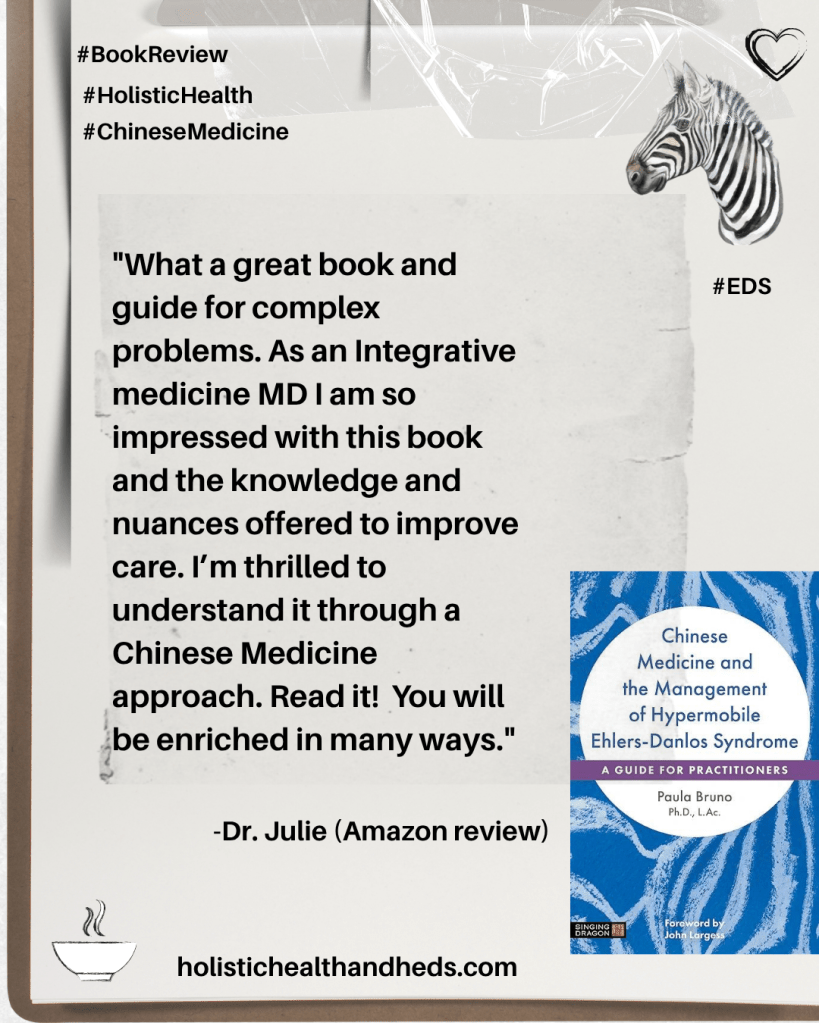
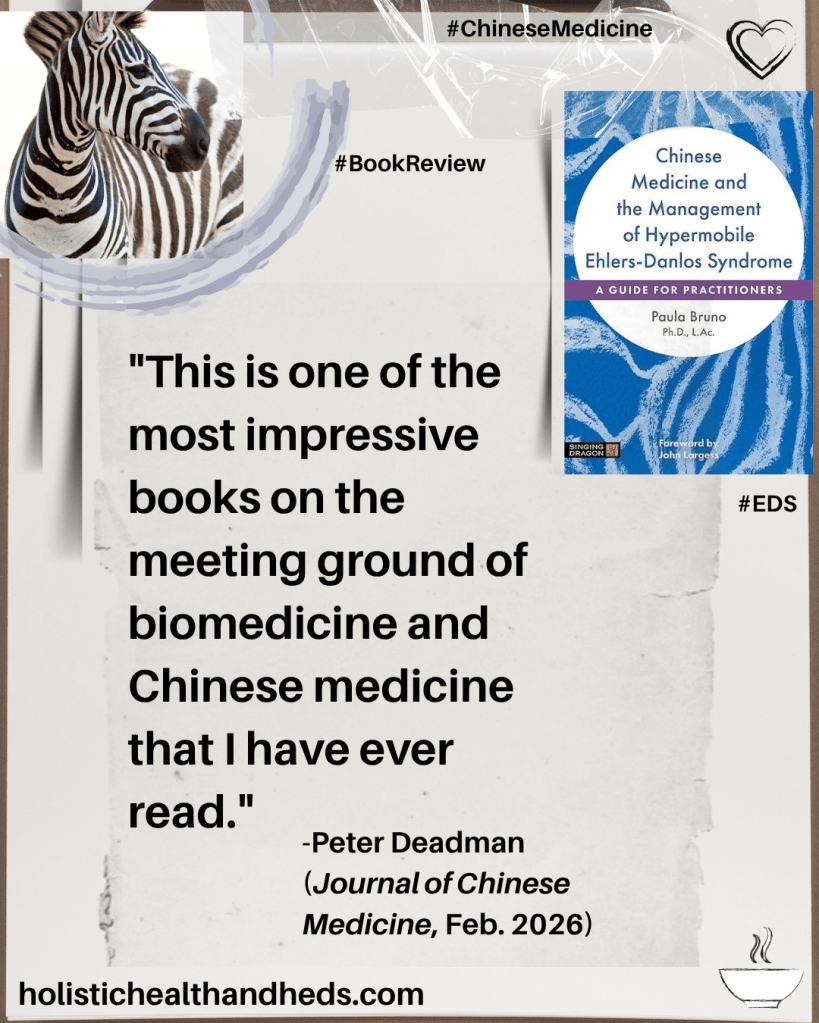
Note: I’m sharing a blurb from my book (Dr. Chia Fu), another from an MD, and another from a well-respected author, teacher, and veteran of Chinese medicine, Peter Deadman (see below) not to break my own arm patting myself on the back. No, it’s not that. Instead, it’s because I cannot emphasize this enough: I am not anti-science. As a practitioner, it is absolutely up to me to follow biomedical news and it is my job to be able to do things like spot red flags that merit a referral to an MD. Am I a fan of biomedicine? No, not really. But safety, scope of practice, and ethics come first. My book and blog posts also clearly demonstrate that I am not some crackpot influencer who is trying to sell snake oil (or a line of supplements, which is kind of the same thing, but anyway…)
*****
*****
Gaslighting: Being wary is not a sign of being anti-science
Looking at the bigger picture from a cultural standpoint is important. We are people, not aberrant genes. We are human beings, not collections of rampaging mast cells. We are people.
And people with chronic conditions, people who are medical mysteries, and people who are tethered for life to the biomedical industrial complex are people who suffer gaslighting and poor treatment at their doctor’s office.
I am glad that the Ehlers-Danlos Society is doing the hard work they are doing to codify things. I would also like to see what they have to say about medical gaslighting. Is EDS going to be adequately be taught at medical school? What’s on board as far as plans to teach doctors not to gaslight and abuse patients? If the EDS Society is going to define EDS for all of us, then I want to know what they are doing to clean their own house over there in Western biomedicine.
I feel very, and I do mean very, strongly about gaslighting and other actions that lead to medical PTSD. I have my own horror stories and I know what my patients have suffered.
Linked here below is my blog post about medical gaslighting. In it, I share a relatively recent story about one Dr. Patel, a rare disease expert who went to the hospital for help when he had a flare-up of his professional specialty, hemophagocytic lymph histiocytosis (HLH). He was gaslit at the hospital and even his own wife, who is also a physician, could not get the doctors there to listen. Dr. Patel died and his widow is now suing the hospital. And that’s not all I discuss. I also have some thoughts to share about the practice at teaching hospitals of using knocked out patients as unwitting models when the students need practice learning how to do pelvic and rectal exams, the treatment of women by biomedicine, and more. Do have a look and see what you think.
*****
*****
Bottom line though?
I think that if the EDS Society owns EDS diagnosis and criteria and treatment protocols then they also need to step up and take ownership of medical PTSD and gaslighting. And not in a piecemeal way. Being gaslit can kill you, as Dr. Patel’s case demonstrates. The damage done by gaslighting can be wide-ranging and profound. What, and I mean this seriously, is the EDS Society going to do to address the elephant in the room that is medical gaslighting?
Ways to think, not what to think.
Do you want to be able to step back from your individual circumstances and see a bigger picture? Chapter six of my book is an entire meditation on building a reading list for practitioners, but the list would work quite well for anyone looking to construct a knowledge base at home. I also wrote a useful (and shorter) blog post (the aforementioned ““Creating an EDS Bookshelf: Must-Have Reading for Savvy Zebras.”
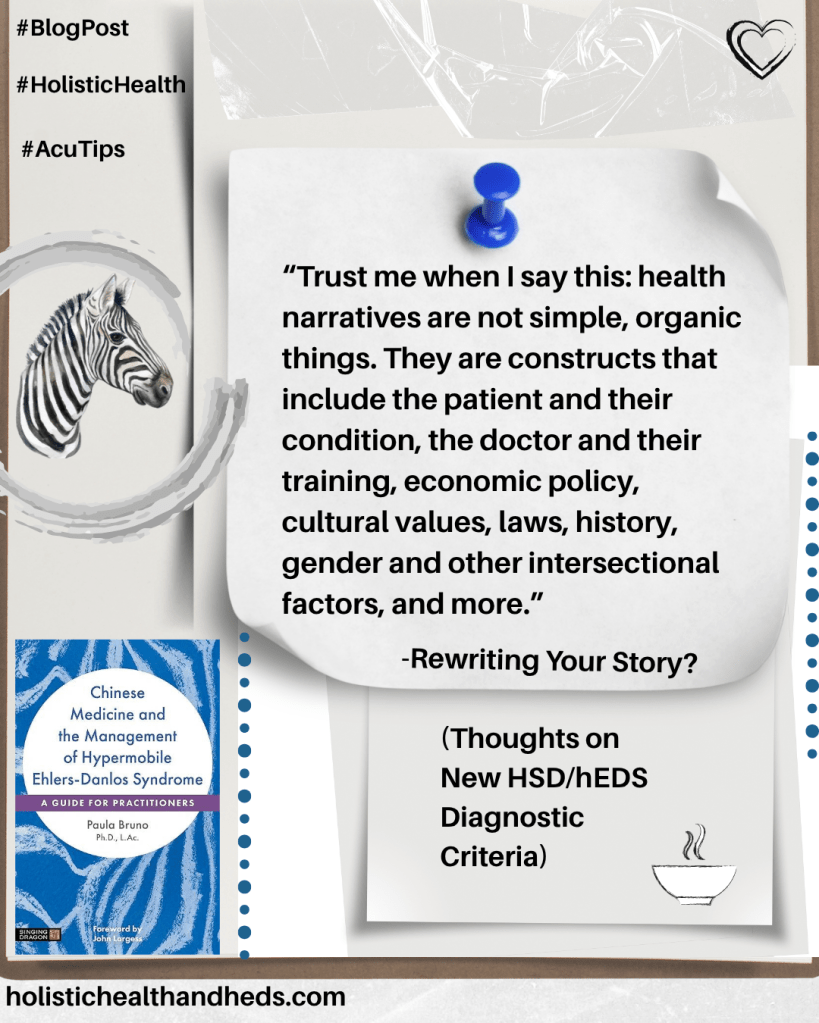
Trust me when I say this: health narratives are not simple, organic things. They are constructs that include the patient and their condition, the doctor and their training, economic policy, cultural values, laws, history, gender and other intersectional factors, and more.
*****
*****
There’s more to illness than the biological construction of it, in essence. My first step, when reading about the EDS Society’s news, for instance, was to look at their panel of experts for the new guidelines. This consists of fifteen people, mostly scientists and a small number of allied health professionals. It’s an international group, which is great, I think. And yet… Only one has a Hispanic surname and there is a Turkish last name and a Middle Eastern one. There are no Asians on this panel and no Black people. Looking on the HSD/hEDS panel, there is one Asian person but no Black people and, in this group, no Hispanic last names that I could see.
As a former Spanish professor who is multicultural and multilingual, I have an opinion about this. The nicest thing I can say is bless their hearts and I hope that they will decide to diversify these specific panels at some point or another. If they do not, then who are they representing? In my experience as a practitioner, I am especially troubled by how it is that much more challenging for my Black patients with EDS. And I doubt that Chinese medicine will ever get the respect it deserves in the new guidelines, but I sure hope not to see “dry needling” or “cupping [as long as it’s performed by a physiotherapist]” on the list of treatment and management protocols.
Note: If they want Chinese medicine for patients, then let’s actually have Chinese medicine for patients, not appropriated modalities delivered by chiropractors and physical therapists. If they don’t think that any of us who are actually trained, licensed, and qualified to offer Chinese medicine are capable of being the ones who do so, then maybe they can read my book and learn something.
*****
*****
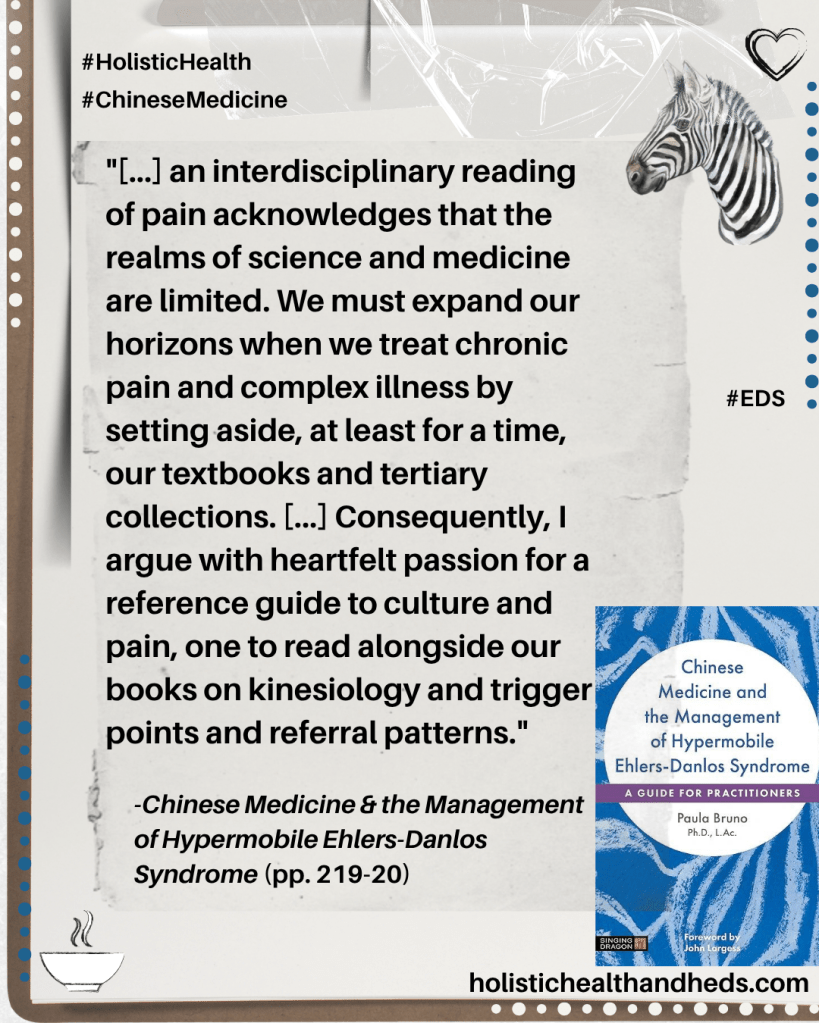
Getting back to the original point of this section: I wrote the final chapter of my book as a meditation on choosing books rather than a definitive list. Even then, I knew that any book I mentioned would be obsolete fairly quickly. Consequently, the chapter means to show my thought process in choosing resources to build a well-rounded knowledge. I used to put together courses on topics like the Spanish Civil War or 20th and 21st century Spanish literature…same idea: big topic, wide range of texts. As always, my philosophy was and is that knowledge is power.
Thinking about ways that we acquire knowledge should go beyond simply accepting a canned AI slop press release and acquiescing to whatever the guideline du jour is. It’s dangerous to be passive about your knowledge when you live with a complex and chronic condition. The specific texts a person might read to learn about EDS will become dated fairly quickly and, consequently, the ability to choose one’s sources wisely is a skill to cultivate. My goal for chapter six of Chinese Medicine was to teach readers the way I used to teach undergraduates: never what to think but instead, ways to think.
*****
*****
What can you do with the upcoming new directives?
Take the useful information if you want it. That’s all. Remember that this comes from people, and people are intersectional and not always objective.
Don’t take any of it to heart though.
When I was in my second graduate program (this would be for my third M.A. degree, this one for Chinese medicine), we had to complete over a thousand hours of clinical internship. One of my first patients was a person with scleroderma, an autoimmune disease that involves the overproduction of collagen, leading to hardened skin, joint pain, and more. It’s serious and I assumed that the patient would be doing whatever their doctor told them to do, and that they were at a student clinic for something basic like anxiety relief or to resolve insomnia.
And that was not how this went. Not at all.
The patient honestly scared little newbie intern me because they said that their doctor was a doomsayer who had nothing to offer but Pharma drugs. The patient declared that the doctor could f*ck right off and that the patient was going to resolve things with Chinese medicine. Mmhmm.
I rather meekly followed the point prescription that the intern who treated them before me recorded in their chart without arguing. I was very worried about this patient. I only treated them twice again, and they really impressed me with their continued subversiveness and hostility against Western biomedicine. I hadn’t yet come to my full flower of attitude towards allopathic practice and, back then, what this patient had to say was fairly shocking to me. (And now here I am…).
Two years later and soon to graduate, I was doing an herbal medicine rotation. Rather than have their own treatment room, the herbal intern goes to everyone’s rooms and make prescription recommendations if requested by the treating intern. And lo and behold, one day I saw that patient again. They were doing amazingly well. They had barely progressed and were holding the line at a manageable level. It really opened my eyes to the power of Chinese medicine, nutrition, and dedicated wellness practice. It also was also a real lesson in not being forced into a narrative meted out by biomedical standards of care.
*****
*****
Not everyone is required to follow biomedicine and only biomedicine’s programs and plans. If you try Chinese medicine, your practitioner will follow their local scope of practice and ethical laws. Again, this is something I discussed at length in my book, but I have patients who go to a long list of allopathic providers and it’s not my job to make them uncomfortable about it. Instead, my treatment supports their health program that is delivered by their MDs. When I’m working with patients who prefer to avoid biomedicine, I still need to be ethical and legal in all I do, and I take that quite seriously indeed. But it doesn’t mean that there are no options for my patients other than to take Pharma drugs and get dry needling from a physical therapist.
I cannot emphasize enough that knowledge is power. I love that I’ve been in great online groups, especially when I was new to EDS. But things have shifted in recent months and it’s a good time to consider one’s social media resources. Social media in the community is changing in response to the onslaught of AI, though, and this very much is damaging our ways of communicating in our groups.
There are large, well-moderated online communities where we find fellowship and share knowledge, but the groups that are not moderated (or not well-moderated) are showing an annoying trend. To wit: someone posts a long screed about how they were suffering from MCAS or EDS or POTS and then they share their canned burble about how they resolved their issue. There is usually a list with cutesy emoji bullet points. Tucked in, as discreetly as possible, there will be some kind of an announcement that the OP is a health coach or has an online business. This kind of AI slop is both brain-numbing and dangerous. I think it is very important to be aware of this trend and to consume AI slop with all due awareness of its considerable limitations.
But the hyper-moderated groups only allow biomedicine to have a voice. I actually ended up leaving the main EDS Society Facebook group because PTs could post about dry needling and cupping and “grafton technique” (that’s gua sha, thank you very much) but if I had anything to say about Chinese medicine, my post would be removed. It was clear to me that Chinese medicine practiced by an actual licensed acupuncturist was not welcome the way that dry needling and other appropriated modalities were. I bounced, eventually. Why stick around where you’re not valued or included?
Gatekeeping is very real is our communities and yes, sometimes it’s a safety issue and other times it’s medical hegemony in full flower. So be attentive to that, too.
Think about where you get your information. Read both the Western biomedical studies and the dissenting voices. If you can, do develop a good relationship with your biomedical practitioners. If you want to work with an acupuncturist, that practitioner should be bilingual in both Western and Eastern practices (even if they question, as I do, allopathic principles). This is for your safety. But when you know that there is more to health than one approach and one narrative, you create a space for choice and agency in your healthcare practice.
Patients always have options. But the very first and foremost option should be to take full control of how one decides to view and care for one’s own body. And that requires knowledge. And that requires questioning where the knowledge is created and how it is constructed. There will always be something new to learn about EDS. The previous outline for EDS was announced in 2017 and this new one might purport to share definitive pronouncements but the work continues. The EDS Society knows this and so does everyone else. But the work of a geneticist is one thing; the labor of living with these conditions is quite another.
It’s great that there will be a more unified narrative coming down the pike. And yet…
Will the upcoming new guidelines “drop” by the EDS Society mean that everyone gets a swift diagnosis? I doubt it. Am I convinced that medical gaslighting is going to be irradicated? Nope. Not in the slightest. Also, I wonder how well making a prescriptive healthcare protocol will help all the outliers, especially since everyone is unique in this community. (I’m going to be polite and not say what I think about Pharma drugs here and I am also going to refrain from making hostile comments about Western biomedicine’s appropriation of Chinese medicine).
*****
*****
Bottom line?
You have options. If you don’t fit the new criteria and you’re suddenly no longer diagnosed or you become ineligible for diagnosis, do not despair. You still have a health concern and you still deserve to be treated with respect and concern.
You have options. You know your own body. You can determine if you are in pain or not functioning properly. (And no, being fat doesn’t mean that your pain is due to your size or shape).
You have options. There is a lot of good information out there and with a good, basic library of resources you can create your own knowledge bank. There are good doctors and bad doctors (and good and bad acupuncturists too). There is useful material and there is trash. But you are thinking and strategizing from a place of knowledge and that, dear reader, is your power. So never stop reading. Never.
You have options.
Yes, you do.
*****
*****

Dr. Paula Bruno, Ph.D., L.Ac., is a licensed acupuncturist and herbalist, an AOBTA-CP traditional Chinese bodywork therapist, an author, and a health coach. She maintains an active and growing practice at Two Hearts Wellness, her Austin, TX office. Dr. Bruno is also available for distance appointments for wellness consultation or coaching.
In her first career, she was a Spanish professor.
Dr. Bruno’s specialties as a Chinese medicine practitioner include: • Musculoskeletal health (acute or chronic pain relief; Ehlers Danlos syndrome & hypermobility support) • Digestive support, gut health, and weight loss • Aesthetic treatment, including scar revision • Men’s health • General preventative care and wellness support for all persons.
She is the author of Chinese Medicine and the Management of Hypermobile Ehlers Danlos Syndrome: A Practitioner’s Guide.
When you are ready to discover what traditional medicine plus a vibrant and engaged approach to holistic health can do for you, either contact Dr. Bruno or book an appointment online.
*****
*****
Two Hearts Wellness/Holistic Health & hEDS does not accept paid advertising on this website and only relies on strictly necessary cookies.
Note: Material on this web site site is not intended to diagnose, prevent, treat, or cure any disease, illness, or ailment. A Chinese medicine practitioner in Texas identifies syndrome patterns but does not diagnose illness. Material on this web site does not purport to identify syndrome patterns.
*****
- Icky, condescending AI slop or sincere attempt to get the plebes enthusiastic and on board? You make the call:
“If you’ve got hypermobility or EDS, there’s a good chance you already know how frustrating the current system is. The Beighton Score, the thing most doctors use to decide if you’re “hypermobile enough,” only looks at a handful of joints. Your thumbs, your pinkies, your elbows, your knees, and whether you can touch the floor.
But what about your shoulders? Your hips? Your ankles?
A lot of people we’ve worked with score low on the Beighton because their hands aren’t particularly flexible, yet their shoulders sublux weekly and their knees hyperextend every time they stand still. The current criteria basically ignore some of the biggest, most problematic joints in the body.
Then there’s the whole hEDS vs HSD split. If you got told you “only” have HSD and not hEDS, you’ll know exactly what that means in practice. Doctors who’ve never heard of it. Insurance that won’t cover treatment. Being told it’s “just” hypermobility when you’re in pain every single day.
The Ehlers-Danlos Society has confirmed that new diagnostic criteria will be published on December 1st, 2026, in the American Journal of Medical Genetics. The second phase of publications, covering treatment and management pathways, is expected to follow in early 2027.
So what’s expected to change?
The Beighton Score isn’t going anywhere, but there’s likely to be a secondary assessment for people who don’t meet the current cutoff but clearly have generalised joint hypermobility. That could include shoulders, ankles, forearms and big toes.
There’s also talk of a potential blood biomarker for hEDS, a 52 kDa fibronectin fragment, which could mean an actual objective test for the first time. It still needs to be replicated in larger studies, and we don’t know if that’ll make it into the final criteria, but the fact it’s even being discussed is significant.
And the hEDS/HSD distinction? It looks like it may be redefined. Early findings from the Criteria Review Study suggest that hEDS and HSD exist on a shared biological spectrum with overlapping features, and the same biomarker shows up in both conditions. Some experts have suggested the two could be recombined, because the current split doesn’t reflect what’s actually happening clinically. These are still preliminary findings, but the direction of travel is clear.
Now, I’m not going to pretend everyone’s optimistic. A lot of people in the community are understandably cautious. The 2017 update left a lot of people worse off, particularly those who had existing diagnoses pulled or who couldn’t meet the new, stricter criteria. There’s frustration, and it’s valid.
But if the new criteria genuinely expand which joints are assessed, and if HSD gets taken as seriously as hEDS, that’s a step in the right direction for a lot of people who’ve been told their symptoms don’t count.
We’ll break it down properly when it drops in December.” ↩︎
 Holistic Health and hEDS