Most of the posts on this blog start with hEDS as the baseline and expand outward to include MCAS and/or dysautonomia. In this one, I’m centering MCAS. Spring season brings its challenges for everyone, but when you’re a mastie? Spring can be particularly and specifically extra difficult for those of us with MCAS. This essay, consequently, shares some tips for seasonal living that can make life better for anyone with hEDS and the common comorbid conditions, including POTS, but its first concern is for those of us with wayward mast cells.
What do you like to do to mark transitional periods? How much weight do you give to the idea of seasonal living? According to Chinese medicine, there are four main areas to consider: environment and its effect on you, organs (each season has a specific organ that merits extra attention during its related season), food (what is in your best interest to eat during the season?), and mood (part of the umbrella category that relates to each season and organ). All things are interrelated and a comfortable and easy season requires being attentive to relations and connects and the notion that we reflect what is around us and what is around us reflects us.
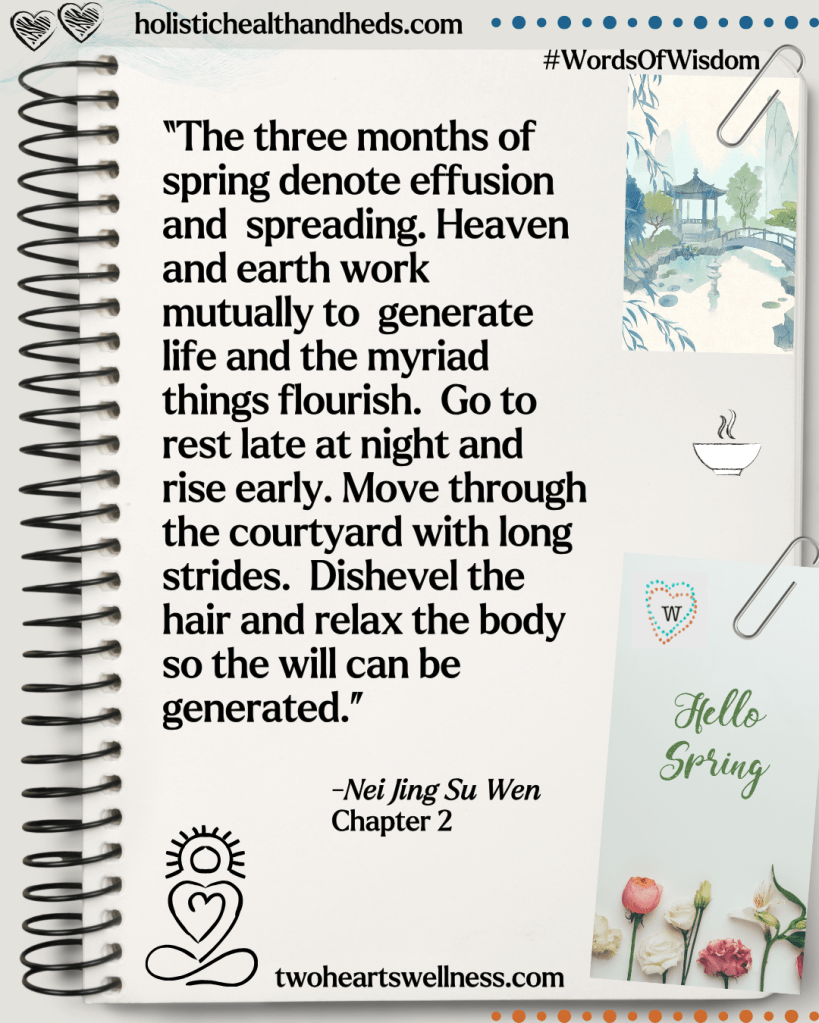
Spring is the time to consider themes of reawakening and growth. The trees and flowers start to bloom and suddenly, nature comes alive all around us. Winter is gone and summer is on the horizon. The transition here is from sleep and cold and stillness (yin) to activity and warm and movement (yang). Being attentive and going with the flow of the shift is a healthy choice that makes the season enjoyable and healing in its own way.
*****
*****
Environment
Allergies flare, and so do you.
Everything from plants to animals to waterways like rivers and streams and lakes wake up from winter’s slumber and are ready to get the party started. This can mean increased pollen and mold and, depending where you live, extreme weather shifts (none of which are helpful when you have MCAS).
When we’re complicated it helps to find your practitioner and get started on a program before the worst of the season hits you. But if that horse is already out of the barn (which, to be fair, is an issue for people with MCAS. Sometimes the horse was never corralled in the barn at all and whoops, there it goes, running down the street with your sanity it tow…!), it still can be worth it to try Chinese medicine. We can put together an herbal regimen for you, educate you regarding a nutrition plan, and set up an acupuncture prescription to lower inflammation and reactivity…that is certainly a fine start for anyone, really.
Each day of spring brings us closer to summer and further from winter and one’s health practice should shift and go with ebbs and flows too. What your Chinese medicine practitioner can also do for you that you might not have considered is help you to move from one to the next season. Spring, like all seasons, has a beginning, middle, and end, and a season preceding it with another following. How can you be present for what spring has to offer without preparing what comes next? Plotting out ways to strategize your unique health presentation so that you are in sync with your environment over the course of the year can make each seasonal shift that much easier. Becoming proactive for your long term, rather than reactive to right this minute, is a superpower that you can develop when working with an acupuncturist.
You don’t need to be a practitioner of Chinese medicine to know that spring is the season for new energy and accelerated growth but it truly can make a difference to work with one as you create your healing path and program.
*****
*****
Organs
Each organ has its pair and its season. For spring, the season’s organ is the Liver (capitalized to indicate Chinese medicine’s organ, which can be either an umbrella category, a channel (aka meridian), or an actual liver organ. The Liver is connected with the health of sinews (very important for EDS folk), and if we have dry eyes or floaters, this, too relates to Liver health. When Liver qi is stagnant, we feel crabby or even outright angry. Extremes of menstrual cramps also come back to Liver qi stagnation.
The Liver’s pair is the Gallbladder and when this organ is healthy, we feel brave. If there is stagnation a person could develop gallstones. If the Gallbladder is deficient, we feel fearful. A healthy Gallbladder is indeed the trusted pair to go with Liver.
Your acupuncturist can help you with Liver health. For anyone with EDS the benefit to tendons and mood can be worthwhile. For issues that are relatively common for people with MCAS, like floaters, the Chinese medicine approach to Liver health can be a resource. And as to the Gallbladder? Well, who wouldn’t want to boost their energy and drive to complete tasks and achieve goals? Spring is the time to focus on these organs and to support them so that they support you no matter how bad the pollen count gets.
*****
*****
Food
What do you like to eat during the spring season? Are you able to eat what you want and enjoy a variety of food? This, for those of us with MCAS, is an issue. Someone with EDS might be struggling with gastroparesis or other digestive complaints, but that oh-so-lovely MCAS experience of being able to eat only a small number of things makes the new season that much more challenging.
What happens when the uptick of seasonal allergies that even normies experience have got you suffering? You go from being able to eat five things to only being able to tolerate three things, maybe, or your skin reacts with fury no matter what you eat. Your immune system is activated and ready to kill with fire anything that comes your way.
“Have you ever thought about the difference between mindful eating and intuitive eating? They are not the same thing, but both can be helpful approaches to nutrition when a person lives with EDS, MCAS, and/or POTS. Especially when a person is limited in what they can eat, an intentional view can soften the hard edges of even the toughest digestive challenges.”
For us in Chinese medicine, food and gut health are extremely important. Spring is the time to eat food that is beneficial to the Liver, and this would include greens (especially bitter greens); legumes; sour things like lemon, grapefruit, or green apples; bitter flavored food (asparagus, bitter melon), and things that support healthy Blood, like da zao (jujube dates), goji berries, and black sesame seeds. Sounds simple, right?
Not so fast, fellow masties and flexies (aka: MCAS and hEDS sufferers). What about unseasonal weather? In Texas, we have pretty wide weather swings and I completed my first graduate program (that would be the first two master’s degrees and the PhD) at IU Bloomington. If you don’t like the weather in Bloomington, that’s fine. Wait five minutes and there will be something new. Texas is the same way and with global warming and climate change, volatile weather becomes a feature not a bug. What does this do to your appetite and digestion?
Your acupuncturist will work with you to strengthen your digestion and support your healthy choices and appetite. For someone with MCAS, this is a whole project…but one that is definitely worth pursuing.
*****
*****
Mood
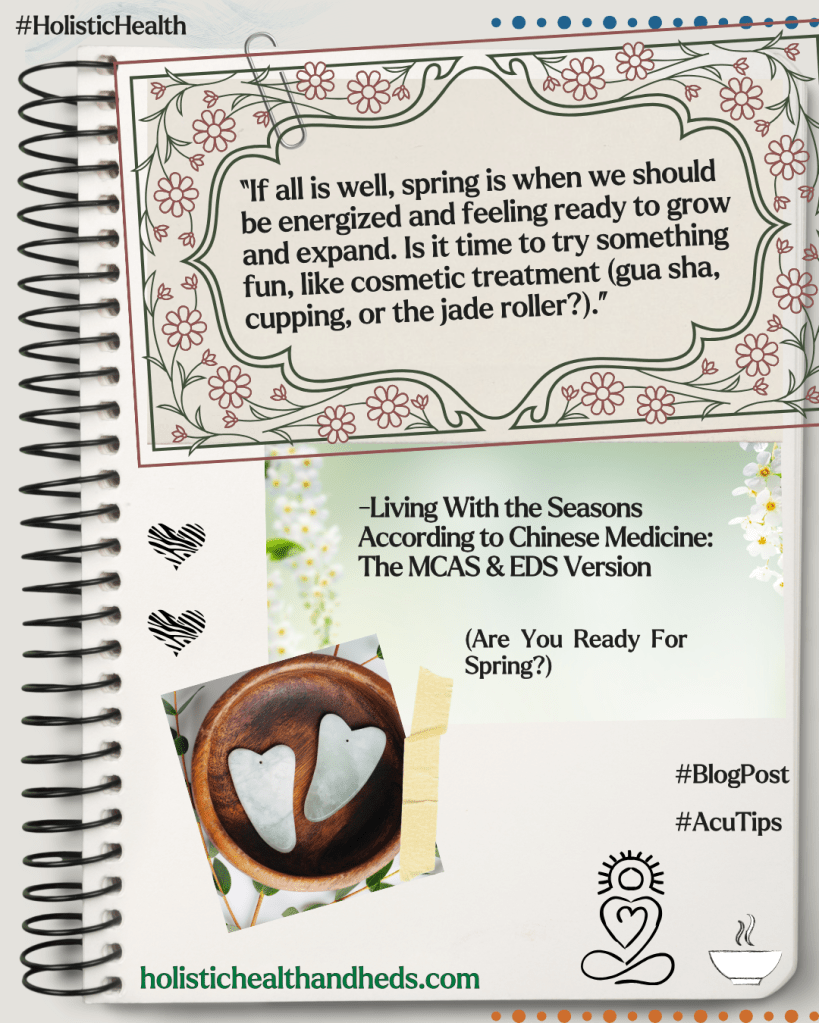
If all is well, spring is when we should be energized and feeling ready to grow and expand. Is it time to try something fun, like cosmetic treatment (gua sha, cupping, or the jade roller?).
As already mentioned above, the emotion associated with the Liver is anger, and during the spring season we may want to be mindful of how we feel along the gamut of emotion associated with anger. Frustration, crabbiness, and irritation are all gradients that, when activated, can easily become anger or even rage. When your Liver qi is stagnated, we feel grouchy and we sigh a lot. If our Gallbladder qi is weak, we feel fearful and indecisive.
Best option is to have enough energy to get in some good trouble (whatever that means for you) and to be decisive while doing so…but that can be tough for anyone but even tougher when we live with chronic conditions.
Spring is the time to be aware of and intentional with our LV/GB energy though. Can you make some incremental changes in your healthcare routine? What is a lot for you might be too much for the next person (and that might be nothing special for the person after that). Everyone is different and you know it. Make the changes you can make and only compare yourself with your own self. It’s not a competition.
It’s seasonal living.
What does growth and expansion to you? How can you shake off some dust from winter? And… are you ready to try acupuncture and other modalities of Chinese medicine?
*****
*****

Dr. Paula Bruno, Ph.D., L.Ac., is a licensed acupuncturist and herbalist, an AOBTA-CP traditional Chinese bodywork therapist, an author, and a health coach. She maintains an active and growing practice at Two Hearts Wellness, her Austin, TX office. Dr. Bruno is also available for distance appointments for wellness consultation or coaching.
In her first career, she was a Spanish professor.
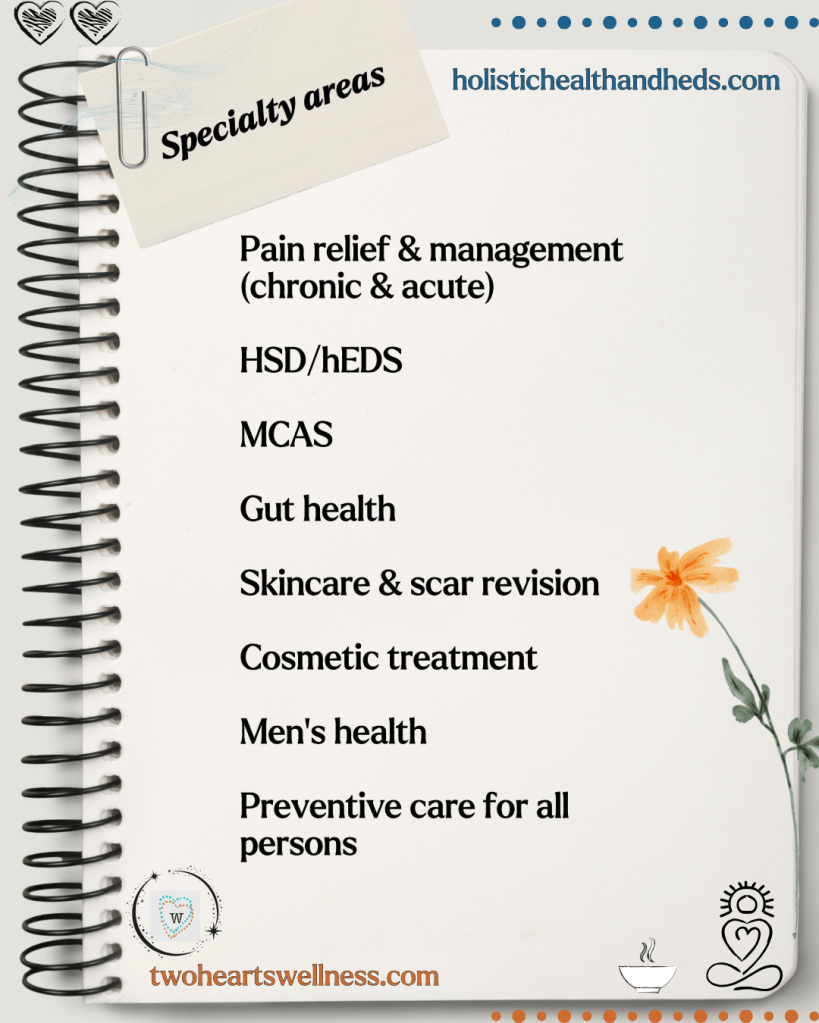
Dr. Bruno’s specialties as a Chinese medicine practitioner include: • Musculoskeletal health (acute or chronic pain relief; Ehlers Danlos syndrome & hypermobility support) • Digestive support, gut health, and weight loss • Aesthetic treatment, including scar revision • Men’s health • General preventative care and wellness support for all persons.
She is the author of Chinese Medicine and the Management of Hypermobile Ehlers Danlos Syndrome: A Practitioner’s Guide.
When you are ready to discover what traditional medicine plus a vibrant and engaged approach to holistic health can do for you, either contact Dr. Bruno or book an appointment online.
*****
*****
Two Hearts Wellness/Holistic Health & hEDS does not accept paid advertising on this website and only relies on strictly necessary cookies.
Note: Material on this web site site is not intended to diagnose, prevent, treat, or cure any disease, illness, or ailment. A Chinese medicine practitioner in Texas identifies syndrome patterns but does not diagnose illness. Material on this web site does not purport to identify syndrome patterns.
*****
 Holistic Health and hEDS