Every season is nested into a context and has its own associations. What do you think about when you ponder winter season? Holidays, colder weather, the space in between fall and spring…? In my practice, about 80% of my EDS, MCAS, and/or POTS patients see winter through the lens of icy hands and feet and aching joints. A smaller percentage of folks are largely unmoved by the change of season and and even smaller percentage than that loves the colder temperature.
What about you? How do you feel when fall gives way to winter? Do you live in a region that has a season worthy of the name? (I ask because I’m in Texas and we have either mild, non-winters… or, depending, ice storms and mass electricity loss that leaves us without power for a week or more).1 No matter where you live, though, you can strategize ways to live with the seasons rather than against them. And, as a practitioner of Chinese medicine, of course I have thoughts on how to live seasonally when you live year-round with a chronic condition like EDS and the comorbids.
As I do with my blog posts about seasonal living, I will confine myself to four categories: environment, organs, food, and mood. There’s a lot to say about seasons and wellbeing. In the interests of not repeating myself unduly, you can find additional information that you might finding interesting in the normie version of this blog post, linked here below:
“And so… this essay invites you to consider how you navigate your wellbeing during during winter and it shares ways to nurture your wellbeing in so doing.”
—Living With the Seasons According to Chinese Medicine: Strategies for a Happier, Healthier Winter
*****
*****
But people with EDS, MCAS, and/or POTS do have specific concerns that normies do not necessarily share or even understand. And thus the EDS version of the blog post.
Environment:
We are part of our environment and as the seasons shift, so do we. This can be good or it can be very challenging indeed.
Bad news first: How many of us experience the barometric pressure shifts in our joints and tissues? Some folks get headaches when it’s cold, or experience ear pain, or worsening of facial issues like trigeminal neuralgia. “Tis the season” for being overwhelmed by holiday demands and perhaps becoming depressed as a result. What, for example, about food? Speaking for myself, I went through a long period of being unable to eat much of anything due to MCAS and that certainly was harder during the holiday season.
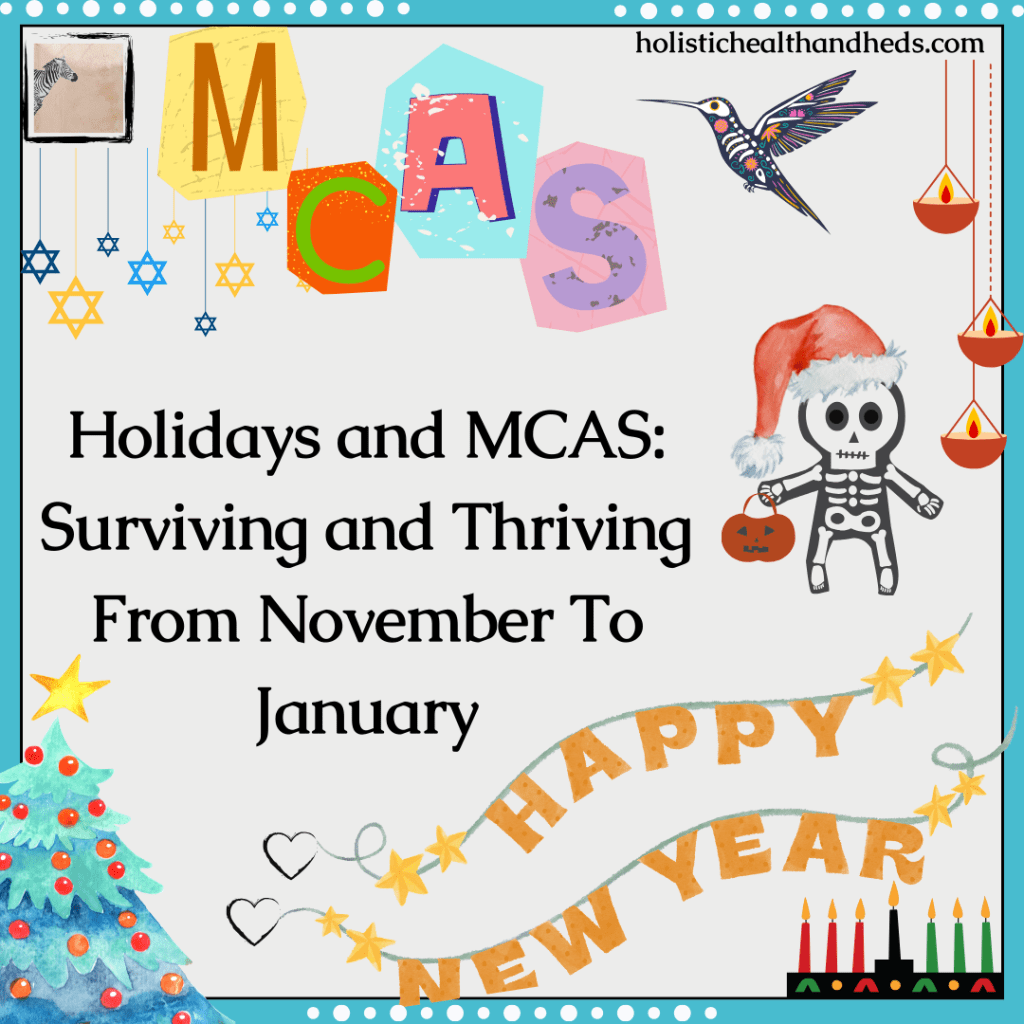
For more on the subject of food, holidays, and MCAS, see “Holidays and MCAS: Surviving and Thriving From November To January.” This is a topic very near and dear to my heart, trust.
Good news, though: it is possible to ease into winter by planning ahead and (if it resonates) by following the precepts of Chinese medicine. Winter is the most yin (cold, dark, slower) time of the year, in contrast to summer (hot, bright, faster), which is yang. Creating your own healthier winter can start by mindfully exploring the Chinese philosophical approach to seasonal living. It is one that insists that we are part of our environment and our environment is part of us. By living with the seasons, we nurture ourselves and the world in which we live.
So, what does this mean?
Organs:
Kidney in biomedicine is an organ that filters waste products into urine that then passes through to bladder and is excreted. Kidneys filter our blood, play a role in blood pressure, and balance salts and other minerals. Both kidneys and bladder are crucial organs in any tradition, but the Chinese value of them encompasses a broad umbrella of associations.
We also see the Kidney (I capitalize Chinese versions of organs to distinguish them from biomedical or functional versions of same) and Bladder as filters, pretty much in the same way that biomedicine does. In Chinese medicine, Kidney is also associated with the health of our ears, hair, teeth, and bones.
We also keep in mind the Kidney’s role as the storehouse of jing, or essence. During the winter season, especially, we do not wish to over-use our innate stores of energy. Especially, especially if we live with chronic pain, we want to respect our bodies and their need for rest. Keep in mind that any ongoing challenges, whether from pain, trauma, or anxiety, can lead to what Western medicine might term adrenal fatigue, something your Chinese medicine practitioner will view as Kidney qi deficiency.
Signs that the Kidney is not functioning at optimal levels include things like frequent being dizzy, suffering from tinnitus, experiencing an aching lower back and/or knees, problems sleeping, diminished memory, a dry mouth, and/or night sweats. If you opt to work with an acupuncturist for these issues, they will more likely than not offer you a prescription for herbal medicine and discuss lifestyle shifts with you. Nutrition is a key component of wellbeing according to Chinese medicine, though parameters do shift in cases of EDS + MCAS.
*****

*****
Food:
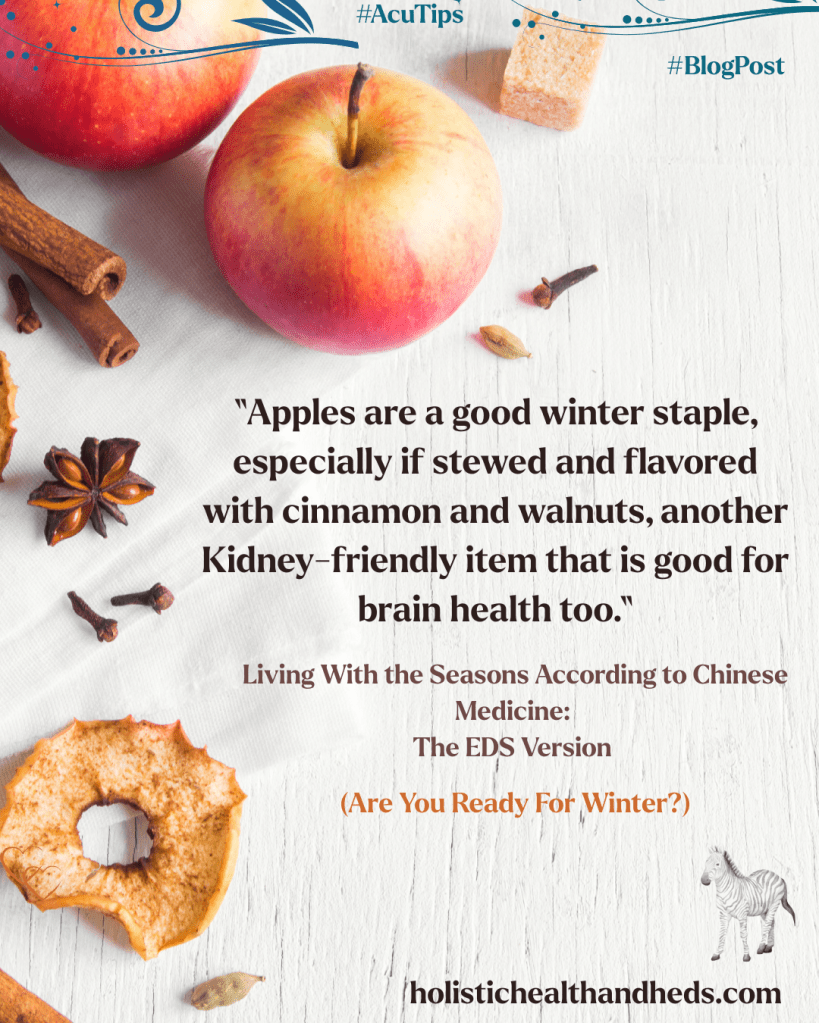
One of the very best ways to take good care during winter is by eating seasonally. We also want to eat stews and soups to nurture our inner heat. Root vegetables are a great choice, as are dark, leafy greens. Brown rice is a worthy option, as are oats and barley. I, personally, love millet but if you have hypothyroidism you will want to avoid this one. Apples are a good winter staple, especially if stewed and flavored with cinnamon and walnuts, another Kidney-friendly item that is good for brain health too.
If you like lamb (I do not), winter is the time to eat it, and beef or chicken are also good winter choices if you are not vegetarian or vegan. Similarly, bone broth will keep your insides warm, and healthy spices like ginger, cinnamon, garlic, and black pepper are an optimal choice.
On the subject of black pepper, we will remember that each organ has a color assigned to it, and during the organ’s season, we want to eat colors associated with that organ. For the Kidney, this would be the color black. Other healthy black foods include black sesame seeds and black beans.
I’m fairly laid-back as a practitioner. Definitely, I’m not one of the ones who tells people not to eat this or that they must eat that or else. I am way to Mediterranean than that. You want pasta? Eat that pasta. You had a dessert? Great… did you enjoy it? I’m all about moderate eating and strategic treats. As a mastie myself, I certainly do understand being on a limited diet and not wanting to restrict (or being able to eat “good”) foods. But during winter, our bodies really do not need icy drinks, raw vegetables, too much caffeine, or lots of cold beer (or any alcohol, for that matter).
Think about winter like you are a just as much a part of the environment as any other creature. We all want to stay warm. We all want to be well fed. We all want and need extra rest and a cushion of grace that accepts and celebrates moving a little slower now than when we were full of spring energy (if, as a person with a chronic condition, we ever were altogether that energetic in the first place).
*****
*****
Mood:
The Kidney in Chinese medicine is associated with fear, and too much of this emotion can damage them. Western medicine isn’t altogether that different if you think about the adrenal glands and what happens during a fight-or-fight episode. This is something to consider with extra gentleness when we live with chronic conditions, though. Living with EDS, MCAS, and/or POTS is not for sissies. It’s exhausting, it can leave a person fearful, and there’s usually at least a fair amount of pain each day. We already know about plowing forward despite pain, uncertainty, and even fear.
Kidney is the organ that aligned with the Water element (a whole new blog post in and of itself, but yes, each organ has an element, too). It makes sense though, given that the Kidney and Bladder filter fluids. Water, as an umbrella concept, represents flow and the ability to take shape of what contains it. Right balance of the Water element helps us to move along our life’s path with an important aspect of this organ, the zhi, or spirit, of Kidney, which houses the willpower and one’s strength. Yes. Even as the Kidney’s emotion is fear, its spirit is one of strength and courage and willpower.
*****
*****
In conclusion:
The Kidney is an important organ no matter what medical tradition you rely on and however it is that you want to categorize it. But for Chinese medicine, it is the rooted aspect of your wellbeing, it is a grounding system and the processor of fluids. If you are trying to improve your health, winter and a focus on the Kidney can be fruitful and enlightening.
Give yourself permission to rest and do not feel guilty about it. Peruse the section of nutrition, above, and consider what you are eating. Is it time to set an appointment with your acupuncturist (or you are ready to find one)? Maybe you are thinking about bodywork therapy or health coaching. Whatever it is that you are considering, keep in mind the season and how your goals align with it. Right now, winter calls upon us to be dormant and to move slowly if we want to go far. Right now, we are like seeds planted in the earth, gathering strength for the next season and the time to germinate.
And before you know it, spring will be here and the seeds you plant today will be bursting forth and blossoming.
*****
*****

Dr. Paula Bruno, Ph.D., L.Ac., is a licensed acupuncturist and herbalist, an AOBTA-CP traditional Chinese bodywork therapist, an author, and a health coach. She maintains an active and growing practice at Two Hearts Wellness, her Austin, TX office. Dr. Bruno is also available for distance appointments for wellness consultation or coaching.
In her first career, she was a Spanish professor.
Dr. Bruno’s specialties as a Chinese medicine practitioner include: • Musculoskeletal health (acute or chronic pain relief; Ehlers Danlos syndrome & hypermobility support) • Digestive support, gut health, and weight loss • Aesthetic treatment, including scar revision • Men’s health • General preventative care and wellness support for all persons.
She is the author of Chinese Medicine and the Management of Hypermobile Ehlers Danlos Syndrome: A Practitioner’s Guide.
When you are ready to discover what traditional medicine plus a vibrant and engaged approach to holistic health can do for you, either contact Dr. Bruno or book an appointment online.
*****
Two Hearts Wellness/Holistic Health & hEDS does not accept paid advertising on this website
Note: Material on this web site site is not intended to diagnose, prevent, treat, or cure any disease, illness, or ailment. A Chinese medicine practitioner in Texas identifies syndrome patterns but does not diagnose illness. Material on this web site does not purport to identify syndrome patterns.
*****

*****
- Yes, there is a blog post for that: “Taking Care In Texas: Some Thoughts On Recovering After The Freeze” in a post from the big freeze of 2021 that left those of us in Austin without power for a week or more. When the weather is volatile we have a variety of things to consider, especially if we live with chronic health conditions. For some tips on preparation, see “Extreme Weather: Strategies to Stay Healthy and Keep Your Cool When It’s Wild Outside.” ↩︎
 Holistic Health and hEDS