I seriously almost titled this essay “girding your loins for the holidays when you have MCAS.”
It kind of does feel like being thrown onto an obstacle course where you have to battle your way from point one (early November) to the finish line (the first week of January), doesn’t it? That work party where people are wearing perfume and all the food is out of range for you…the family tradition where you can’t touch anything that everyone else has eaten since forever…all those advertisements that frame the holidays as a marvelous whirlwind of friends, family, and great food (except that you can neither participate nor partake)? It can be lonely and frustrating and depressing.
I remember the days when I could only eat five items and only those five. I could only eat very slowly and in very small amounts, too. Otherwise, my upper lip would swell and the roof of my mouth would peel off in one piece, leaving my palate raw and painful. And that would just be the start. Things were very, very bad for me for a very, very long time. I remember.
Fortunately I am a gut-health-obsessed practitioner of Chinese medicine, so I now have my MCAS fairly decently under control. Fairly decently. I have flares like any normal mastie does. I have to watch my stress levels and guard my peace on an ongoing basis…or else. There are things I cannot eat even now, and chemical poisons like Febreeze and anything artificially “fresh scented,” not to mention perfumes and odiferous soaps, all will cause my mast cells to choose violence. But I’m not nearly as bad off as I was even two years ago, and for that I am grateful…and determined.
Even now, though, the holidays really bring it all home for me, both personally and in my work as a practitioner of Chinese medicine and health coach. The question of the day, consequently, is:
How can you get through the holiday season with your sanity and self-esteem intact?
*****
Six potentially helpful tips:
~~Acknowledge yourself and your experience~~
Sometimes, we forget how little the average normie knows about EDS, POTS, and MCAS. EDS, especially, is not rare.1 POTS and other manifestations of dysautonomia are not unusual, especially with rates of long COVID increasing apace.2 And allergies, histamine intolerance, and varying degrees of sensitivity are also growing more and more common.3 But it’s not easy to live with any of these conditions and it is even more challenging when the people around you don’t understand them.
So give yourself your flowers for being here today. EDS, MCAS, and/or POTS is not for sissies. We manage these conditions and find our ways to thrive because we are strong. Also, remember: stress and anxiety make things worse. So when you guard your peace, you’re doing so not because you’re selfish. You are taking care of yourself so that you have the energy to go to that family holiday dinner or work party that you can’t skip. You are managing your condition, and for that you deserve all the support and respect in the world.
~~Plan ahead and prioritize your treats~~
I’ve had a few holidays where there was nothing but my five items. Those were lonely, hungry holidays. I remember, though, the first time that I was able to eat a whole Christmas cookie and taste all of it and swallow it down without my mast cells going berserk. The feeling on my tongue of different flavors was incredible. I don’t think I’ll ever forget how happy I felt when I ate that whole entire cookie all in one sitting. My super treat is to go to Alamo Drafthouse and watch a movie and eat my favorite lunch. Yes, I am a wreck for days afterward, but since I do this only very rarely, it’s ok. It’s worth it. During the five options period I could never have made it through a lunch at Alamo Drafthouse. At least now I am actually able to choose to indulge this way, for which I am truly grateful.
Is it possible for you to pick a few things that you will eat or do, even if there are consequences? If you have a gluten-free dessert or something that’s the hyper-healthy version of a treat, would that help you to experience some holiday spirit? Or maybe it would be possible to do something that doesn’t involve food but, instead, something else that would make you feel special and like this is a special time? When we need to be hyper-vigilant for years on end it is discouraging. If it is at all possible, find a few items or actions that make you feel some holiday cheer even if they’re only small things, or things that a normie takes for granted (but which maybe can make you feel daring and like a real party animal).
What do you think?
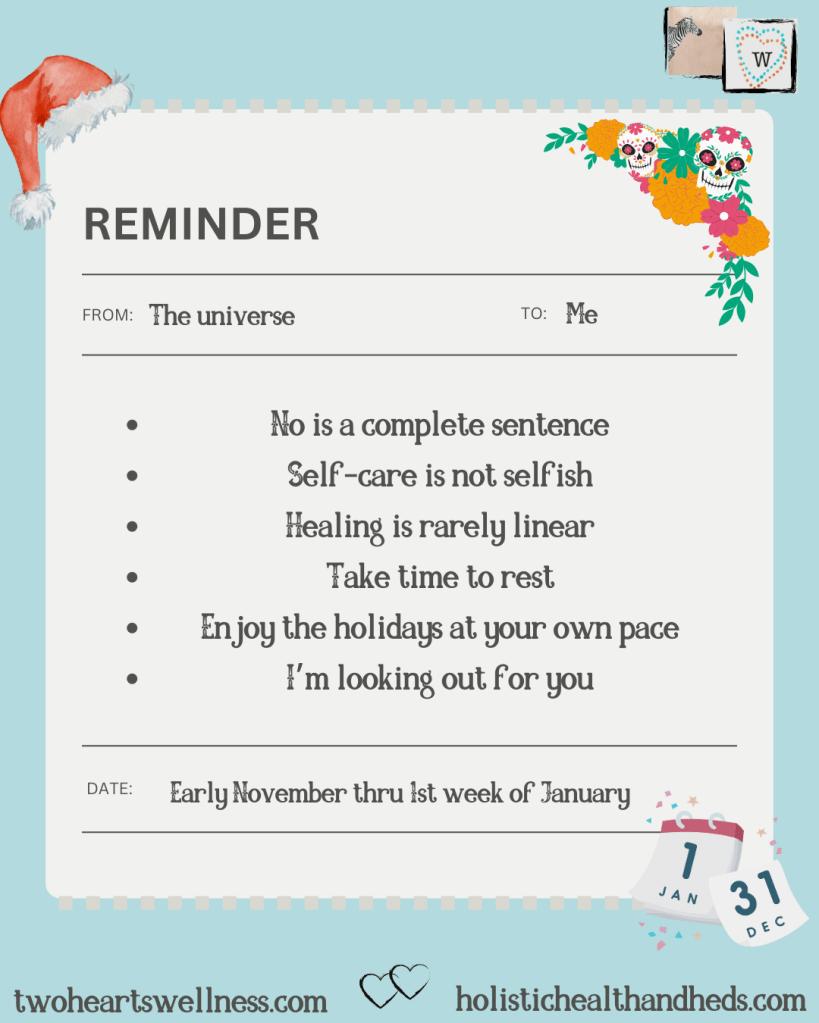
~~No is a complete sentence~~
If the normies in your life don’t get it and want you to do things that exhaust you, then the answer is no. If you have a limited amount of ability to go off your regular and rigid menu, then you get to decide what that will be, not the person at that party who insists that you try something from this dish or that plate.
The answer is no.
~~Plan, plan, and plan~~
Never go to a party hungry or tired. Otherwise, you’ll flare just because your fatigue has angered the Mast Cell Gods or you’ll eat something you know you shouldn’t and then you’ll flare. Remember to stay hydrated, too.
I still mask in my office (and so do patients) for safety’s sake. When I go out in public on my own time, I still mask. Part of it is safety and part of it is because I might actually faint when I walk into local stores like CVS and smell the disgusting perfume and the reek of industrial chemical “fresh scents” as soon as I step inside their doors. Or if someone is wearing strong cologne…my mask protects me from that. Moral of the story? Bring a mask with you if you think it will help you navigate pumpkin spice season. Wear it with pride, too.
Pace yourself. Choose what’s important to you and set those boundaries. Every day that you’re on this earth that you don’t have a flare or you feel a bit better is a day of moving towards your goal of more stable health. If at all possible, keep your eyes on that prize and plan when and where and how you will expend your precious energy.
~~“I’m allergic to everything” — What’s your story?~~
People who know, know. Those who do not, don’t. I’m not entirely convinced that the blissfully ignorant want to learn about MCAS or any other complex chronic illness, to be honest. And that sounds harsh but…everyone has their own burdens. Maybe the person who can’t take the time to be present for your explanation is suffering in ways that you don’t see either. So giving normies some grace is kind to them and good for your own spirit.
Speaking for myself? I’m pretty matter-of-fact about all of it. If it comes up, I don’t try to explain MCAS. I just say that I’m allergic to everything (people understand the concept of allergies) and I laugh it off, or I declare that I am a sensitive flower who reacts to all the things (and I laugh it off). Sometimes people will ask what I mean by that and other times, the person skates over it (but at least they respect that I’m “allergic to everything”). If I am in a situation where I don’t want to disclose, I may also shift the conversation to get the person to talk about themselves, which most people love to do. Redirecting the attention from me and my mast cells is usually my preference in social situations.
What about you? Can you ponder ways to let people know that you have a medical condition without drawing attention that you don’t want or need?
~~ Ignore the organic police ~~
Don’t let anyone scold you or give you lectures about “nutrient-dense whole foods.” Seriously.
I’ve seen a couple blog posts written by licensed medical care providers on how to survive the holidays. One really left me with my eyebrows raised up to the crown of my skull. The post had good information but it was material that most masties already know in terms of what to eat or what not to eat. And the part where the doctor (the author is an MD) lectured about how people with MCAS need to eat “nutrient-dense whole foods” chapped my hide. I was honestly offended by their descriptors for what kind of poultry and eggs (pasture-raised), meat (grass-fed), and/or fish (wild-caught) that folks should be eating as part of their “nutrient-dense whole foods” diet if they want to get through the holidays intact.
Could you actually go to a party and ask the host or hostess if the eggs they cooked with are from pasture-raised chickens, the meat was grass-fed, and/or any fish they serve is wild-caught?
I think that most of us do recognize that we are better off if we eat pasture-raised, grass-fed, and wild-caught but that’s not available to everyone. It’s definitely not an argument to start if you’re someone’s guest, either. And to assert this as though it were new information that is easy to follow in a blog post about surviving the holidays with MCAS didn’t land well with me.
Bottom line? You know what you should be eating. You know what you are eating. But what if there’s a gap between the “should be” and the “are”? My advice is to just do your best. That’s all you can do. And trust that your host or hostess is doing their best too. (And if you know that your host is not? Well, bring your own food or hearken back to the above-written section “No is a complete sentence.” Don’t go or don’t eat the food. It’s your health and you’re protecting it, end of discussion.)
*****
~~In conclusion~~
I have this conversation with patients and health coaching clients fairly often: and my position is that it’s a balancing act. On the one hand, minimizing what you’re going through is not helpful. Living with EDS, MCAS, and/or POTS is not easy. There is a lot to be angry about and there is a lot to grieve. But holding on to the anger or grief is not healthy or helpful. And yet (circling back to square one) toxic positivity and acting like everything is just peachy also is not healthy or helpful at all.
Instead, it’s a matter of respecting the feelings you have and acknowledging that complex chronic illness is neither fair nor fun. If at all possible, you find a space where you can grieve or be angry when those feelings arise (maybe it’s with a supportive friend or loved one…perhaps you can express yourself in your online support group or with a therapist…maybe it’s when you go for acupuncture…maybe it’s with the support of your health coach).
And then…if it’s available to you, you move on and figure out what you can do. Focus on the treats you can eat or the joy you can feel in the presence of loved ones. Can you make a gift for someone important to you or do a service for a person who needs support? Where can you find a sense of joy and purpose outside of your health condition? Who around you could use some kindness? What around you makes you feel grateful?
The holiday season will be over before we know it. When we plan, when we take care of ourselves, and when we cut ourselves and others around us some slack, we do better. And if it’s available to us to be grateful for something, no matter how small, or to do a kindness to another, even if it’s just a little thing, then it can be possible to celebrate, and to find joy in the season.
What do you think?
*****
*****

Dr. Paula Bruno, Ph.D., L.Ac., is a licensed acupuncturist and herbalist, an AOBTA-CP traditional Chinese bodywork therapist, an author, and a health coach. She maintains an active and growing practice at Two Hearts Wellness, her Austin, TX office. Dr. Bruno is also available for distance appointments for wellness consultation or coaching.
In her first career, she was a Spanish professor.
Dr. Bruno’s specialties as a Chinese medicine practitioner include: • Musculoskeletal health (acute or chronic pain relief; Ehlers Danlos syndrome & hypermobility support) • Digestive support, gut health, and weight loss • Aesthetic treatment, including scar revision • Men’s health • General preventative care and wellness support for all persons.
She is the author of Chinese Medicine and the Management of Hypermobile Ehlers Danlos Syndrome: A Practitioner’s Guide.
When you are ready to discover what traditional medicine plus a vibrant and engaged approach to holistic health can do for you, either contact Dr. Bruno or book an appointment online.
*****



*****
Two Hearts Wellness/Holistic Health & hEDS does not accept paid advertising on this website
Note: Material on this web site site is not intended to diagnose, prevent, treat, or cure any disease, illness, or ailment. A Chinese medicine practitioner in Texas identifies syndrome patterns but does not diagnose illness. Material on this web site does not purport to identify syndrome patterns.
*****
- See “Millions have the same ‘bendy body’ disease as my daughter. Why isn’t the medical profession paying more attention?” for discussion of hEDS prevalence and the issue of diagnosis. As a practitioner who treat EDS patients and as a hypermobile person myself, I obviously am never far from EDS. To me, it’s not rare. Also, I discuss in my book, Chinese Medicine and the Management of Hypermobile Ehlers-Danlos Syndrome, it is not unusual to have a new patient who comes in for one thing (chronic pain, for instance) and then the real issue (hypermobility) becomes evident sooner or later. I’m in the camp of “it’s not rare, just rarely diagnosed.” I also think that hEDS and HSD will become more common and well-known in decades to come. Not an achievement I’d have wanted for any of us, but there we go. ↩︎
- Refer to “COVID-19 and POTS: What You Should Know” for further discussion. ↩︎
- See “Why Are Autoimmune and Allergic Diseases Rising?” and “The increasing prevalence of autoimmunity and autoimmune diseases: an urgent call to action for improved understanding, diagnosis, treatment, and prevention” for further discussion. Refer also to “Mast Cell Activation Syndrome: A Research Update” for consideration of rising rates of MCAS. ↩︎
 Holistic Health and hEDS