
Even though hEDS is (mistakenly) categorized as a rare disorder, there actually is a lot of information out there once you start looking. But what happens if you start wading in without knowing just how many tangents and rabbit holes might call your name? Without a roadmap, you could easily waste time and lose out on opportunities to create a knowledge bank that works for you and your unique needs.
In this blog post, consequently, I sketch a list of resources. I also comment on ways to decide which books to buy vs. which are better for ordering from the library. And what about the books that sound great but maybe aren’t really necessary right this minute? I will mention a couple of those too. Everyone’s situation is different and so are their must-haves, but at the very least I hope to inspire some thought about the subject of one’s personal library for EDS.
Three Must-Haves:
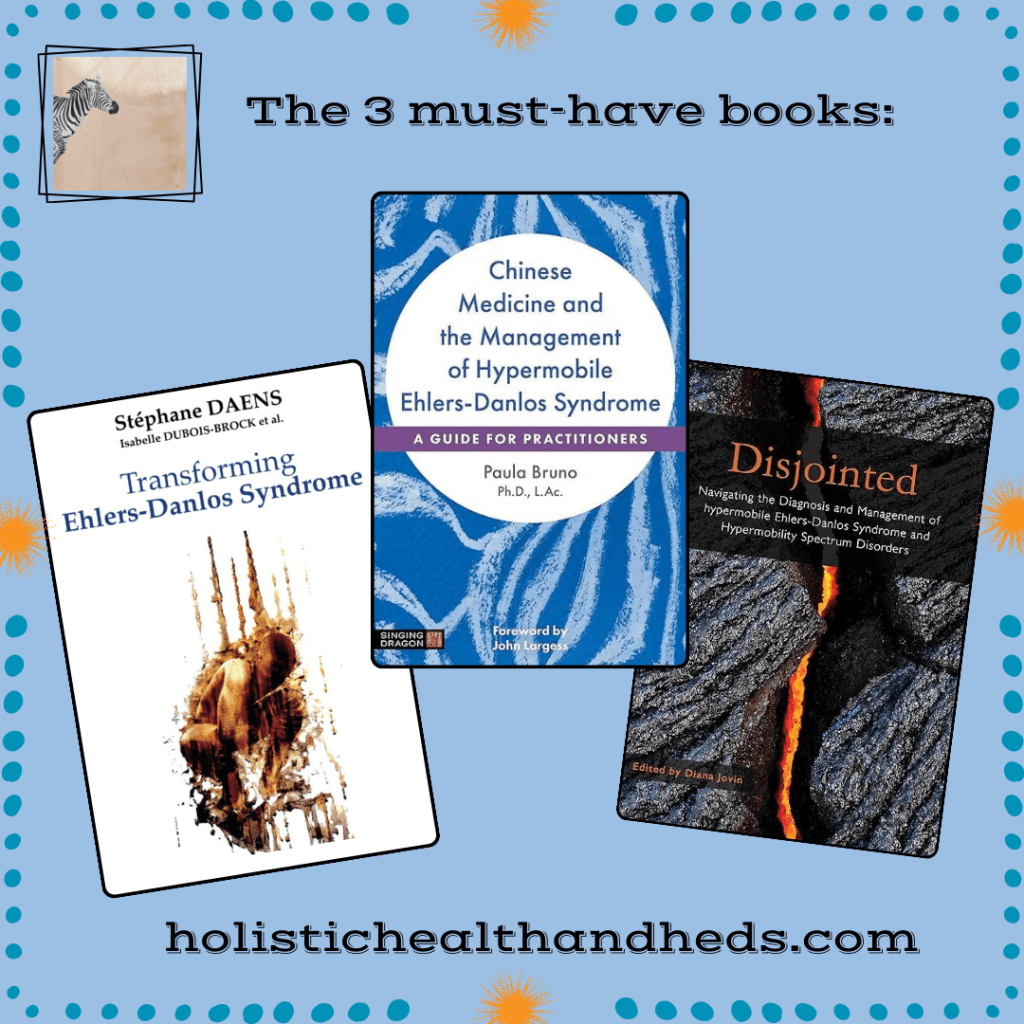
Disjointed1 is a must-have. When I was in graduate school for my first two master’s degrees and the Ph.D., I kept a copy of the Princeton Encyclopedia of Poetry and Prose on desk alongside staples like A New Reference Grammar of Modern Spanish. These weren’t the books to read for relaxation. But as desk references? They were fantastic. Disjointed is the precisely the same type of book. Each entry is thorough and well-referenced and each section covers quite a bit of ground. In my estimation, this is a book that everyone should own.
Transforming Ehlers-Danlos Syndrome: A Global Vision of the Disease2 offers a similar collection of professional essays. While Disjointed is a thoroughly American text, Transforming represents the heartfelt labor of a Belgian physician and his colleagues. There are some amusing quirks to its writing voice that are likely due to its having been translated from French to English and the viewpoints are decidedly, and enjoyably, European.
If I were starting to build my EDS library I would start with Disjointed because it covers everything, from soup to nuts as the saying goes, and then I would supplement my knowledge and build my learning via comparison and contrast through close reading of Transforming. I personally enjoyed the second book more and view the first as being somewhat dry but potentially more useful, especially for an American readership.
Moving from American and European biomedical resources to Chinese medicine means adding my book to the bookshelf. Its title, Chinese Medicine and the Management of Hypermobile Ehlers Danlos Syndrome: A Guide for Practitioners,3 makes it sound like you need to be an acupuncturist to find it useful but that’s not the case. The book covers not only treatment approaches and modalities but also discusses key themes like diagnosis (or not), chronic illness cultures, medical PTSD, Chinese medicine as a world medicine, and more.
In my first career, I was a Spanish professor. For some courses (example: Survey of Hispanic Literature), I could allot only two measly class periods to the Spanish Civil War. With other classes (example: Literature of the Spanish Civil War), I had the whole semester to focus solely on this crucial period in Spanish history, culture, and literature. My entire first career was all about synthesizing massive quantities of information so that students who were not working in their native language could understand it and learn it. This background has a lot to do with how I was able to pack so much into the book, to make it accessible and interesting, and to nurture readers into learning new ways to critically think about EDS in under 300 pages. You will leave your reading of it with an appreciation for Chinese medicine and what it, as a world medicine, can do for people with connective tissue disorders.
*****
*****
Comorbid conditions:
A person could put together a massive collection of tomes in the attempt to build a knowledge base regarding all the comorbid conditions that a person with EDS might have. Though the must-haves, above, all address comorbidity, it helps to have books specifically pertaining the subject at hand. And as a theme, the “what else?” of EDS is most certainly a topic that can send someone on multiple different tangents and down one rabbit hole after the next.
A better option is to purchase The Dysautonomia Project: Understanding Autonomic Nervous System Disorders for Physicians and Patients.4 Somewhat akin to Disjointed, the reader is presented with an anthology, this time of the autonomic nervous system and how it can go awry. What I like about it is the way it presents the material. On the left-hand pages, there is a simple explanation of things for patients. On the right-hand pages, there is clear, professional narrative for practitioners, biomedical or otherwise. Having both accounts facing one another is extremely helpful for all readers.
This is a book to purchase and set next to your copy of Disjointed. Those in the community who struggle with POTS should find this book very useful, as will any of us who experiences brain fog, fatigue, palpitations…in sum, this is a good book to have on hand.
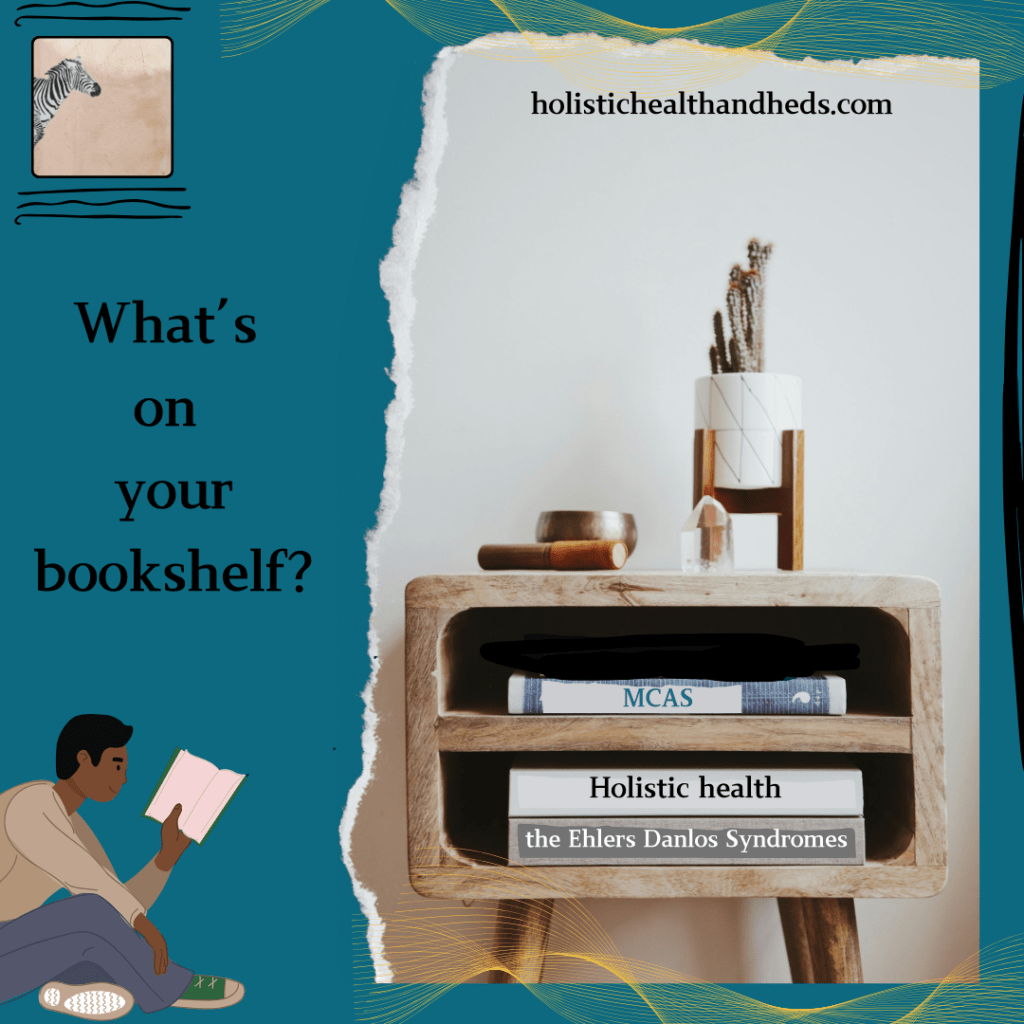
Amber Walker’s Mast Cells United5 is an exceptionally good resource for anyone who is afflicted by MCAS. She’s thorough, her writing voice is reasonably accessible, and the information is valuable. She feels pretty strongly about the topic, given that she, herself, has aberrant mast cells. This is a book that could be ordered from the library if you aren’t unduly attached to the subject but if you are on Team MCAS sufferer, it is a reference to own.
My Crazy Life: A Humorous Guide to Understanding Mast Cell Disorders6 by Pamela Hodge is a good book for anyone who wants to learn about mast cell dysfunction in a super-easy way. This book was written by a regular, everyday person with extreme mast cell activity. Not everyone has the energy to read books written by medical care providers. If you don’t have the spoons for denser narratives, then this is a great resource for you. I do think that this is a good book to borrow from the library but it could be one to keep, depending on how it resonates with you.
Personally, I love Lawrence Afrin’s Never Bet on Occam: Mast Cell Activation Disease and the Modern Epidemics of Chronic Illness and Medical Complexity7 but if you’re squeamish or easily discouraged it is a tough read. It’s essentially one case study after the next and each patient suffers with extremely complicated presentations. It was published in 2016 and it is a little dated today, but it’s an eye-opener and useful, especially if read alongside Walker’s book. I’d get this one from the library unless I felt very strongly about the topic.
*****
*****
Culture:
The above-listed resources are foundational but there is more to EDS than what healthcare providers have to say about it. Being able to identify with writers and creative works is affirming and useful.
One of the recurring themes of my book is the discussion of cultures and, of the suggestions I make in the book, I will say that a treasure of a memoir is The Invisible Kingdom: Reimagining Chronic Illness8 by Meghan O’Rourke. The author writes so movingly about the progression and digressions of her chronic illness and anyone with mystery diseases will feel a sense of kinship with her. She was diagnosed with EDS, though that is not a focus of her discourse. Instead, she parses out what it means to go from being healthy to sick, and she unravels one fine thread after the next in the tapestry of her life as a person with a complex condition. Anyone with EDS or complicated illness will feel seen and heard and not so alone after reading this beautiful memoir.
Maya Dusenbery’s book, Doing Harm: The Truth about How Bad Medicine and Lazy Science Leave Women Dismissed, Misdiagnosed, and Sick,9 is a good one to get from the library. I own it and am glad I purchased it but even just one reading will give you what you need to know. To wit: gaslighting is a serious concern for all of us, and women have special considerations when it comes to dealing with the modern biomedical industrial complex. If you have ever have been treated badly by your medical care providers and wonder if the problem is you, this book might change that perception. It is an important book and people with chronic illness, no matter their gender, will benefit from reading it.
Men are not as well-represented in EDS narratives but An Accident Waiting to Happen: A Life With Ehlers Danlos Syndrome,10 self-published by a retired teacher in the UK, is one to consider buying, especially if you want to see things from a guy’s perspective.
If you want to dissect the way illness is constructed and identities of sickness are created, Arthur W. Frank’s The Wounded Storyteller11 is superb. He is an academic and writes in an academic’s voice (I can cast no stones at him for this; I fight my professor voice all the time when I write). You will read his book and notice how chronic illness is granted a limited menu of narratives: restoration (things get restored; i.e., the patient gets better), chaos (no, no happy ending or cure here), or the quest (akin to the hero’s journey). If you are chronically ill, you may gain some insight into the way such narratives affect your self-perception.12
We don’t owe anyone a hero’s journey or a tidy ending, do we? Nor, let’s keep in mind as we move on to the final sections of our library, does anyone with chronic illness owe the world the presentation of a safely chaste and unthreateningly bland sexuality.
What do you think?
*****
*****
Sex:
As my former students and current patients and health coaching clients all will attest, I am all about the “knowledge is power” attitude. Plus, as a literature PhD, my answer to everything is to suggest a book to read. Old habits die hard (or they don’t die at all, as I suspect will be the case in this context). In any event, I think that anyone’s library is enriched by having some worthy resources about sex and sexual health. The ones I mention here are the ones I suggest to my patients.
Coco Berlin’s Pussy Yoga: Pelvic Floor Training for Radiance, Confidence, and a Fulfilling Love Life13 is a book that I recommend often because it’s so cheerful and gung-ho on the subject of the female pelvic floor. It’s hard to finish this book and remain ashamed or uncomfortable about your undercarriage because Berlin is just so jolly and encouraging. There are good line drawings of the pelvic floor that are clear and understandable. The exercises and breathwork that she outlines are helpful and doable. This is a lovely book to purchase and keep for reference and for inspiration.14
The Penis Book: A Doctor’s Complete Guide to the Penis–From Size to Function and Everything in Between15 is wonderful and a book to buy and retain in one’s library. Its author, Dr. Aaron Spitz, is a urologist and this book is informative, cheerful, accessible, and helpful. As a practitioner with an area specialty in men’s health, I used to be surprised by how little men know about their own bodies, pelvic floors, and reproductive organs. No longer. I’m more surprised by guys who actually do know much about themselves at this point. Anyone who ever see me for erectile dysfunction is urged to buy and read this book. It’s one to keep.
It’s not enough to know about one’s reproductive organs and pelvic floor. Finding support, community, and creative options for healthy sexual expression (whatever that might mean for you) are also crucial aspects of zebra wellbeing.
A good book for sexual health and practices is The Handi Book of Love, Lust & Disability16 compiled by siblings Andrew Gurza and Heather Morrison. This collection of essays, art, and poetry by folks from within the disabled community is their first book. The Australian activists have changed their name, and their second volume, The Bump’n Book of Love, Lust & Disability, reflects their evolution. If you’re not interested in the books, at least take a look at their blog. This is disability sexuality by and for people with disabilities. I love the way they insist on their place at the table…their rightful place at the table, mind you.
In conclusion:
There is a lot of information floating around. The biomedical context has constructed certain stories; people’s lived experiences create others. And yet, complex and chronic illness tends not to fit neatly into easy narratives, as anyone familiar with EDS will already know.
As a humanities scholar, I tend to view a reading list as a map-making project, one that will create a common set of references between a group of readers. As a practitioner of Chinese medicine, I view this project along the same lines. This is a condition that often does require Western biomedical supervision and intervention, and–to a certain degree–biomedical narratives constrain what it means to be a person with connective tissue disorder. We need our must-have readings and a shared medical story, true. But we also need our communities’ experiences and their voices. A broad, yet well-thought, reading list that includes cultural approaches and a hearty screw-you to those who think that disabled peopled have no sex drive is a healthy response to a challenging condition, I think.
What do you think? And what, consequently, is on your reading list?
*****
*****

Paula Bruno, Ph.D., L.Ac., is a licensed acupuncturist and herbalist, an AOBTA-CP traditional Chinese bodywork therapist, an author, and a health coach. She maintains an active and growing practice at Two Hearts Wellness, her Austin, TX office. Dr. Bruno is also available for distance appointments for wellness consultation or coaching.
In her first career, she was a Spanish professor.
Dr. Bruno’s specialties as a Chinese medicine practitioner include: • Musculoskeletal health (acute or chronic pain relief; Ehlers Danlos syndrome & hypermobility support) • Digestive support, gut health, and weight loss • Aesthetic treatment, including scar revision • Men’s health • General preventative care and wellness support for all persons.
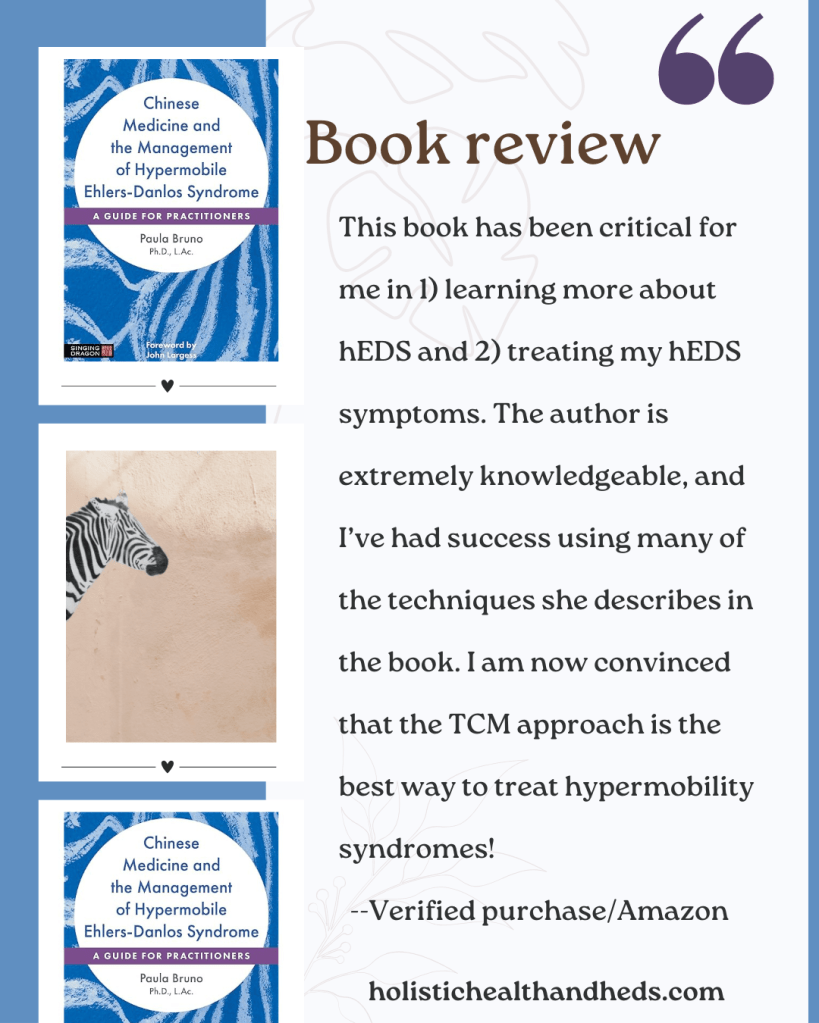
She is the author of Chinese Medicine and the Management of Hypermobile Ehlers Danlos Syndrome: A Practitioner’s Guide.
When you are ready to discover what traditional medicine plus a vibrant and engaged approach to holistic health can do for you, either contact Dr. Bruno or book an appointment online.
*****
*****
Holistic Health & hEDS does not accept paid advertising on this website
Note: Material on this web site site is not intended to diagnose, prevent, treat, or cure any disease, illness, or ailment. A Chinese medicine practitioner in Texas identifies syndrome patterns but does not diagnose illness. Material on this web site does not purport to identify syndrome patterns.
*****
- Note: I do not have an Amazon affiliation and do not profit by linking the books in this essay. Readers are encouraged to purchase from whichever source is most convenient, be it Amazon or other. Jovin, Diane, ed. Disjointed: Navigating the Diagnosis and Management of Hypermobile Ehlers-Danlos Syndrome and Hypermobility Spectrum Disorders. San Francisco: Hidden Stripes, 2020. ↩︎
- Daens, Stéphane and Isabelle Dubois-Brock, et al. Transforming Ehlers-Danlos Syndrome: A Global Vision of the Disease. 1st ed., English. Belgium: The GERSED, 2022. ↩︎
- Bruno, Paula. Chinese Medicine and the Management of Hypermobile Ehlers-Danlos Syndrome: A Guide for Practitioners. London: Singing Dragon, 2023. ↩︎
- Freeman, Kelly, David S. Goldstein, and Charles R. Thompson. The Dysautonomia Project: Understanding Autonomic Nervous System Disorders for Physicians and Patients. Bardoff & Company, 2015. ↩︎
- Walker, Amber. Mast Cells United: A Holistic Approach to Mast Cell Activation Syndrome. Amber Walker, 2019. ↩︎
- Hodge, Pamela and Daniel Hodge. My Crazy Life: A Humorous Guide to Understanding Mast Cell Disorders. 3d ed. Lulu.com, 2014. ↩︎
- Afrin, Lawrence B. Never Bet Against Occam: Mast Cell Activation Disease and the Modern Epidemics of Chronic Illness and Medical Complexity. Sisters Media, 2016. ↩︎
- O’Rourke, Meghan. The Invisible Kingdom: Reimagining Chronic Illness. New York: Riverhead Books, 2022. ↩︎
- Dusenbery, Maya. Doing Harm: The Truth About How Bad Medicine and Lazy Science Leave Women Dismissed, Misdiagnosed, and Sick. Harper One reprint edition, 2019. ↩︎
- Howard, Philip. An Accident Waiting to Happen: A Life With Ehlers Danlos Syndrome. CreateSpace Independent P: UK, 2015. ↩︎
- Frank, Arthur W. The Wounded Storyteller: Body, Illness, and Ethics. 2nd ed. Chicago: U of Chicago P, 2013. ↩︎
- The chaos narrative is one familiar to chronic disability and it is the one most silenced. See “Claiming Chaos Narrative, Emerging from Silence” for commentary. ↩︎
- Berlin, Coco. Pussy Yoga: Pelvic Floor Training for Radiance, Confidence, and a Fulfilling Love Life. Trans. Rebecca Darby and Anne Kavanaugh. Germany: Aleksandra Kettelhoit-Lohmann, 2021. ↩︎
- A less “fun,” per se, but extremely good book for women’s pelvic floor knowledge is Blandine Calais-Germain’s The Female Pelvis Anatomy & Exercises. ↩︎
- Spitz, Aaron. The Penis Book: A Doctor’s Complete Guide to the Penis–From Size to Function and Everything in Between. Rodale Books, 2018. ↩︎
- For all text mentioned, refer to Bumpn’s website and do not forget to take a look at their blog. ↩︎
 Holistic Health and hEDS