
What is going on with my body? … Why is this happening to me? … Hypermobility? Hypermobile Ehlers Danlos syndrome…what is that? And what causes it? …
People with dysfunctional connective tissue have a lot of questions, and rightfully so. Without a diagnosis–or at the very least, a coherent narrative regarding their unique presentation–patients with HSD/hEDS face one obstacle after the next in their quest to find meaningful treatment.
And even with a diagnosis, there is no cure.
When my patients ask the crucial question (that would be: “What can I do so that I might live my best life with this disorder?”) I think that it can be helpful to consider the why, the cause, or the roots of hEDS. At first, as I do here, I focus on the Western narrative; just as when a person is learning a new language, culture, or literature, it helps to ascertain what they already know in their native parlance. (A summary of how Chinese medicine parses out syndromes and patterns is a complete essay in and of itself, one that will appear here on Holistic Health and hEDS in due time.1)
But where, when it comes to hEDS from an allopathic perspective, to begin?
Of the thirteen official subsets of the Ehlers Danlos syndromes, only the hypermobile version has no specific universal genetic mutation that unequivocally signifies hEDS. This lacuna in scientific knowledge makes it challenging for people whose lives are marked by this ostensibly rare condition. An hEDS diagnosis is clinical; consequently, if a patient can achieve such designation, it is hard-won and may be undercut by changes in diagnostic criteria.
And yet…genetic mutations have been identified and there are intriguing theories regarding etiology (in other words, cause) and pathogenesis (development) of hEDS. In this essay, I present a summary of the six theories regarding causative factors that are most significant at the time of this writing. There is more to it than what I share; hence, the sources in the endnotes.
Note: the question of why any of these theories matter contains multitudes; my brief commentary in this area is meant only to inspire further discussion and critical thought.
Without further ado, then, some whys:
A specific genetic marker?
The holy grail of “why” for many is a specific genetic marker. Indeed, it is likely that a number of mutations cause the condition and researchers appear confident that a gene or a selection of problematic genes will ultimately be identified as the driver behind hEDS.2
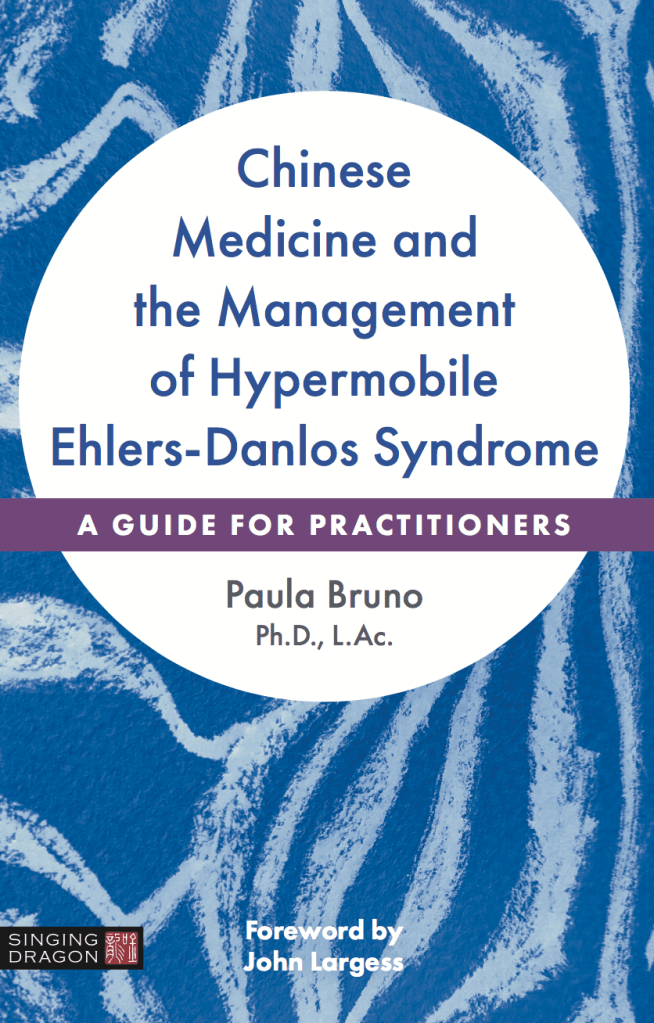
“So very much hinges on the notion of finding a genetic link, a visible (though not tangible) something that says: ‘Here it is, right here. The disorder exists and the patient has it.’”
—Chinese Medicine and the Management of Hypermobile Ehlers Danlos Syndrome, pg. 139
I’ve seen enough patients who have a notable family history of hypermobility and mystery illnesses and I am definitely team “Scientists will identify a gene or genes.” Is the gene the be-all, end-all, though?
Two reasons why this matters: It’s hard to gaslight a patient with an identified genetic marker for hEDS. Also: some people really do need a diagnosis.3
The Role of Physical Trauma
Some people start out as normies but then, after a concussion, whiplash, or other major trauma, they develop hypermobile EDS. In fact, French researchers reviewed extant literature and came to the conclusion that, and I quote: “physical trauma could be a triggering factor in EDS.”2
One example of this scenario pertains to an active member of the international community, the Belgian physician and co-author of Transforming Ehlers Danlos Syndrome (2022). After being attacked and injured, Dr. Daens developed hEDS.3
“In my clinical experience, I have treated patients who had no signs of EDS until they either suffered a concussion or whiplash, after which they developed disabling hypermobility and other comorbid conditions.”
—Chinese Medicine and the Management of Hypermobile Ehlers Danlos Syndrome, pg. 266, note 4

Why is this important? It raises more questions about how vulnerable any one of us is and invites further investigation into the whys of hEDS.
An Autism Connection
Neurodivergence is not uncommon and can be a factor in an hEDS presentation. In fact, current research points to a connection between autism and hEDS.4
Anxiety and/or depression can also be part of the larger picture. The patient may be struggling because of life events, trauma, and/or their reaction to their condition. It could be that the patient’s sympathetic nervous system is hyper-reactive, and what feels like anxiety is actually a chronic, debilitating fight or flight response.
Both scientific literature and my clinical experience correspond in this regard: it’s never a surprise to find neurodivergence and/or a psycho-emotional component to the patient’s presentation.
“For some, the argument that hEDS is a manifestation of autism is persuasive.”
—Chinese Medicine and the Management of Hypermobile Ehlers Danlos Syndrome, pg. 241
Why does this matter?: The depths and breadth of the mind-body connection are writ large across the experiences of people with hEDS.
Folate deficiency
Drs. Jacques Courseault and Gregory Bix at Tulane identified mutations in the MTHFR gene along with a pattern of high folate (B9) in the blood of hEDS patients in their clinic. The resulting build-up of unprocessed B9 in the patient’s blood is concurrent with folate deficiency because the vitamin is not being metabolized. They argue that this deficiency interferes with the way certain proteins bind collagen within the extracellular matrix, thus causing altered connective tissue and hypermobility.5
“[…] gene mutations associated with hEDS have been identified and research findings continuously shift narratives. In addition, there are some fascinating ideas regarding the immune system’s role in collagen dysfunction, not to mention others pertaining to metabolism of folate.”
—Chinese Medicine and the Management of Hypermobile Ehlers Danlos Syndrome, pg. 34
Why this matters: Nutrition can be a point of departure for hEDS wellbeing and folate and other vitamins merit review.
The Extracellular Matrix
The extracellular matrix (or ECM), is a network made up of collagen, fibronectin, proteoglycans, and lamina. Sabeeha Malek in the UK is focusing on dysfunction in cells that help with the formation of connective tissue (fibroblasts) and the way cells function within the ECM in order to support healthy (or not) connective tissue.6
“An upcoming generation of current graduate students is also breaking new ground. At Warwick University in England, Sabeeha Malek is undertaking research that focuses on alteration in cell adhesion and cytoskeleton dynamics.”
—Chinese Medicine and the Management of Hypermobile Ehlers Danlos Syndrome, pg. 266, note 3
Her findings raise questions about whether or not the collagen really is the problem and how, instead, structural adhesion within the ECM might be a more important concept than hitherto understood.
Why is this significant?: These findings are valuable for diagnosis efforts and potentially useful for the treatment of vEDS.
MCAS
Each person who lives with HSD/hEDS is unique. Some people have an unmistakable family lineage. Others had an accident that changed their lives. For some, this writer included, aberrant mast cells are a likely culprit.
“At about the time frame when [this book], Chinese Medicine, was in an embryonic stage, Lawrence Afrin gave a talk and subsequently published a paper that presented a novel theory. In his estimation, and given the failure to discover a genetic link to hEDS, Afrin posited that some manifestations of hEDS might be due to mast cell activation syndrome (MCAS).”
—Chinese Medicine and the Management of Hypermobile Ehlers Danlos Syndrome, pg. 210
In my personal and my clinical experience, Dr. Afrin’s theories ring true for some patients.7
Why this matters: It’s a call to arms for investigation into environmental damage, for one thing. It also speaks to the protean quality of this disorder.
In conclusion (at least for now)
Genetics are a key aspect of diagnosis but a coherent narrative of a person’s daily life and experience within their own body is comprised of many additional factors.
It is normal to want to know why, and a defective gene makes sense. When aberrant DNA can be codified as such, a narrative, consequently, can be contained within it. Furthermore, the discovery of an unequivocal genetic marker will be useful, both for diagnostic purposes and for research into a possible cure. In sum: scientific advances will one day, I assume, designate a specific genetic why (or several).
But this still leaves us with the most important question for people who live with hEDS or HSD, and that is: “What can I do so that I might live my best life with this disorder?”
Answering this last is another essay, if not a reiteration of my book as a whole. But once a professor, always a professor, and my short answer here and now is: keep asking that question.
Keep asking.
The answers will change as your knowledge base and your experience level shift over the fullness of time. What helped you when you were younger will not be the same once you are older. What benefited one patient might not ever be useful to you. You need to learn about yourself, first and foremost. And your practitioner needs to listen to you and work with you (as opposed to gaslighting you and demanding compliance without regard for your consent). Do not take the first answer you are given as you develop your wellness team and your treatment strategies. Living well with (or in spite of) EDS requires self-advocacy and a lot of mindful effort. Your healthcare practitioners should nurture and support your development in this realm.
Keep asking.
There is always something a person can do or discover, and while some of us have to be more strategic and dedicated as we create and nurture our wellness strategies, it is always possible to remain hopeful, realistic, and self-compassionate. This is a marathon, not a sprint, and–most importantly–knowledge is power. You are a student of your own life if you so choose, and yes, the journey of a thousand miles begins with that first one.
Where, then, will you begin?
*****
*****

Paula Bruno, Ph.D., L.Ac., is a licensed acupuncturist and herbalist, an AOBTA-CP traditional Chinese bodywork therapist, an author, and a health coach. She maintains an active and growing practice at Two Hearts Wellness, her Austin, TX office. Dr. Bruno is also available for distance appointments for wellness consultation or coaching.
In her first career, she was a Spanish professor.
Dr. Bruno’s specialties as a Chinese medicine practitioner include: • Musculoskeletal health (acute or chronic pain relief; Ehlers Danlos syndrome & hypermobility support) • Digestive support, gut health, and weight loss • Aesthetic treatment, including scar revision • Men’s health • General preventative care and wellness support for all persons.
She is the author of Chinese Medicine and the Management of Hypermobile Ehlers Danlos Syndrome: A Practitioner’s Guide.
When you are ready to discover what traditional medicine plus a vibrant and engaged approach to holistic health can do for you, either contact Dr. Bruno or book an appointment online.
~~~~~~


Notes:
- How we diagnose in Chinese medicine constitutes an entire chapter in my book, Chinese Medicine and the Management of Hypermobile Ehlers Danlos Syndrome: A Practitioner’s Guide and discussion of this theme runs through the entire book. ↩︎
- To learn more about this topic, refer to “MUSC researchers
announce gene mutation discovery associated with EDS” (http://tinyurl.com/yvra3pnf), “Researchers Found New Possible Causative Gene For HEDS: MIA3” (http://tinyurl.com/4tb78ztb), and “Mutation in MIA3 gene a likely cause of hEDS, study suggests” (http://tinyurl.com/423h2bvx). The June 2024 announcement by the Norris Lab, “Variants in the Kallikrein Gene Family and Hypermobile Ehlers-Danlos Syndrome,” shared then-new findings regarding genetics and hEDS. In September of 2025, a shared preprint, “Complex Genetics and Regulatory Drivers of Hypermobile Ehlers-Danlos Syndrome: Insights from Genome-Wide Association Study Meta-analysis” concluded with the declaration that, and I quote: “In conclusion, while generalized joint hypermobility and tissue fragility remain hallmark features of hEDS, our genetic findings suggest a broader pathophysiological model, in which hEDS present features of a neuroimmune–stromal disorder, in which inherited variants disrupt regulatory pathways across connective tissue, neurodevelopmental pathways, immune, neurological, pain, and gastrointestinal systems.” ↩︎ - Whether or not a person wants or needs a diagnosis is unique to the individual in question. This is another theme that runs throughout Chinese Medicine and will, more likely than not, be addressed in a blog post here at Holistic Health and hEDS. ↩︎
- To follow up on research on connections between physical trauma and hEDS, see “Brain injury unmasking Ehlers-Danlos syndromes after trauma: the fiber print” at http://tinyurl.com/y6x6zm3n. ↩︎
- For Dr. Daens’s narrative in his own words, see Transforming Ehlers-Danlos Syndrome: A Global Vision of the Disease, pg. 36. ↩︎
- Refer to“The Relationship between Autism and Ehlers-Danlos Syndromes/Hypermobility Spectrum Disorders” (tinyurl.com/3ekbffj3) for an in-depth discussion of this issue. ↩︎
- The scientists’ theory and reasoning behind it can be found here: “Folate-dependent hypermobility syndrome: A proposed mechanism and diagnosis” (http://tinyurl.com/5yf5expe). ↩︎
- Though potentially a challenging read for non-scientists, I highly recommend “The Role of Cell Adhesion and Cytoskeleton Dynamics in the Pathogenesis of the Ehlers-Danlos Syndromes and Hypermobility Spectrum Disorders” (http://tinyurl.com/bdhyxabm) for anyone who would wish to follow up on this consideration. ↩︎
- Lawrence Afrin’s article, “Some cases of hypermobile Ehlers-Danlos syndrome may be rooted in mast cell activation syndrome” (http://tinyurl.com/2627hwmh), is accessible for non-scientists and it is a key piece of the hEDS puzzle. Stéphane Daens subsequently wrote an essay on this topic that was translated from its original French into an even more readily-available explanation of this phenomenon (“I Spent My Saturday Translating This Life-Changing Article About EDS and MCAS Into English”), here: http://tinyurl.com/tmhdy78u ). ↩︎
 Holistic Health and hEDS