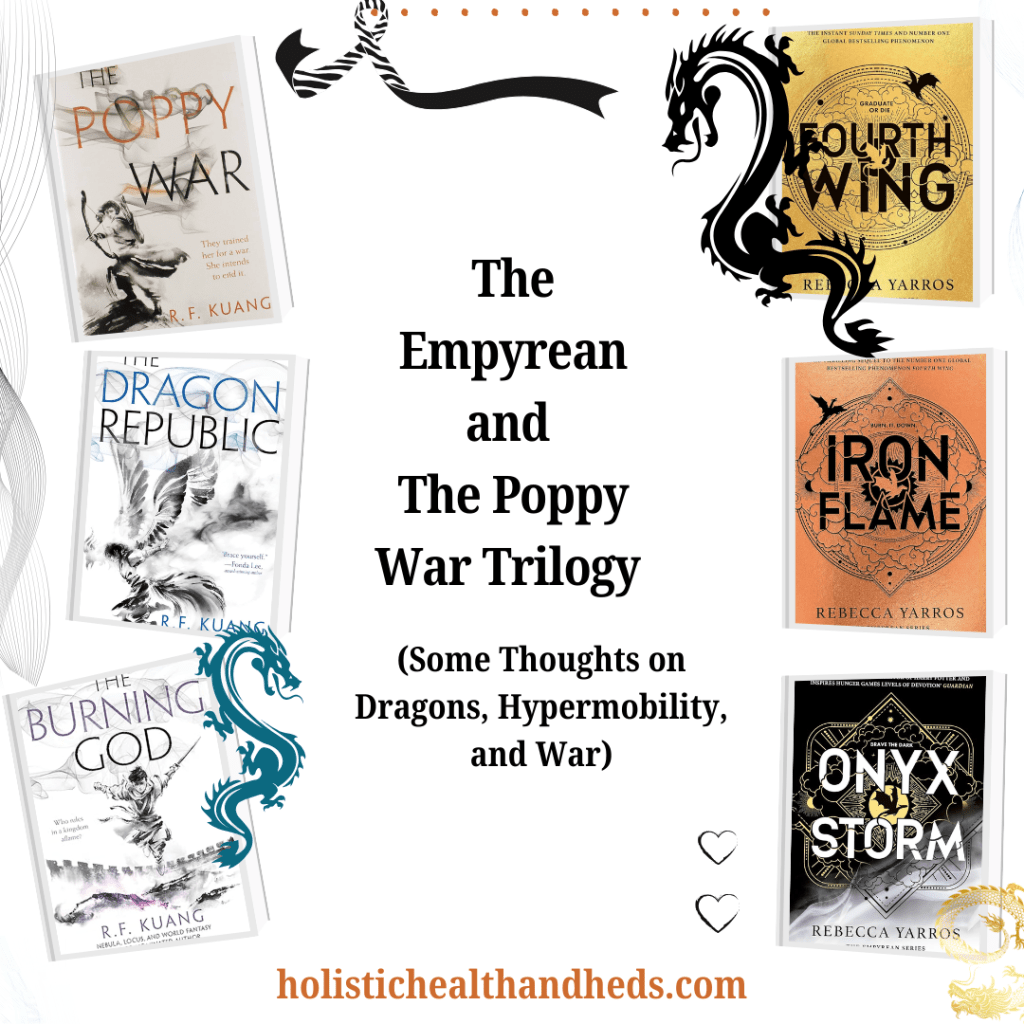
Did you expect to feel moved when you read The Empyrean series by Rebecca Yarros only to find that the main character, one Violet Sorrengail, lives with her book world’s version of hypermobile Ehlers-Danlos Syndrome? Would you be more interested in Rin, the protagonist of The Poppy Wars series if you discovered that she, too, is hypermobile? Representation matters, and it is meaningful to see one’s own folks in the pages of one’s favorite popular novels.
As a practitioner of Chinese medicine and a literature Ph.D., I definitely have thoughts about these characters and the worlds they inhabit. I am going to restrain myself, though, and keep this blog post fun. There is so much to say about either or both, and the key word of this blog post is going to have to be restraint.
You’ll just have to read these books for yourself, trust me. But with some caveats. Definitely, be aware of the caveats.
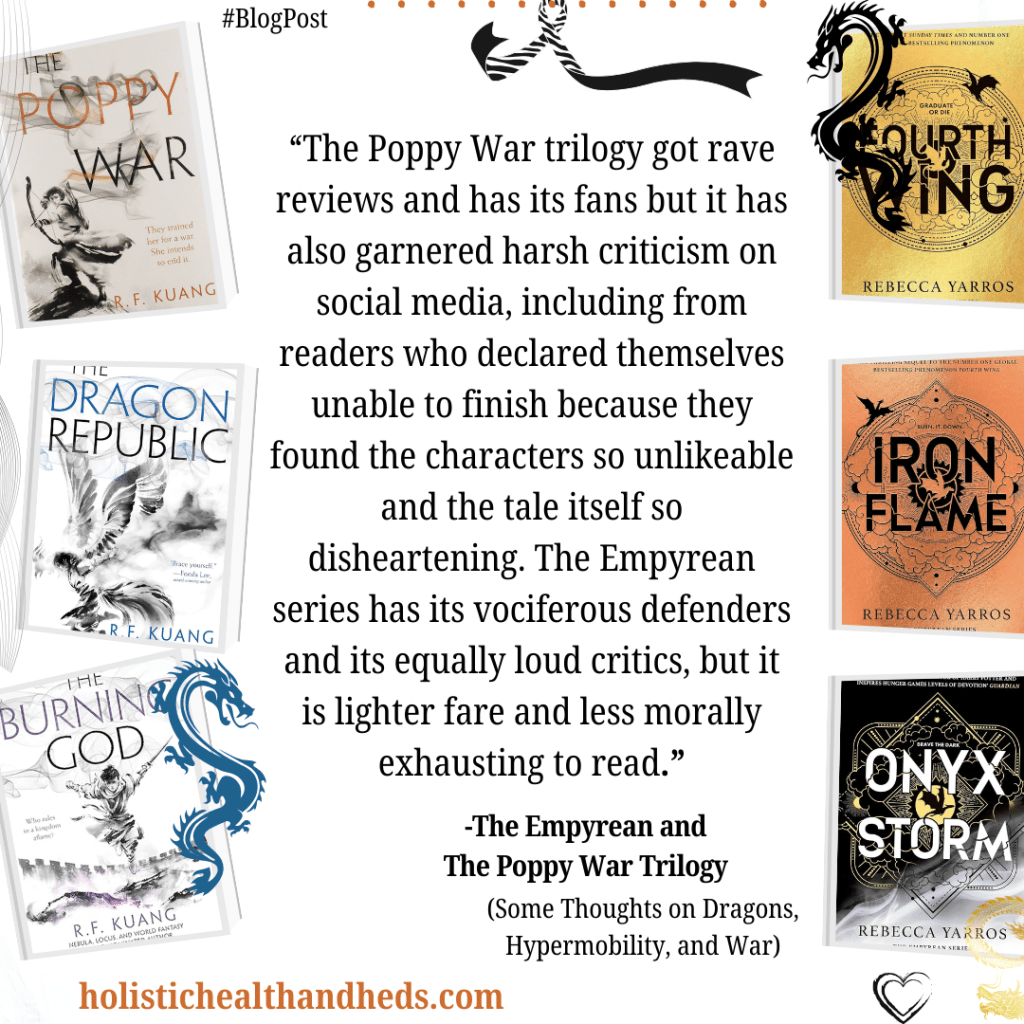
The Poppy War series was written by RF Kuang, a Chinese-American woman who was only nineteen years old when she started writing the first volume. The collection is deemed grimdark, a type of narrative that is dystopian, characterized by hopelessness, and steeped in brutality. The trilogy got rave reviews and has its fans but has also garnered harsh criticism on social media, including from readers who declared themselves unable to finish because they found the characters so unlikeable and the tale itself so disheartening. The Empyrean series has its vociferous defenders and its equally loud critics, but it is lighter fare and less morally exhausting to read.
*****
*****
In my first career I was a Spanish professor and my area was national trauma (civil war, dictatorship, genocide, and torture) and how it filters through art and literature. Though I later focused more on realist/non-fantasy and visual narrative in the form of photographs, especially, I wrote my doctoral dissertation on how fantasy, the literary fantastic, and magical realism are used to engage with and work through trauma. That was just the start of a lifetime of study. For me, The Poppy War trilogy is familiar on many levels. It definitely took me back to my scholarly years. I used to study certain texts in controlled batches. Reading about atrocity is less painful if you take breaks at intervals and avoid the most graphic narratives when you are already having a rough day, for instance. Same thing with The Poppy War. I read in timed intervals and took breaks.
For me, The Poppy War trilogy is familiar on many levels. It definitely took me back to my scholarly years. I used to study certain texts in controlled batches. Reading about atrocity is less painful if you take breaks at intervals and avoid the most graphic narratives when you are already having a rough day, for instance. Same thing with The Poppy War. I read in timed intervals and took breaks.
The Empyrean is a romantasy and, though I am quite familiar with the genre and its strategies, it’s The Poppy War series that resonate most with me professionally. Iron Wing and its sequels are fun books, although the spicy scenes are a little cringey and, overall, it’s not necessarily the deepest set of novels on the planet. I actually have read the ACOTAR series by Sarah J. Maas too, but I’m not a romantasy fan. I only started The Empyrean because I’d heard that Violet was hypermobile and yes, I did end up enjoying the books. And yes, I could teach a course on the series because I am well-versed in fantasy narratives. But to really spread my wings and truly serve the marvel that is my professional acumen in this realm? It would be The Poppy War books for me. They would make a fun course to create and deliver, no doubt about it.
Well, I mean: fun if you study trauma, atrocity, and entities like dragons. Which I did back when I was a professor. (And, as I think anyone who reads my blog knows, I’m still Professor Bruno in my heart where it counts, so…)
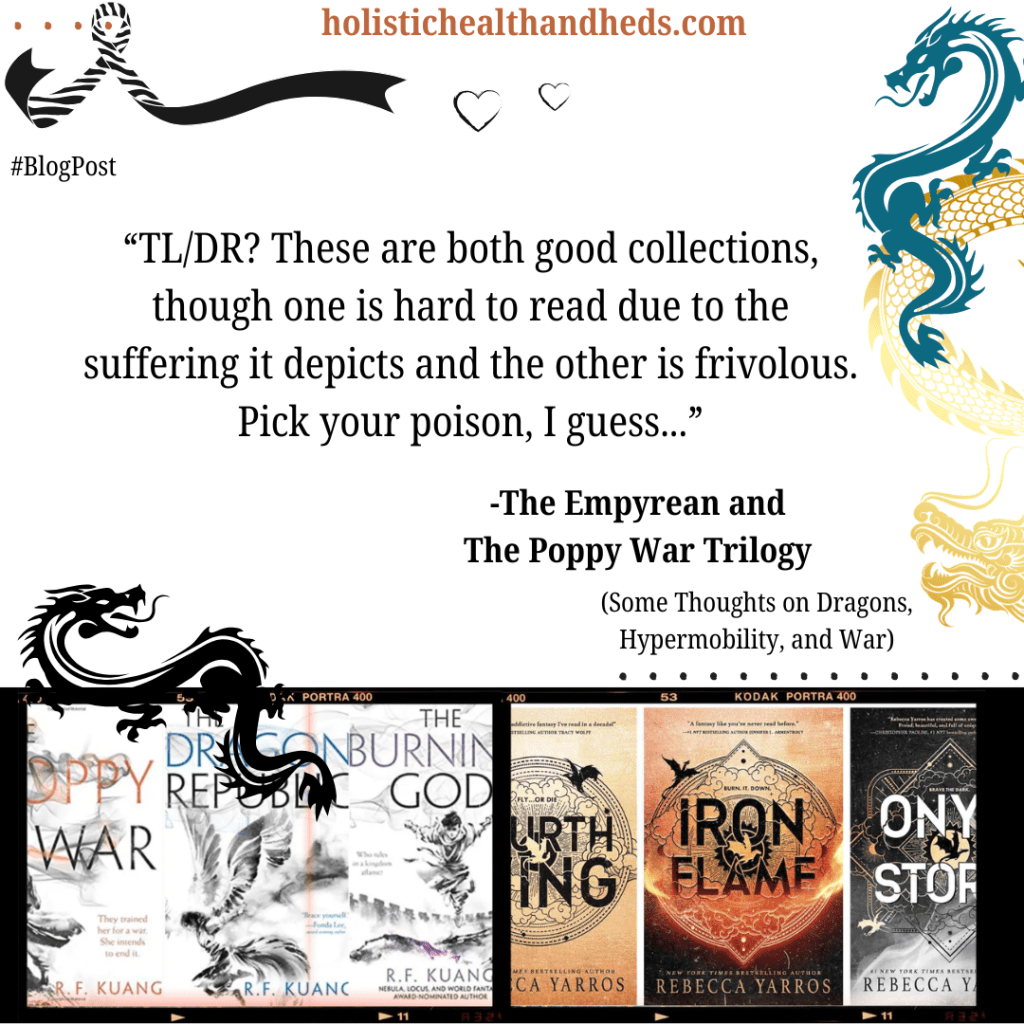
TL/DR? These are both good collections, though one is hard to read due to the suffering it depicts and the other is frivolous. Pick your poison, I guess…
*****
*****
Hogwarts and Hunger Games and a Touch of ACOTAR
The Poppy War (Book 1): The series is set in Nikan (aka China), a country ruled by the Jade Empress (also known as the Viper or the Vipress), and divided into twelve provinces named after the animals of the Chinese zodiac. Fang Runin (Rin) is a war orphan whose evil adoptive mother (an opium dealer) plans to sell her into marriage to a much older man. Rin instead studies for a national exam and secures a place at a military academy. There, students are elite scions of the warlord families that rule the individual provinces. Also there: Rin finds her power as a shaman and is taken on by Master Jiang, a disgraced teacher who is linked to the chaotic shaman world. By book’s end, the Federation of Mugen (Japan) invades, the Vipress betrays, and Rin brings forth the power of the Phoenix god in defense of her country.
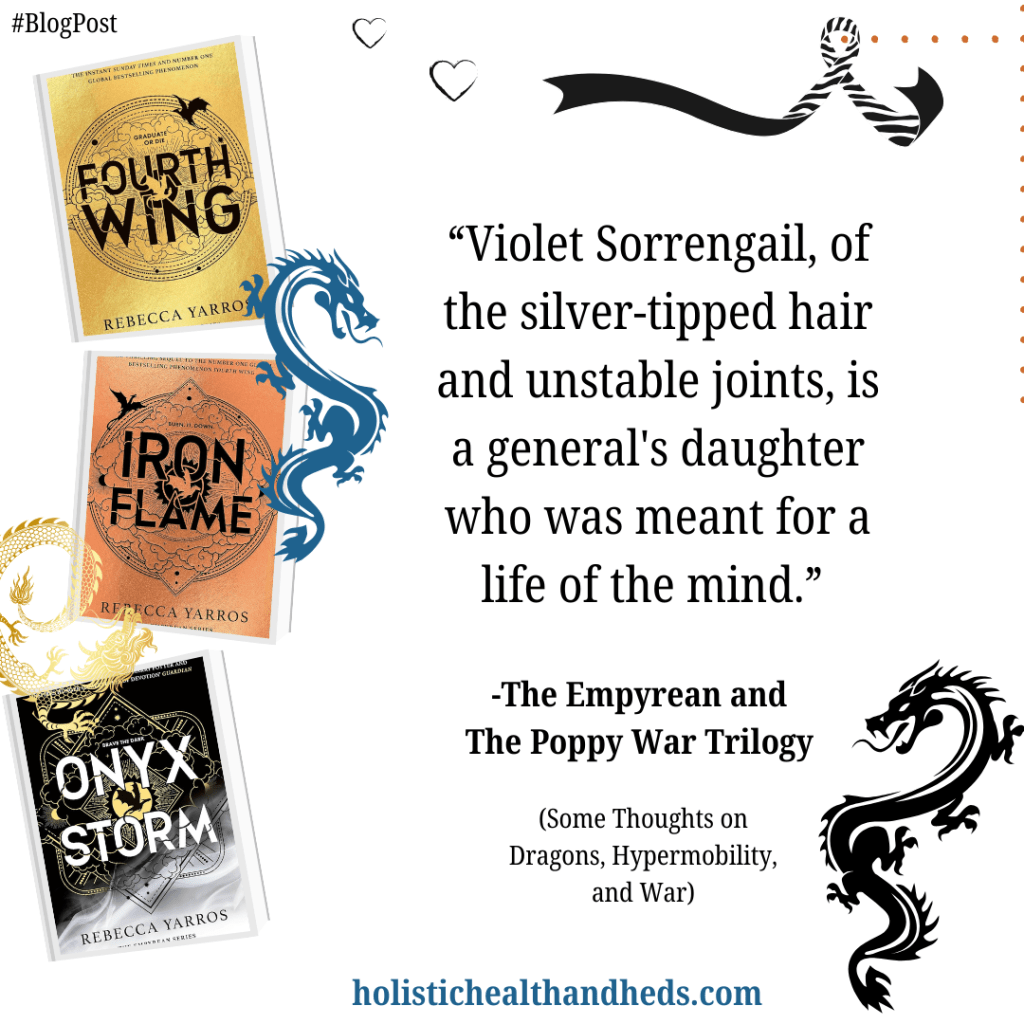
Fourth Wing (Book 1): Violet Sorrengail, of the silver-tipped hair and unstable joints, is a general’s daughter meant for a life of the mind. Her story is set in fictional Navarre and begins at Basgiath War College, where she is forced by said general to walk a parapet into the Rider Quadrant, thus bypassing her original destiny within the Scribe Quadrant. She survives her first year and bonds with not just one extremely powerful and unique dragon, but an unheard of two. Navarre is beset by border incursions and mysterious undercurrents. Violet, though disabled by her condition, perseveres. She navigates both a love triangle (Daen, the good boy/childhood bestie who wants to protect her vs. the Xaden, the brooding hottie whose father was the face of the rebellion) and the brewing conflict with aplomb.
*****
*****
Ah, the intertextuality…!
Anyone who wants to read these books with an eye for catching Harry Potter allusions will not be disappointed (or, depending on how they feel about JR Rowling, will be left feeling let down).1 Both novels are set in quasi-magical wizard’s boarding schools. Violet, in her world, is repeatedly tagged as being brilliant (I don’t see that; rather, I see a good memory and someone who is well-read, but she didn’t strike me as being a critical thinker) and her framing is strikingly like that of Hermione Granger, who is described as the most clever witch of her generation in the HP universe. She’s got a bit of Katniss Everdeen, too: Violet is a girl who has lost her father, and she is one who can climb trees and poison enemies and fight through pain.
Xaden and his friends initially are the tributes if one reads this as portraying a hunger game. All children of the executed rebels are required to become dragon riders, which is a way to see that they all get killed in battle as punishment for their parents’ rebellion effort. Eventually, though, Violet and her friends (children of loyalists) are also drawn into war. There is no end to the cyclical violence against which they do battle. Their world is one big arena and they revisit the conflicts of previous generations over and over and over again.
Violet does not emulate her literary godmothers when it comes to love, in any case. She chooses Xaden (the Harry Potter/Gayle) over Dane (the Ron Weasley/Peeta). Godmother Feyre from ACOTAR, for her part, gifted Cadet Sorrengail with a smart mouth and a vigorous sex drive. After all, Xaden Riorson is not just equivalent to the chosen one (Harry Potter) or the warrior from the Seam (Gayle)… because really? He is such a Rhysand, the most powerful High Lord of all time and the ruler of the Night Court from ACOTAR. (Thank you, Auntie Feyre!).
Rin, for her part, is a Harry Potter–she’s an orphan, she doesn’t fit in at first (but give her time, because she is chosen for…well, you’ll see). And when she and her friends are thrown into their arena, readers can see Rin as a faltering Katniss. People only follow her because she’s so powerful but she is not loved and she is not the face of anyone’s rebellion. She is not a girl on fire or a mockingjay but, instead, an opium-addicted, rage-filled conduit for the Phoenix god who possesses her when she steps into her role as shaman.
This is not a romantasy and Rin is only alluded to being in love with (and loved by) her nemesis from school, Nezha, the second son of the Dragon Lord. But she wasn’t created to burst forth as a romantic lead. Upon experiencing her first menstrual period, Rin chose to take medication to disrupt her womb and render herself infertile. She views herself as a coarse product of the Rooster province. Nothing happens between her and Nezha. There are no spicy scenes in any books in this trilogy and Rin’s body exists only as an instrument for war and a vector for fire and ash and pain.
One the subject of bodies in pain? Well. Violet is hypermobile and Rebeccas Yarros, her author–and her author’s children, too–have hEDS. Being a physically fragile and emotionally and intellectually tough person is the essence of this character. Part of why Violet is beloved (and why the series is so popular) is that she represents the hypermobile community the way she does. She needs accommodations in order to succeed and, with them, she is able to not just keep up with her peers but, instead, exceed them. She speaks for many, and with verve, too.
Violet is an interesting hypermobile person, from my perspective as an acupuncturist who treats EDS. For one thing, she breaks bones more than I would expect from someone with hEDS (unless they either struggle with osteogenesis imperfect, aka brittle bone disease). She doesn’t have MCAS or (as far as I noticed), POTS or other manifestations of dysautonomia. And–ok, I’m just going to say it–Xaden is, shall we say, endowed and they have really vigorous intercourse. If Violet is that hypermobile (and he’s that endowed and their intimacy is truly that wild) then how she doesn’t end up with her own cervix coming out her nose after he’s done with her I do not know. (I’m only slightly exaggerating here. The point being, really, is that people with EDS are more apt to experience pelvic organ prolapse than the average normie and things like popping out one’s hip sockets is not unusual either so it is a little striking how much rampaging she and her partner do).
And–ok, I’m just going to say it–Xaden is, shall we say, endowed and they have really vigorous intercourse. If Violet is that hypermobile (and he’s that endowed and their intimacy is truly that wild) then how she doesn’t end up with her own cervix coming out her nose after he’s done with her I do not know. (I’m only slightly exaggerating here. The point being, really, is that people with EDS are more apt to experience pelvic organ prolapse than the average normie and things like popping out one’s hip sockets is not unusual either. That she and Xaden can have such an excellent time without injury is remarkable in this context).
Rin is a different story and her mobility is not a plot point. She’s just tough, inside and out. The only reference to her being unusually flexible way comes in this first book, and it’s brief:
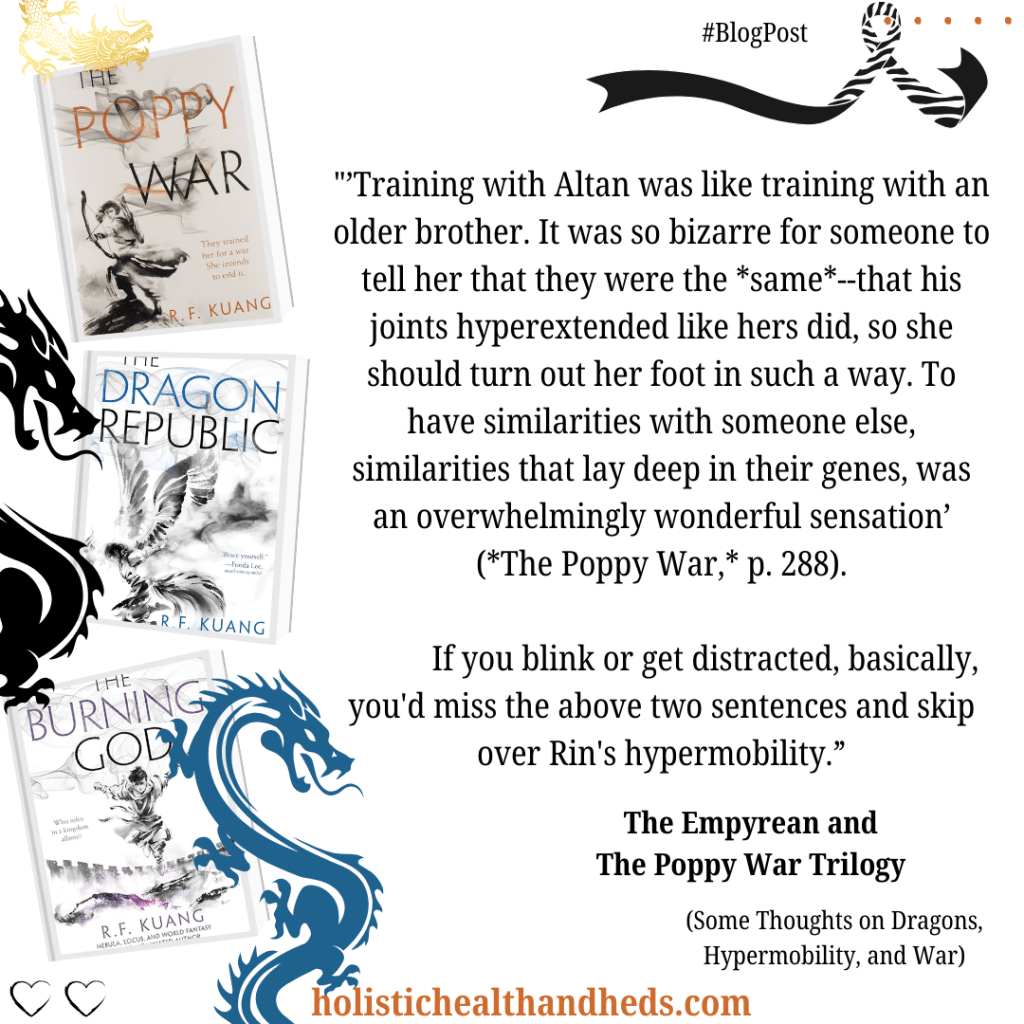
“Training with Altan was like training with an older brother. It was so bizarre for someone to tell her that they were the same–that his joints hyperextended like hers did, so she should turn out her foot in such a way. To have similarities with someone else, similarities that lay deep in their genes, was an overwhelmingly wonderful sensation” (PW, 288).
If you blink or get distracted, basically, you’d miss the above two sentences and skip over Rin’s hypermobility. We have to wait until the second book to be given another snippet of clue regarding Kuang’s recognition of hypermobility or chronic pain, in fact.
*****
*****
Here be Dragons…
The Dragon Republic (Book 2): This book has Rin and her allies aligning with the Dragon warlord to remove the Viper and stabilize Nikan. Annihilation by the Federation of Mugen (aka Japan) and betrayal by the Empress are not the only threats. The twelve warlords were ostensibly loyal to the duplicitous Empress, but their infighting and corruption contribute to the undermining of national integrity. Hesperia (aka the West) meddles, bringing religion and dangling offers of help against the Mugenese, but both are falsehoods that compound threats both external and internal. Book two presents Rin as deeply traumatized and its relentless depictions of genocide are overwhelming for not just literary characters but also readers. This is not an easy book to digest by any means.
Iron Flame (Book 2): There’s conflict within the war college (the evil Major Varrish is dispatched to stir the pot there) and throughout the border states (embodied by evil creatures called venin who ride two-legged dragon-like creatures with venomous tails and a thirst for blood). Old enemies (gryphon riders) become allies. Cadets at the war college eventually have to decide whether they will stay at Basgiath or leave to fight the encroaching evil that is becoming stronger and stronger. Violet and Xaden argue about being truthful and honest with each other. Violet’s second dragon is growing up quickly, but disabled by a wing that doesn’t completely unfurl. By the end of the book, war is upon them and Xaden has been turned into a venin. What, then, will Violet do to save not only her country but also the man she loves?
Ancestral trauma and Greek tragedy
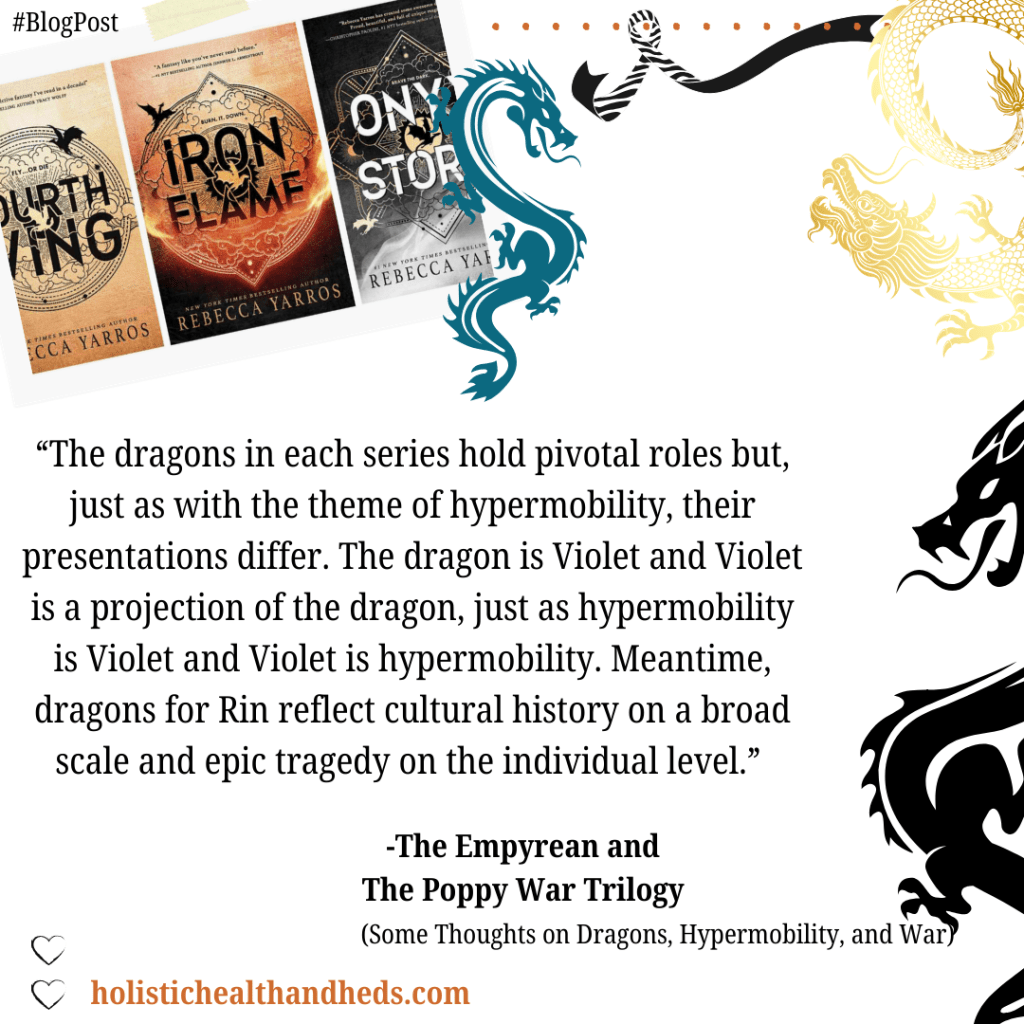
The dragons in each series hold pivotal roles but, just as with the theme of hypermobility, their presentations differ. The dragon is Violet and Violet is a projection of the dragon, just as hypermobility is Violet and Violet is hypermobility. Meantime, dragons for Rin reflect cultural history on a broad scale and epic tragedy on the individual level. In The Empyrean series, dragons and their riders communicate telepathically and are bonded to the extent that if one dies, the other goes along too. Dragons are a projection of self in Violet and Xaden’s universe. In The Poppy War trilogy, dragons are wrathful and divine.
*****
*****
In The Dragon Republic, readers get to know the Dragon warlord, Yin Vaisra. His ostensible aim is to create a republic that is powered by military might and mythical divinity. His second son, Nezha, was destined for the Sinegard Academy but the boy’s life is marked by what may well be a generational curse. He takes his little brother, Mingzha, out to the river near their home and a dragon kills and eats the child. He then takes possession of Nezha the way that the Phoenix claimed Rin. Like Rin, he suffers and, though he is never described as hypermobile, a comrade remarks at one point that, “Nezha’s been a prick his whole life. I imagine it’s hard to be pleasant when you are in chronic pain” (The Dragon Republic, p 624). There is something intrinsically wrong with Nezha, clearly, but the fatal flaw here is never entirely articulated and thus the reader is left to speculate.
Basgiath College, on the other hand, maintains its similarities with Hogwarts over the course of The Empyrean. Varrish, for instance, is a male version of Dolores Umbridge, and when he makes Professor Carr oversee Violet’s punishment for not producing her smaller dragon on command, the way she is forced to wield lightening until she drops is reminiscent of when Harry was forced to write I will not tell lies on his own hand with a magic pen that draws blood. When Varrish tortures Violet, one cannot help but remember the scene in Umbridge’s office before the students take her out to the Forbidden Forest and escape, leaving her to the untender mercies of the centaurs.
Iron Flame ends with a battle scene that is redolent with the ghost of chapter 31 of Harry Potter and the Deathly Hallows and its depiction of the Battle of Hogwarts and the showdown with Voldemort.
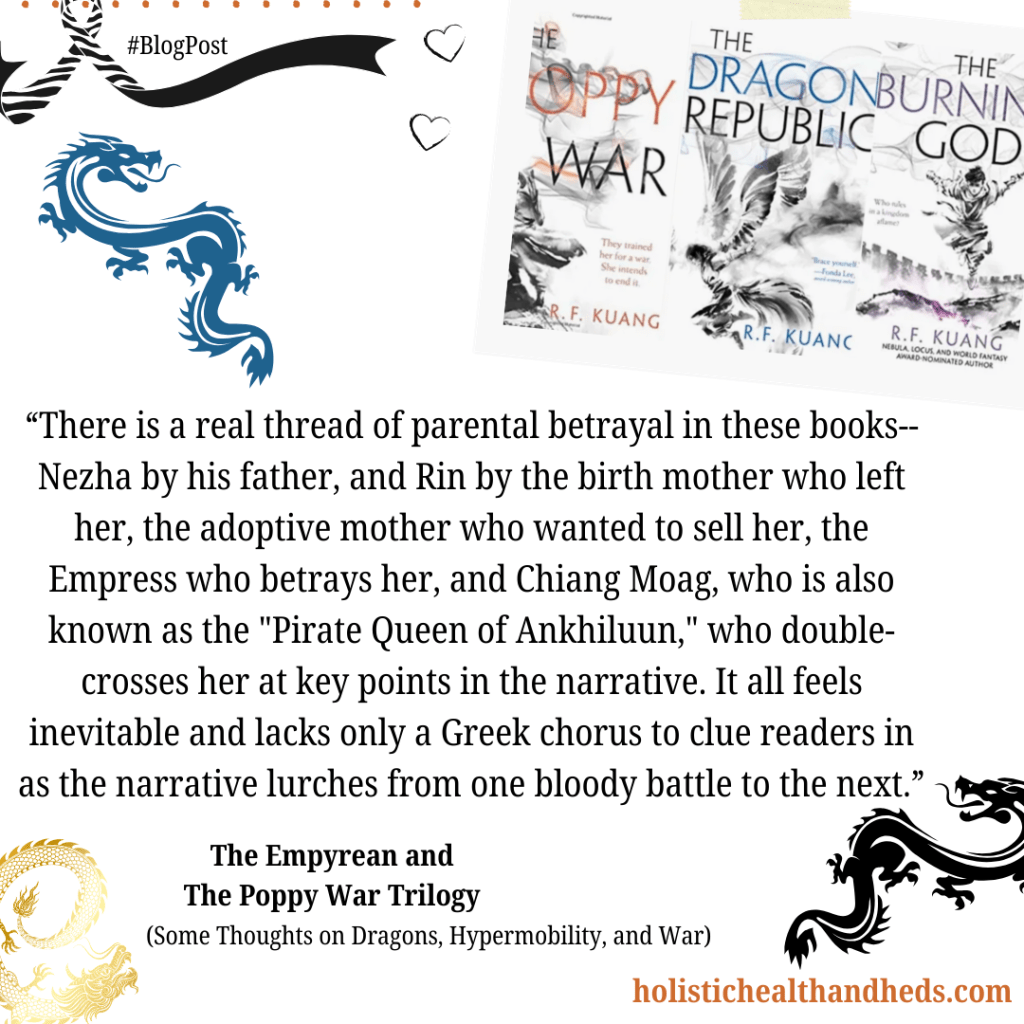
Nezha’s fate, for its part, feels more like a frustrated version of the Oresteia. Or something. Definitely tragic and laden with bitter inevitability. There is a real thread of parental betrayal in these books–Nezha by his father, and Rin by her birth mother who left her, the adoptive mother who wanted to sell her, the Empress who betrays her, and Chiang Moag, who is also known as the “Pirate Queen of Ankhiluun,” who double-crosses her at key points in the narrative. It all feels inevitable and lacks only a Greek chorus to clue readers in as the narrative lurches from one bloody battle to the next.
*****
*****
In Conclusion: No Conclusion
The Burning God (Book 3): The series concludes in a blaze of trauma and chaos. Rin, now, is a military leader crushed by the soul-destroying options offered by the Federation, the Hesperians, the warlords, the Empress, and the pantheon of Nikan’s ancient gods. Keep fighting or surrender? What about the endless killing fields and the waves of cruelty and violence, the starvation and the displacement and the abuse? Rin has become a monster. Nikan will implode from within or be massacred by the Federation of Mugen or be overtaken by Hesperia. The warlord who prevails will be a humiliated figurehead, beholden to either the Muganese or the Hesperians. As conduit to the Phoenix god, she might be expected to rise from the ashes. But Rin is so damaged (as is her country) that a conclusion showing this figure triumphantly overcoming is not even remotely realistic and in fact does not occur.
Onyx Storm (Book 3): The varying factions (Navarre, Poromiel, and the Tyrrendor) unite to combat the invading venin army. A specific venin, the silver-haired Theophanie, emerges as an ongoing threat. To save Navarre and its neighbors from the hordes, Violet looks to both her dragons (her second one, Andarna, may hold a key to lasting peace) and her father’s legacy (he was a scribe and he left her a trail of books that she must follow). Xaden takes his place as the rightful Duke of Tyrrendor but eventually his transformation into a venin is complete. Battles and quests fill this third installment. Violet eventually prevails in her fight to the death with Theophanie. The narrative concludes with Violet returning to Riorson House as Duchess of Tyrrendor, her memories wiped clean but in possession of a wedding ring on her finger and a marriage certificate in hand. (But where, though, is Xaden?).
*****
*****
Stay tuned for what might come next…
As unrelenting as chronic pain, both narratives conclude without conclusions. Onyx Storm has an excuse: there are supposed to be two more installments before the denouement. The Burning God is inconclusive because it’s one grand metaphor and a literary trope. War and ancient grievances never really end; instead, they recycle in the form of ancestral trauma, continued conflict, and a destiny–like any good tragic hero’s–that has no outlet other than catharsis and the option of a repeat unless the gods are somehow appeased. In other words, a repeat.
When will humanity ever learn from its mistakes? (You know the answer: probably never).
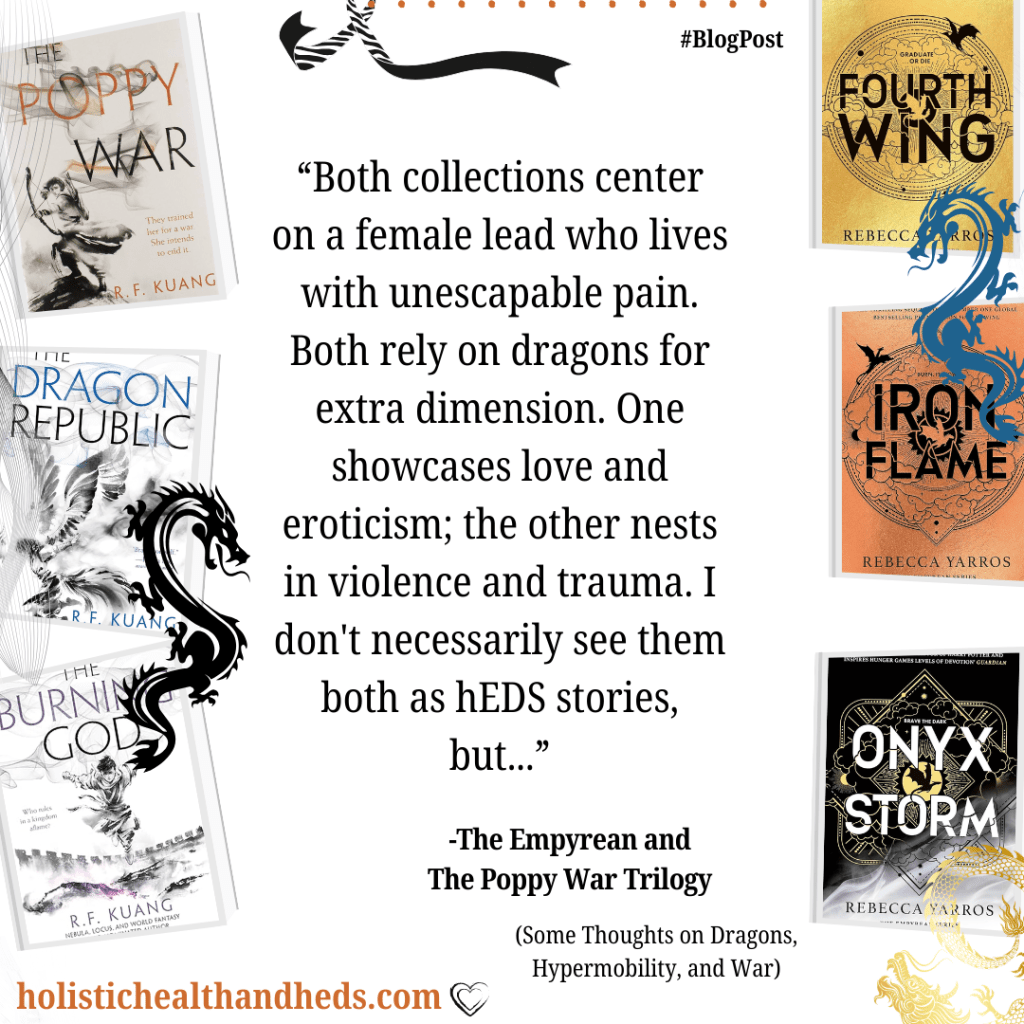
Both collections center on a female lead who lives with unescapable pain. Both rely on dragons for extra dimension. One showcases love and eroticism; the other nests in violence and trauma. I don’t necessarily see them both as EDS stories, but since Rin is hypermobile, I was inspired to look at that connection between the two series. Probably, if it weren’t for that, I might–instead–find a more fruitful comparison in the dragons or the war colleges or the heroine’s journey of the one and the hero’s lonely path in the other. I’d have a good time with the intertexual references (who wouldn’t, when there is such a rich vein of connection between these and other popular narratives?). But Kuang gave that description of genetic ability to loosen one’s inner bonds at the joint and it stuck with me, I guess.
What do you think? And which series speaks more to you?
*****
*****

Dr. Paula Bruno, Ph.D., L.Ac., is a licensed acupuncturist and herbalist, an AOBTA-CP traditional Chinese bodywork therapist, an author, and a health coach. She maintains an active and growing practice at Two Hearts Wellness, her Austin, TX office. Dr. Bruno is also available for distance appointments for wellness consultation or coaching.
In her first career, she was a Spanish professor.
Dr. Bruno’s specialties as a Chinese medicine practitioner include: • Musculoskeletal health (acute or chronic pain relief; Ehlers Danlos syndrome & hypermobility support) • Digestive support, gut health, and weight loss • Aesthetic treatment, including scar revision • Men’s health • General preventative care and wellness support for all persons.
She is the author of Chinese Medicine and the Management of Hypermobile Ehlers Danlos Syndrome: A Practitioner’s Guide.
When you are ready to discover what traditional medicine plus a vibrant and engaged approach to holistic health can do for you, either contact Dr. Bruno or book an appointment online.
*****
*****
Two Hearts Wellness/Holistic Health & hEDS does not accept paid advertising on this website
Note: Material on this web site site is not intended to diagnose, prevent, treat, or cure any disease, illness, or ailment. A Chinese medicine practitioner in Texas identifies syndrome patterns but does not diagnose illness. Material on this web site does not purport to identify syndrome patterns.
*****
- For the most part I really have never paid much attention to British literature aside from, say, Tolkien (whose work I love) so I didn’t engage with the Harry Potter series until my second graduate program when my bestie there turned me on to the Potterverse. I’ve written a couple blog posts about HP-themed material and even now I do remain fond of the narratives. And yet… It truly saddens me to see Rowling trying to gin up hostility against trans persons. I don’t like it. I still retain my fondness for the books and will discuss them in relation to other texts (as I do here) but I no longer buy HP merchandise and am reluctant to share my related blog posts (one of which was republished in a fan magazine). ↩︎
 Holistic Health and hEDS