
Self-care when you live with a complex disorder like EDS (especially if you have the usual add-ons like MCAS or POTS) is crucial…but what, for a person with chronic illness or pain, does this term actually mean? And how can a person create a meaningful program if they already dedicate considerable energy to making it through the day relatively intact? Self-care, like everything else, has an extra layer of nuance for anyone who lives with a chronic condition.
The purpose of this blog post is to inspire some thought and to share tips for folks who are complicated. And yes, there is a blog post on Two Hearts Wellness, my original website. It was written for normies but you can find some pearls of wisdom in it nonetheless.
“As a practitioner of Chinese medicine, as a health coach, and from my perspective as a human being who has had to learn to take good care of herself, I do have thoughts regarding self-care that bear no resemblance to the pop culture narrative of it. Instead, I view self-care as a life practice, and one that evolves as a person’s needs shift and change. Anyone who is familiar with my social media posts will know that I bring up the topic regularly. This is a topic very dear to my heart!”
“Self-Care. No, Really…What Is It?“
So what about the life practices of people with chronic conditions?
The occasional mani-pedi as a treat or the facial or other special something is just as valid for people with the trifecta as it is for a person whose most pressing health concern is an occasional cold or a patch of situational fatigue or anxiety. Everyone deserves fun and treats, no doubt about it, but the more frivolous or superficial versions of self-care don’t always address the genuine needs of a person with hEDS, MCAS, and/or POTS. On top of that…when we live with chronic conditions, we often already feel guilty for the amount of time we spend on the self-maintenance that is absolutely necessary if we want to get through our day relatively intact.
When is the last time you considered your understanding of the term self-care? Do you blur self-care and self-maintenance, or do you see the first as an indulgence (that may or may not be available to you) and the second as an ideal (that you maybe struggle to achieve)? Where does a mindful practice fit into these polar opposites? One thing to keep in mind is that there is a middle ground between self-care and self-maintenance.
As a practitioner of Chinese medicine, I am always about the balance and, as a humanities scholar, I think it can always improve things if there’s creativity involved. Consequently, I share this short list of possibilities in the hope that either some (or all) are resonant, or–if not–they at least inspire.
*****
Get inspired
I don’t know how self-actualized you are, but when my life-long sensitivities developed into full-blown MCAS and I couldn’t eat anything but five specific things and I had to schedule my whole life around experiencing flares, avoiding flares, and recovering from flares…I struggled. It was hard to feel anything other than pain and fear and exhaustion and despair. I’m a literature PhD, though, with a minor in art history and I sought refuge in my library. Humanity at its most raw, real, and fine are in books and other art, and resting within them can expand horizons and inspire compassion for self and for other. If this is not self-care, then what is?
Art and online museums: Going to a museum requires a lot of energy, it may set you up for an exposure to COVID, and it can be expensive, especially if you don’t live in a big city. But so many museums now have online options and there are individual artists to follow if you are interested in what fellow zebras have to offer. Making time to connect with inspiration is an act of self-care for your soul (and if you prefer to read, then finding online library resources can do the same).
Note: There are a number of contemporary artists with EDS, including but not limited to Lori Earley, Lauren Rubin, and Jacob Chandler, whose story can be found here. Take a look at this essay, “Amy Scoggins’ ‘The Caretaker And The Warrior’: Advocating for Ehlers-Danlos Syndrome” which details the process of an artist mother creating a work to honor her daughter’s battle with EDS. See also the short magical realist documentary, “The Body is a House of Familiar Rooms.”
Creativity: We sometimes lose touch with things that don’t relate to our condition. Focusing on something, no matter how small, that has nothing to do with the illness and everything to do with joy or interests or aspirations is a form of self-care. You know what your experience of Ehlers-Danlos syndrome means to you…so what else, if you look, is available, and how can you build something–anything, even if it’s small–that has less to do with illness and more to do with simple, everyday enjoyment of color or sound or flavors or…?1
Compassion practice: Altruism feels good, and even if we don’t have a lot of resources, it still can be healing to look around and see who may benefit from an act of kindness. Cut yourself some slack (that’s an act of kindness for many of us) and then maybe shift some of that energy towards seeing others around you with compassionate eyes. What can you do with this lesson?
Do something different
It is way too easy to fall into a rut and stay there. People who enjoy good health may putter along their well-worn paths for decades before doing so leads to boredom or anxiety or poor health. Folks with chronic illness don’t have that luxury. We need to work harder to find ease and it takes greater creativity to flourish. The following tips are an invitation to view and re-view ways of seeing the world.
Distraction: How do you take your mind away from your challenges? If the answer is that you doom-scroll or otherwise zone out in ways that don’t enrich your mind and/or spirit, then a true act of self-care is to figure out how to change that dynamic. Any time spent trying out different options and learning how to distract in healthier ways is genuine self-care.
Find something new every day: Everyone’s life has a certain level of routine to it. That’s normal, but when we calcify our habits, especially when life tests us day after day after day, then maybe it’s time to practice seeing new perspectives. Can you spend a couple minutes each day to review something–anything–around you and look for a new way to perceive it? Brain training to learn how to see in new ways is self-care, and it’s a way to remind yourself of a bigger picture that may, if you reframe it, hold inspiration or contain a pearl of wisdom.
Guided meditation: It usually takes practice to calm the mind and be present in a non-grasping manner but learning to focus in this way can be a lifesaver. This is not easy for normies and it’s not any easier for people with chronic conditions. Either finding an online source that soothes or by working with someone who provides support, meditation can develop into a healthy practice when there is a guide.
*****
Try something new
Getting into a rut is not just for daily life. When ongoing medical treatment is a feature not a bug, it’s easy to focus on certain aspects of one’s program and forget that there are other possibilities. Conversely, we might start chasing every new thing we read about online and that, just as much as an unchanging routine, can be unhealthy. What about mindfully trying new health activities and doing so in a non-attached way? That’s self-care.
Learn about different healing approaches: When I first heard the term “tui na,” I thought it sounded funny and I couldn’t even imagine what would be so different about Chinese-style medical massage. Over a decade later, I continue to be amazed by the artistry of Asian bodywork therapy in general and tui na (pronounced “twee nah”) in particular. There is a range of options available and, by exploring them, you are practicing self-care that is both indulgent and that might be perfect for you and your condition.2
“It seems unbelievable when I look at it, but the first blog post I wrote about tui na and EDS went live in September of 2017.”
“Ehlers-Danlos Syndrome, Tui Na, and You” Revisited (Some Thoughts on the OG Blog Post)
Fluffy objects and foot massage: The best-case scenario is tui na for your feet (I think, anyway). But if that’s not an option, do just keep in mind how good it can be to pay attention to one’s feet. Finding ways to keep these appendages happy, from a massage ball to brushing them across something soft and tactile to soothing foot soaks, is an act of self-care that feels good and can positively affect overall wellbeing.
Acupressure: Not all of my patients derive benefit from acupuncture and, instead, they thrive with acupressure and/or seeds. There are a lot of good learning options online, but it is better to at least have one appointment with a professional to discuss point choice, technique, and plan for self-care treatment. I particularly like to create at-home acupressure protocols for my patients and have noticed that becoming good at it can build confidence and a sense of self-efficacy.
In conclusion (at least for now)
Some of these things you can try on your own; others might work better for you if you have some structure provided by a psychotherapist, a mentor, or a guide of some sort. A health coach or a practitioner of Chinese medicine could support you in meaningful ways too. There are many, many options for building your self-care practice. Whether your focus leans more towards the care end of things or the maintenance side, it’s important to remember, always, that meaningful self-care is crucial and–most of all–that you deserve it.
Yes, you do.
*****
*****

Dr. Paula Bruno, Ph.D., L.Ac., is a licensed acupuncturist and herbalist, an AOBTA-CP traditional Chinese bodywork therapist, an author, and a health coach. She maintains an active and growing practice at Two Hearts Wellness, her Austin, TX office. Dr. Bruno is also available for distance appointments for wellness consultation or coaching.
In her first career, she was a Spanish professor.
Dr. Bruno’s specialties as a Chinese medicine practitioner include: • Musculoskeletal health (acute or chronic pain relief; Ehlers Danlos syndrome & hypermobility support) • Digestive support, gut health, and weight loss • Aesthetic treatment, including scar revision • Men’s health • General preventative care and wellness support for all persons.
She is the author of Chinese Medicine and the Management of Hypermobile Ehlers Danlos Syndrome: A Practitioner’s Guide.
When you are ready to discover what traditional medicine plus a vibrant and engaged approach to holistic health can do for you, either contact Dr. Bruno or book an appointment online.
*****
Two Hearts Wellness/Holistic Health & hEDS does not accept paid advertising on this website
Note: Material on this web site site is not intended to diagnose, prevent, treat, or cure any disease, illness, or ailment. A Chinese medicine practitioner in Texas identifies syndrome patterns but does not diagnose illness. Material on this web site does not purport to identify syndrome patterns.
*****
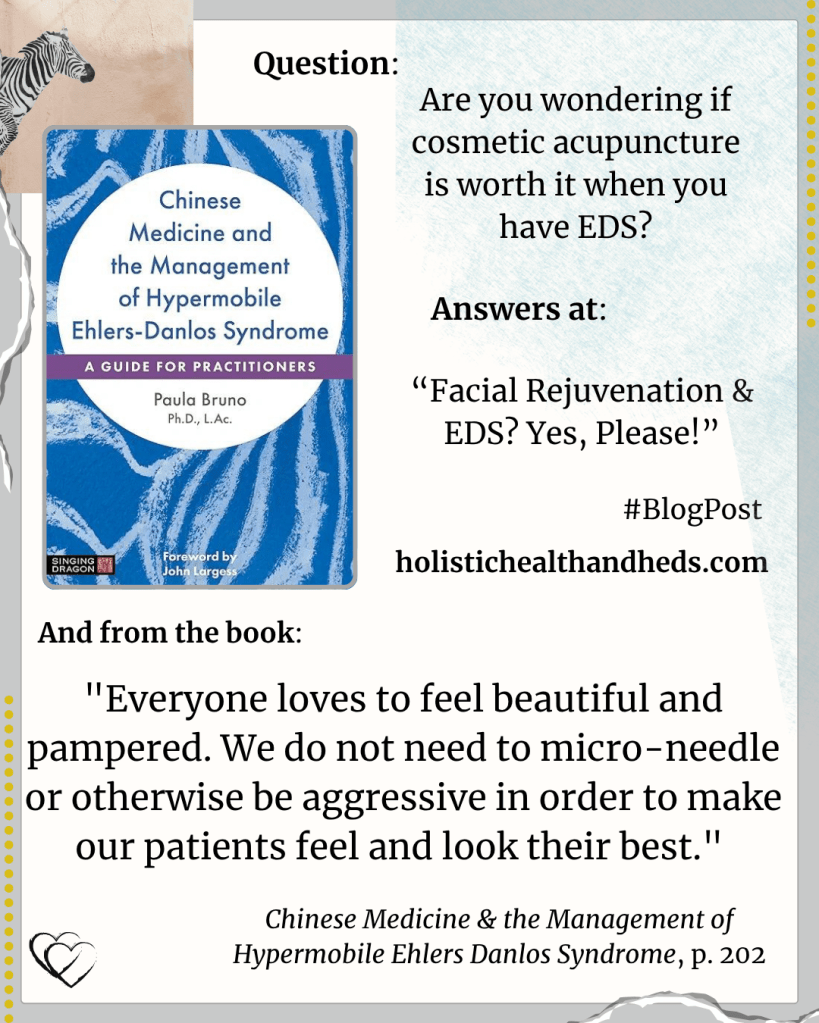
Self-care can include cosmetic treatments too. Take a look at the blog post and I also discuss the topic in Chinese Medicine and the Management of Hypermobile Ehlers-Danlos Syndrome:
- Living with chronic conditions means different things to different people. “Ehlers Danlos Syndrome: What Does it Mean to You?” outlines some possibilities. ↩︎
- Obviously, I am biased on favor of Chinese approaches but Asia covers a lot of ground. Thai massage might be a little vigorous for a person with EDS, but what about Japanese shiatsu? A quick google search of the term “Asian bodywork therapy” can give you a good start…and while I am here I cannot miss the opportunity to remind people about the wonders of movement and breath work. If you haven’t yet considered trying tai chi or qigong then take a look at this post, “Traveling With Hope: An Interview With Nicola of Earth Balance Tai Chi.” Nicola, the owner of Earth Balance, has hEDS and other chronic conditions and her classes are online and on-demand. Why not have a look and see what resonates? ↩︎
 Holistic Health and hEDS