
Are you thinking about getting a tattoo? One question that routinely pops up in online groups and on places like Reddit are questions about ink and EDS. Is it a realistic option, will the skin heal decently, are they safe for zebras?
People want to know and the questions are certainly valid. As a practitioner of Chinese medicine who specializes in these complex conditions, I decided that it’s time to share some thoughts for people with POTS, MCAS, and/or EDS. However, after writing to a number of tattoo shops to ask about their experience and policies and getting a surprising outcome of that effort, I will say: I think that tattoo artist awareness is crucial…but not necessarily for the reasons I initially thought were important.
That said, let me begin with the easier elements and we’ll return to artist awareness at the conclusion of this blog post.
General Safety:
EDS, MCAS, and POTS each have some individual concerns that I will address section by section, but one concern across the board relates to systemic inflammation and how you heal. A history of systemic inflammation or poor wound healing is cause to pause for everyone, even normies. When we live with complex chronic disorders, the stakes are that much higher though. If you are someone who has a history of extremes of infection and poor wound healing, then it is important to speak to a doctor who knows your particulars before even beginning to shop for a tattoo artist.
In terms of general safety…each person is different. It’s not up to the tattoo artist to decide what is or is not safe for you. Think about this: how many doctors have you been to who don’t know anything about EDS and who have delivered poor medical care to you as a result? And those are doctors whose job is to take care of your health. You can’t expect a tattoo artist to know what medical doctors often do not, right?
The issue of tattoo artist awareness is important and I will come back to it, but ultimately it really is the responsibility of the person getting the tattoo to educate themselves and to proceed accordingly.
Ehlers Danlos Syndrome:
If you have EDS and want a tattoo, the obvious issues relate to post-session bruising and swelling, whether the new body art will heal properly, and how long the healing process might take. Another concern that I’ve seen discussed online is the matter of blowouts, or when the ink becomes blurry or smudged in an unanticipated manner.1 Blowouts can happen to anyone, hypermobile or not, if the tattoo artist in not experienced and/or makes a mistake. They can also happen if the person who got the tattoo stretches out their skin during the early healing process (a definite consideration for people with EDS).
*****

*****
I have a number of EDS patients with tattoos, including persons who are pretty much inked from head to toe. I have treated people with extremely lax skin who successfully were tattooed. Everyone’s situation is unique, but if the tattoo artist has experience with older skin or with people who have lost a lot of weight quickly (in other words, populations with thinner skin and lax tissue) and they are able to work with a light hand, then the risk of blowout may be lessened. This is between the individual client and the tattoo artist, however.
On the client side: everyone should listen to their artist and follow the after-care instructions to the letter. Someone with EDS needs to be extra vigilant about not stretching the skin during the healing process too.
As a practitioner who treats EDS patients on the regular, I would also invite aspiring clients to consider the process and their bodies. For instance: it might be important to pick your tattoo location so that you are seated comfortably for your unique body while getting tattooed. You know yourself. If you are compelled to sit facing up in a semi-locked position for hours, will your ribs slip out? If you are prone with your face in a cradle for three hours, will your jaw dislocate? Each one of us is unique. Before you even start, it is smart to consider practicalities like seated position and how it might affect you.
In addition to your communication with your MD, it could be useful to work with an acupuncturist around the time of your tattoo. The acupuncturist shouldn’t get in the way of what your tattoo artist has told you to do. Instead, we can help you lower inflammation levels and–depending on how things went–ameliorate any pains you might have from sitting, for instance. If you have a strange reaction due to mast cell issues, your acupuncturist may be able to sort that out with you, too.
Which brings us to the subject of MCAS and tattoos:
I say this as a fellow mastie…getting tattooed when you have MCAS requires meaningful consideration. Do you really want to do this? Read the article in the footnote, “When Body Art Goes Awry—Severe Systemic Allergic Reaction to Red Ink Tattoo Requiring Surgical Treatment,” and give it some thought.2
Still want a tattoo?
Alrighty then. Some things to take into account:
How serious is your MCAS and how does it present? Everyone is different, so it is important to sit down and discuss things with your most trusted healthcare provider before you set your appointment. Make sure it’s someone who actually knows you and who will take the time to weigh out options with you.
Example: I have some mastie patients who could get tattooed as long as they strategize correctly and others who might not do so well if they took the chance and I can tell each one precisely why I think what I think about their situation. But these are patients I know. I am familiar with their histories and I’ve seen how they react to my treatments. In sum: I have specific knowledge and can connect what I’ve seen in them to both Chinese medical thought and to Western biomedical research. I never tell patients what they can or should not do, but I would clearly lay out a case for rethinking things if I deemed it wise. And then I’d leave it up to the patient and support their choice (because it is their choice, truly).
Whatever you presentation may be, you must plan ahead. Some points to ponder:
Does your MCAS show on your skin? People with EDS and MCAS who experience dermatographia may be able to get tattoos without undue drama, for instance, but it would probably be in your best interest to have an herbal formula for histamine release (ask your acupuncturist) on hand if you tend to have skin-related reactions to stimuli.3 Another thing you can do if you have an acupuncturist is get them to teach you how to give yourself acupressure on certain points that we use for allergies.
*****
*****
If you run super-sensitive, can you ask your artist to give you a tiny spot tattoo a few weeks before your appointment to see how you do?
As the article in endnote number two clarifies, it’s a good idea to not include red ink in your project.
If you opt for a topical painkiller, keep in mind that benzocaine is on the “avoid” list for masties.4
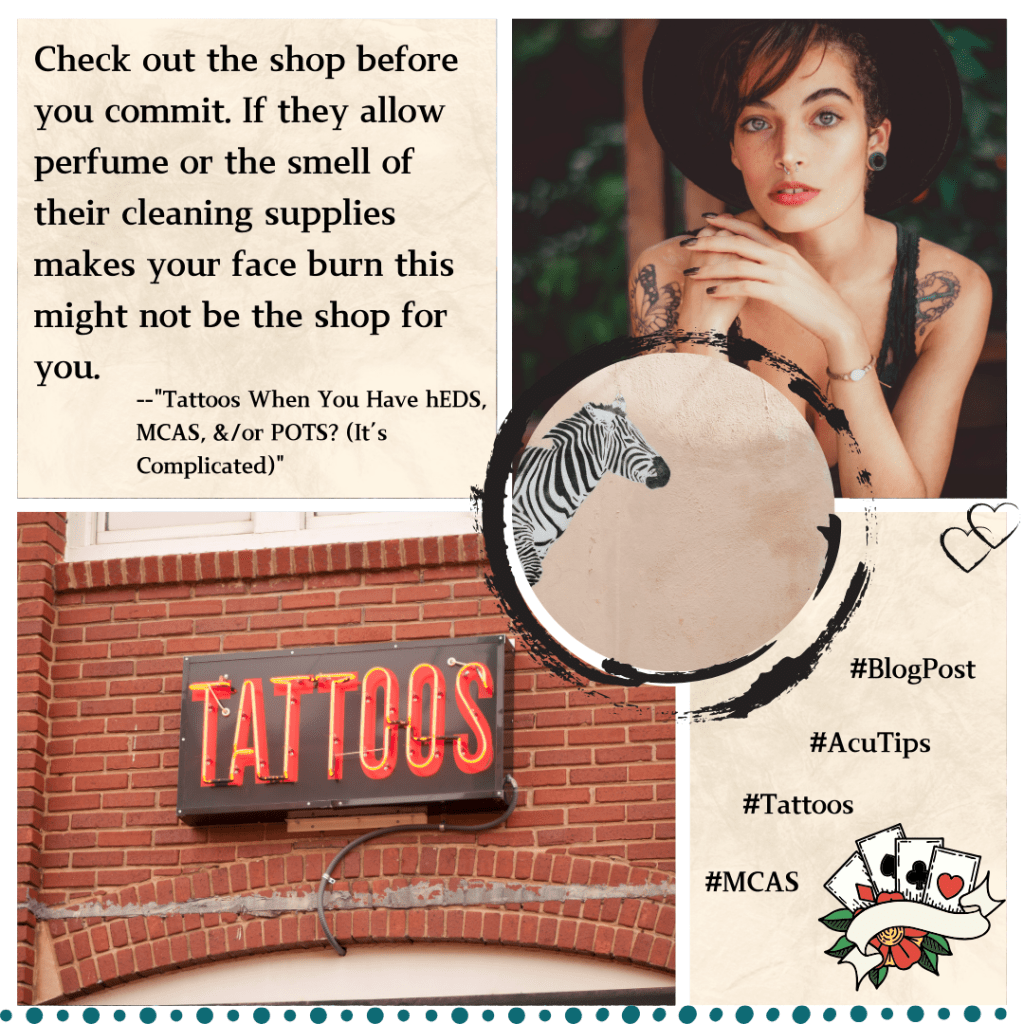
Check out the shop before you commit. If they allow perfume or the smell of their cleaning supplies makes your face burn this might not be the shop for you.
Bottom line: you know yourself and you know how you react to things. Speaking for myself? I have thought about getting tattooed and I might one day do it, but my MCAS is no joke. For example: I was fine using mascara until one day I was not…so what would happen to me if one day my body decided that the tattoo inks were the enemy is a question that I cannot ignore. As for you…communication with your artist and self-knowledge will take you far. If you are uncertain, please do consult with your trusted acupuncturist or other tattoo-savvy healthcare professional.
But definitely read the article on systemic allergic response and definitely ask yourself if you’re okay with taking the risk. And if you go for it, do not be surprised if your tattoos heal in a puffy, raised fashion or if they itch or swell when you’re in a flare state. I’ve seen this enough in tattooed patients that I think–at least in my professional experience–that this sort of a response is a feature, not a bug, for people with MCAS.
Also: keep in mind that if you are a mastie and get a tattoo you may then end up becoming a potsie too. Not to be a Debbie Downer, but once the ink is in there you cannot unring that bell. People with hypersensitivities need to consider the worst case scenarios before proceeding whether we want to or not.5
What about POTS?
The short answer: know yourself, communicate with your artist, and plan ahead.
The longer answer: keep in mind that even normies pass out in response to tattoos. The shop should have suggestions for preparation before the tattoo and you will want to read their handouts and follow the instructions. You will also want to filter their instructions through the lens of what you know about yourself and how you present.
*****

*****
Another thing to consider is the time of year that you get your tattoo and how you react to shifts in barometric pressure. A tattoo session that might have been relatively unremarkable during a moderate season could become a dramatic exercise in futility during the hot Texas summer, for instance.6
One option (cue up the plug for acupuncture) might be trying acupuncture first. It is unusual but a patient can experience needle shock during an acupuncture treatment. What we do then is remove the needles, give acupressure on certain points, and offer a ginger candy or some fruit juice to help with blood sugar. People recover from needle shock fairly quickly so it’s somewhat alarming but not a medical emergency. In any case, if you have tried acupuncture and it gives you needle shock, there’s your answer.7
Otherwise, plan ahead and follow your pre- and post-tattoo instructions to the letter.
Make sure your artist knows that you faint easily and be sure that they give you a little extra time to stand up at your own pace after the tattoo. You might want to break the tattoo into several sessions, not just one long one. It could be a good idea to plan to have someone drive you to the appointment and pick you up afterward. And so forth.
Know yourself, plan ahead, communicate with your artist; rinse, wash, repeat.8
And this, finally, brings me to the issue I raised at the beginning of this essay.
Tattoo artists and what they know about EDS, MCAS, and POTS.
I am a little taken aback and disappointed, to be honest. I created a short, to-the-point email and sent it to twenty local shops, one international shop that I follow on Facebook, and four well-known names in the business.9 Fifteen shops did not respond and none of the well-known names replied. One of the shops promptly wrote back to say that they would not tattoo anyone with EDS, MCAS, and/or POTS due to health concerns. Another wrote back and stated that EDS/MCAS/POTS has not ever been an issue for their studio. Three artists wrote back with substantive responses.10
At first, I was indignant…surely, tattoo artists who work with skin every day would be interested in this topic and surely, they would care about client safety and tattoo outcome. How, I wondered, could they be willfully blind to serious issues like connective tissue dysfunction, hypersensitivity, and/or dysautonomia and POTS?
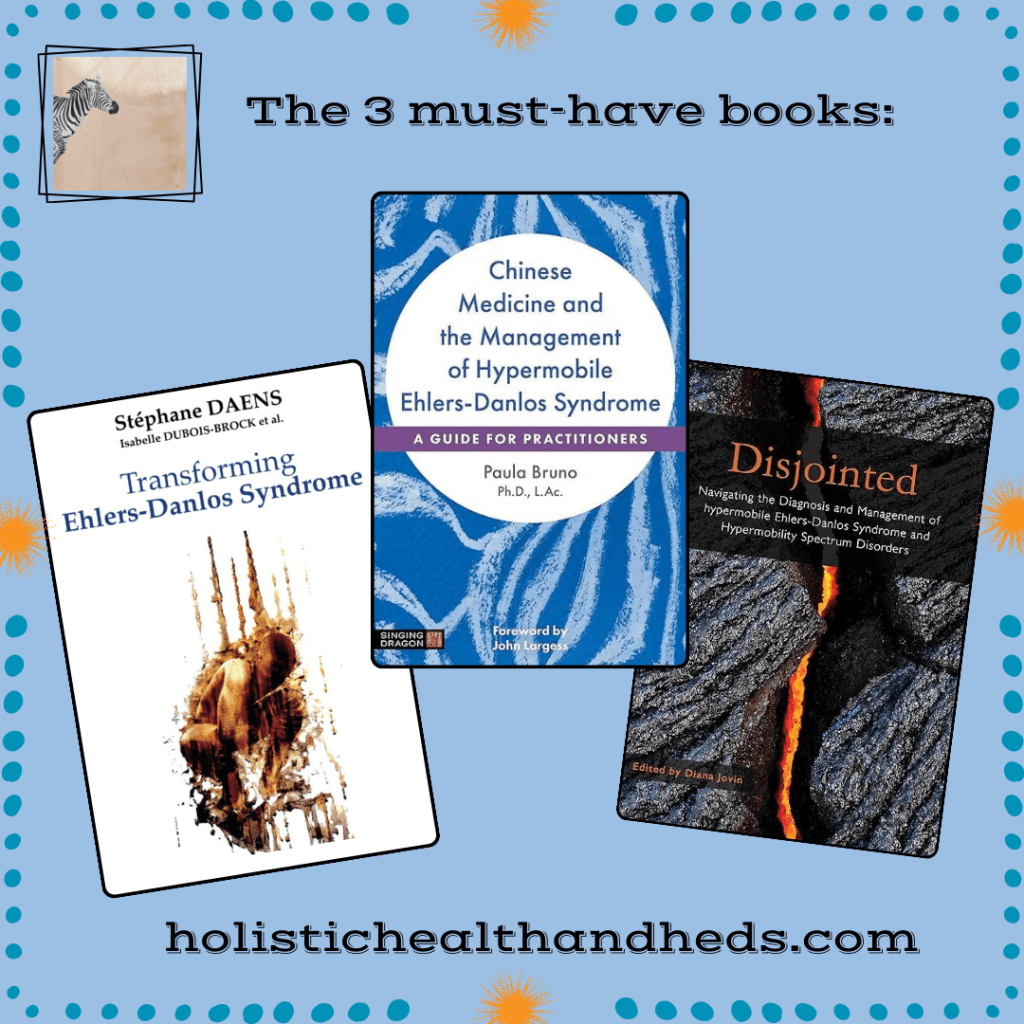
But then I remembered how many patients I’ve seen who were gaslit by their doctors or who went to biomedical physicians who clearly neither knew nor cared to learn about these conditions. I realized that it’s not realistic and it’s not fair to expect tattoo artists to be well-versed in conditions that biomedicine isn’t necessarily handling well. Part of the reason I wrote my book, Chinese Medicine and the Management of Hypermobile Ehlers Danlos Syndrome, is because there are gaps in knowledge and patients do need options, including Chinese medicine.
So no, it’s not up to the tattoo industry to take up the cause at present.
In my estimation? I think that tattoo artists are wise to learn all that they can about the focus of this essay. To that end, please refer to this essay’s companion piece: “EDS, MCAS, & POTS: A Short Guide for Tattoo Artists.“

*****
And yet…the world is changing now that COVID has entered the chat. Both MCAS and POTS are associated with post-COVID syndromes.11 The world is also changing due to the meteoric rise of autoimmune disease and allergies.12 In addition, diabetes is increasingly common in young people and its prevalence is expected only to rise in the near future.13 Meantime, tattoos are becoming more popular and more mainstream worldwide.
I do think that the industry itself will undergo shifts in response to changing health demographics. Do I think that tattoo shops need to be EDS-aware? Short answer: it’s complicated. Truly, it’s up to the client to walk into the shop with self-knowledge and a plan, and I most certainly hope that this essay will be a helpful contribution to the topic. And tattoo shops should know that this condition (not to mention MCAS and POTS) exists and that post-COVID syndromes, allergies, diabetes, and autoimmune disease all might factor into client safety and tattoo outcome. What shops and artists choose to do about this information might come in the form of tighter industry regulation or it might simply be the result of being aware of one’s client base.
Either way, none of this is going anywhere in the near future. Tattoos aren’t going anywhere in the near future.14
It makes a difference when we are aware, when we take responsibility for our own health, and when we communicate–artist to client and client to artist–with integrity.
If you live with EDS, MCAS, and/or POTS, will you choose to go ahead with a tattoo? If so…what is your plan for safety, efficacy, and an excellent experience with your artist?
*****
*****

Dr. Paula Bruno, Ph.D., L.Ac., is a licensed acupuncturist and herbalist, an AOBTA-CP traditional Chinese bodywork therapist, an author, and a health coach. She maintains an active and growing practice at Two Hearts Wellness, her Austin, TX office. Dr. Bruno is also available for distance appointments for wellness consultation or coaching.
In her first career, she was a Spanish professor.
Dr. Bruno’s specialties as a Chinese medicine practitioner include: • Musculoskeletal health (acute or chronic pain relief; Ehlers Danlos syndrome & hypermobility support) • Digestive support, gut health, and weight loss • Aesthetic treatment, including scar revision • Men’s health • General preventative care and wellness support for all persons.
She is the author of Chinese Medicine and the Management of Hypermobile Ehlers Danlos Syndrome: A Practitioner’s Guide.
When you are ready to discover what traditional medicine plus a vibrant and engaged approach to holistic health can do for you, either contact Dr. Bruno or book an appointment online.
*****
Two Hearts Wellness/Holistic Health & hEDS does not accept paid advertising on this website
Note: Material on this web site site is not intended to diagnose, prevent, treat, or cure any disease, illness, or ailment. A Chinese medicine practitioner in Texas identifies syndrome patterns but does not diagnose illness. Material on this web site does not purport to identify syndrome patterns.
*****


*****
- Anecdotal evidence suggests that bruising and swelling during the immediate healing period can be relatively more extreme for people with EDS. However, according to WebMD and the selection of tattoo shop websites I checked, even normies can expect some degree of bruising and/or swelling in the week or so after getting tattooed. Blowouts, on the other hand, are not par for the course and, unfortunately, are more common for zebras simply because the skin can be stretchier. Refer to “Tattoo Blowout: What It Is and What You Can Do About It” for more information. ↩︎
- This article should be required reading for anyone with histamine intolerance or MCAS who is considering a tattoo: “When Body Art Goes Awry—Severe Systemic Allergic Reaction to Red Ink Tattoo Requiring Surgical Treatment.” For myself, hypermobility would be less of a concern if I were to get tattooed. Becoming much less hyperflexible after my thirtieth birthday (aka turning into a “stiff bendy”) shifted my dynamic, for instance. But MCAS? Oh, now that is a different story. For me, the MCAS is the deciding factor as far as tattoos go. Everyone has their own unique presentation, as we all know, but MCAS, in my personal as well as my professional opinion, would be cause for reconsideration of a tattoo. ↩︎
- This is one person’s experience: “Personal Adornment: Can People With Dermatographia Get Tattoos?” but I cannot repeat enough: everyone is different. One person’s interesting skin reaction to a gentle scrape might mean little to a tattoo while the next person’s could be a puzzle piece in a very unpleasant final picture. ↩︎
- “Medications to Avoid with MCAS” is a good resource for anyone but in the context of OTT topicals, scroll down to the section “Local anasthetics to avoid with MCAS” for the reference to benzocaine. ↩︎
- Refer to the case study “Tattoo as a Possible Trigger for Autoimmune Syndrome Induced by Adjuvants” for further discussion. I cannot emphasize it enough: everyone has the right to make their own choices in this life. AND–especially if your system is volatile–it’s equally important to do your due diligence beforehand and to make your choices from a position of knowledge. It’s not up to the tattoo artist to have professional knowledge of complex chronic illness, especially when a good percentage of MDs don’t even know all that much about some of them. And we know this, right? People with chronic illness, by default, need to be their own best advocate (and do a great job at it, as “The Internet Knows More Than My Physician: Qualitative Interview Study of People With Rare Diseases and How They Use Online Support Groups” demonstrates). ↩︎
- “The Impact of Weather on POTS Symptoms” is a helpful article to read before planning your tattoo schedule. ↩︎
- “Acupuncture-Associated Vasovagal Response: Revised Terminology and Hospital Experience” is a bit of a long read but it’s a good one. My one case of needle shock occurred when I was a very new intern in student clinic. As I discuss at length throughout my book, Chinese Medicine and the Management of Hypermobile Ehlers Danlos Syndrome, part of a successful treatment is knowing how many or few needles to insert and when a patient needs an especially light hand. Getting acupuncture is not the same as getting tattooed by any means but if a person is genuinely unsure, it could be useful to try acupuncture first and see how things go. In essence: if a dozen acupuncture needles set you off then you probably can’t expect to do well over the course of hours and multiple needles at once. What do you think? ↩︎
- One of the more useful Reddit conversations I have found on the subject of POTS and tattoos (you’ll notice that there are also mentions of EDS and MCAS in the thread) is “Tattoos and POTS.” It is very much worth reading in its entirety. What I would suggest to anyone with concerns is to (a) read this thread and (b) highlight the parts that resonate and take them to a healthcare provider who knows you, or who at the very least is knowledgable about this topic. A thorough discussion of your unique presentation and all possibilities based on it can give you information that you can use. ↩︎
- The email I sent is as follows:
“Greetings:
Does anyone at your studio have experience tattooing clients with Ehlers Danlos syndrome, MCAS (mast cell activation syndrome), and/or POTS (postural orthopedic tachycardia syndrome)? If so, do you have any particular policies regarding a client’s preparation?
Full disclosure: I am not looking for a tattoo for myself. I am a practitioner of Chinese medicine here in Austin and the author of the book Chinese Medicine and the Management of Hypermobile Ehlers Danlos Syndrome. I am writing to you because I am making a guideline for patients and I am simply curious to know which shops know of these conditions and if they have policies or even just opinions on preparation.
Thank you for your reply at your convenience.
Cordially,
Dr. Bruno.” ↩︎ - I would like to thank Tina Vaziri Poe of Moon Tattoo Studio, Coley Jackson of Tiny Tats ATX, and Sky Rockenbach for taking the time to respond to my query. Sky Rockenbach, particularly, was very thorough and generous, and I appreciate our exchange. ↩︎
- For further information, see “Pathophysiology of Post-COVID syndromes: a new perspective” and “COVID-19 Induced Postural Orthostatic Tachycardia Syndrome (POTS): A Review.” ↩︎
- A useful article on autoimmune disease is “Autoimmunity Has Reached Epidemic Levels. We Need Urgent Action to Address It,” while statistics regarding allergies can be found in “More Than a Quarter of U.S. Adults and Children Have at Least One Allergy.” ↩︎
- Refer to “Projections of Type 1 and Type 2 Diabetes Burden in the U.S. Population Aged <20 Years Through 2060: The SEARCH for Diabetes in Youth Study” for some depressing projections about the sheer numbers of metabolic disease expected in forthcoming decades. For useful information on tattoo safety when diabetes is an issue, see “Diabetes and Tattoo Safety.” ↩︎
- A look at American statistics makes it clear that tattoos are becoming more and more mainstream as time goes on: “32% of Americans have a tattoo, including 22% who have more than one.” Given that I lived in Spain and Italy during my twenties and I am of Mediterranean heritage, I found “Which Country’s Residents Have the Most Tattoos?” intriguing (and not entirely surprising either–take a look and see what you think). A thoughtful article on the cultural history of tattoos is the BBC’s “Will tattoos finally be accepted as art?” Just as I did in my book, I find that looking overseas broadens one’s perspective immeasurably. To that end, I suggest reading “Tattoo artist anger over new EU rules goes beyond skin deep” and listening to the “Save The Pigments talk” on youtube. The talk is especially thought-provoking when the two discuss the economics of regulation. Listening to it, I thought: the tattoo industry needs to seize the narrative before governmental health regulators do. Otherwise, the day may come when only licensed medical care providers with tattoo training (or AI driven machines) will be legally able to provide tattoos. In any event, refer to the European Society of Tattoo and Pigment Research for developments in the EU countries and compare, then, with American considerations of tattoo ink in “Detection of anaerobic and aerobic bacteria from commercial tattoo and permanent makeup inks.” Ink safety is one consideration; what will happen as a result of changing health demographics is yet to be seen. And it truly does behoove tattoo artists to become as educated and articulate as possible regarding said changes. Doing so will safeguard client health and it could well save the industry itself. What do you think? ↩︎
 Holistic Health and hEDS